AP Syllabus focus: 'More random residual plots after transformation, or r squared moving closer to 1, can indicate a better transformed regression model for prediction.'
When a transformation is used to improve linearity, the next step is deciding whether the new model is actually better. AP Statistics emphasizes residual plots and as the main evidence.
What makes a transformed model better
A transformed regression model should be judged by how well it supports prediction, not just by whether it looks different from the original model.
Transformed regression model: A regression model fit after changing the scale of one or both variables so the relationship can be modeled more effectively.
A better model usually does two things:
it leaves less visible structure in the residuals
it explains more of the variation in the response
The specification gives two signals of improvement: a more random residual plot and an value closer to 1. The word can matters. Either feature may suggest improvement, but neither should be treated as automatic proof on its own.
Residual plots: the most direct check
A residual plot is often the clearest way to tell whether a transformation helped. After transformation, the residuals should look more like random scatter around 0.
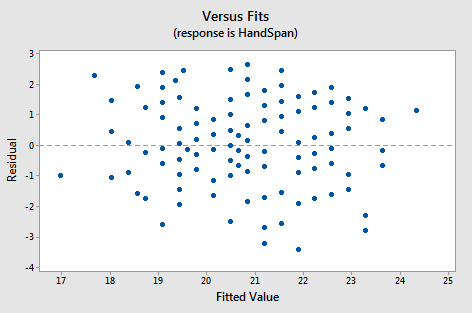
Residuals versus fitted values for a straight-line regression with the residuals scattered randomly around 0 and roughly constant vertical spread. This is the visual pattern you want when a linear model (or a transformed linear model) is appropriate for prediction. Source
What to look for
In a better transformed model, the residual plot should show:
no obvious curve
no clear increasing or decreasing pattern
no funnel shape or changing spread
points scattered fairly evenly above and below 0
A plot that becomes more random after transformation suggests the linear model is matching the data more appropriately. That matters for prediction because systematic leftover patterns mean the model is still missing structure.
The comparison is relative.
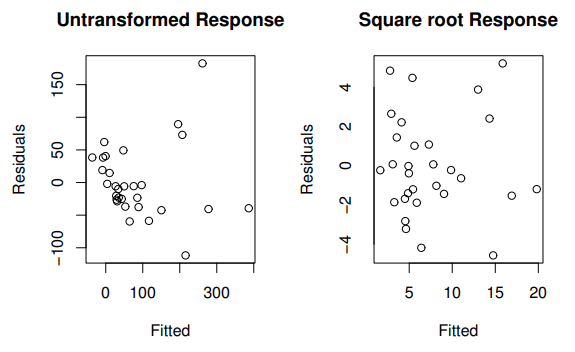
Residual-fitted plots shown before and after a square-root transformation of the response: the untransformed plot shows changing spread, while the transformed plot has more uniform scatter. This illustrates how a transformation can improve the model form for prediction by making residual behavior closer to random noise. Source
You are not asking whether the transformed residual plot is perfect; you are asking whether it is more random than before. If the original model showed curvature and the transformed model removes most of that pattern, the transformation likely improved the model. If strong structure remains, the transformation did not fully solve the problem.
Why randomness matters
Prediction works best when the unexplained part of the model behaves like random noise instead of following a pattern. A nonrandom residual plot suggests that the model is still missing some feature of the relationship. That missing feature can make predictions less dependable, especially across different parts of the data set.
Because of this, a transformed model with a noticeably more random residual plot is often preferred even before looking at any numerical summary. The residual plot directly shows whether the model form has improved.
Using as supporting evidence
The second clue is whether moves closer to 1 after transformation.
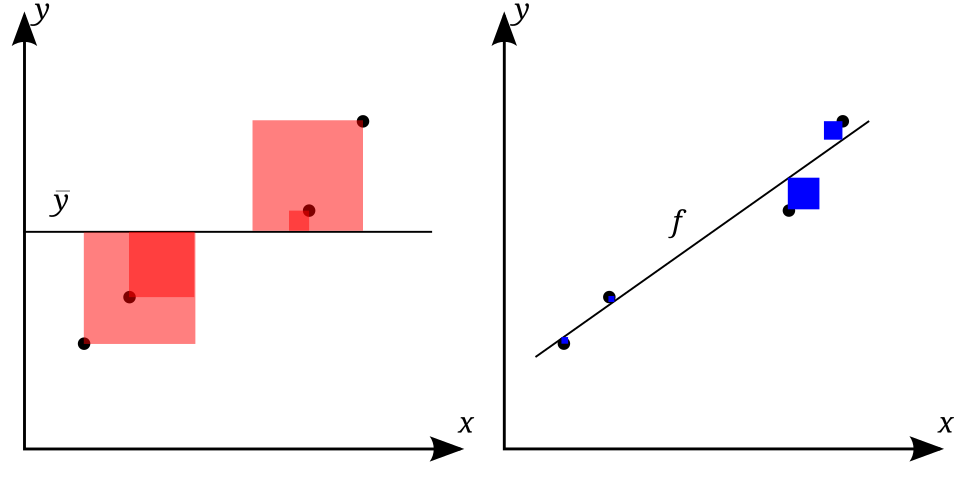
Diagram illustrating (coefficient of determination) as a comparison of explained variation versus unexplained variation in a linear regression. The colored areas help connect the numeric value of to the idea of “how much variability the model accounts for,” which is why larger can support (but not replace) residual-plot evidence. Source
Coefficient of determination: , the proportion of variability in the response explained by the regression model.
A larger means the model accounts for more of the variation in the response. In AP Statistics language, that suggests the transformed model gives a stronger linear fit.
However, a higher should be treated as supporting evidence, not the only evidence. A model can have a fairly large and still show a patterned residual plot. In that case, prediction is less trustworthy because the model is not fully capturing the form of the relationship.
Small differences in should also be interpreted carefully. If one transformation raises only slightly but makes the residual plot much more random, the improvement in residual behavior is usually the more important sign.
Comparing models for prediction
When comparing an original model with a transformed model, use both pieces of information together.
Strong evidence of improvement
You have the strongest case for the transformed model when:
the residual plot is noticeably more random
the residuals show less pattern or changing spread
is closer to 1 than before
If both criteria improve, you can reasonably say the transformed model is better for prediction.
Mixed evidence
Sometimes the evidence is mixed. A transformed model may have a more random residual plot but only a small change in . In that situation, focus on whether the transformation reduced nonrandom structure, because prediction depends on the model form being appropriate.
If increases but the residual plot still shows a clear pattern, be cautious. The transformation may have strengthened the numerical fit without fixing the model form well enough for reliable prediction.
How to describe this on an AP Statistics response
A clear evaluation should directly compare the two models and link the evidence to prediction.
Useful language
“The transformed model appears better because the residual plot is more random, with no clear pattern.”
“Its is closer to 1, so the model explains more of the variation in the response.”
“Because the residuals show less structure, the transformed model is more appropriate for prediction.”
Avoid statements such as “the transformation definitely makes the model correct” or “a higher always means the better model.” The AP standard is more careful: these features indicate a better transformed regression model, especially when they are considered together.
Practice Questions
A student compares an original linear model with a transformed model. After the transformation, the residual plot shows random scatter around 0, and increases from 0.74 to 0.87.
Which model should be preferred for prediction, and why?
1 mark: Identifies the transformed model as the better choice.
1 mark: Gives a valid reason, such as the residual plot is more random or is closer to 1.
For the same data set, Model A is fit to the original variables and Model B is fit after transforming the response variable.
Model A has , but its residual plot shows a curved pattern.
Model B has , and its residual plot shows random scatter with roughly constant spread.
(a) Which model is more appropriate for prediction?
(b) Explain why the residual plot matters in this comparison.
(c) Explain why alone is not enough to choose the better model.
1 mark: Correctly identifies Model B as more appropriate for prediction.
2 marks: Explains that Model B has a more random residual plot, showing the transformed model better matches the form of the relationship and is more suitable for prediction.
1 mark: Explains that Model A’s higher does not outweigh the curved residual pattern.
1 mark: States that alone does not check whether the model form is appropriate.
FAQ
A transformation changes the scale of the variables, not the underlying observations.
That scale change can:
straighten a curved relationship
reduce unequal spread
make residuals behave more like random noise
So the data are the same, but the relationship may be easier for a linear model to capture after transformation.
Predictions are first made on the transformed scale.
Then the inverse transformation is used to convert them back to the original scale. For example, if the model was fit to $\log y$, the predicted value must be transformed back before being reported as a prediction for $y$.
This matters because a prediction that is accurate on the transformed scale still has to make sense in the original context.
There is no universal cutoff.
A small increase in $r^2$ may matter if it comes with a clearly improved residual plot. A larger increase may still be unconvincing if the residuals remain patterned.
In practice, look for whether the change in $r^2$ supports a real improvement in model behavior, not just a slightly bigger number.
Yes. More than one transformed model can appear reasonable.
If that happens, compare them using:
residual randomness
stability of spread
how close $r^2$ is to 1
how easy the model is to interpret after prediction
A model does not have to be the only acceptable choice to be a good choice.
Some transformations compress large values and spread out smaller ones, or vice versa.
That can reduce curvature or unequal variability that was strongest in only part of the data set. As a result, predictions may improve most where the original model struggled most.
This is one reason the residual plot should be checked across the full range of explanatory-variable values, not just near the center.