

AP Syllabus focus:
‘Introduce the concept of the union of events A and B, denoted as P(A ∪ B), and explain how it represents the probability that either event A or event B (or both) will occur. This subsubtopic will lay the groundwork for understanding how probabilities are combined and how they relate to the broader concept of event unions.’
Understanding Unions of Events
Probability often requires combining information from multiple events, and understanding how events overlap is essential. The union of events provides a structured way to describe situations where one or both events might occur within a random process.
The Concept of a Union in Probability
The union of events is a central idea in probability because it allows statisticians to study situations in which several possible outcomes can satisfy a condition. When an event is defined as a union, it expands the set of outcomes that count as successful for that event.
Union of Events: The set of all outcomes that are in event A, in event B, or in both A and B.
The symbol A ∪ B represents this relationship, emphasizing that the outcome only needs to belong to one of the events for it to satisfy the union. This perspective helps describe the likelihood of broad or inclusive conditions in probability settings.
Relationship Between Events in a Union
Recognizing how events relate to each other is essential for interpreting unions with accuracy. When events overlap, some outcomes belong to both events, and this overlap must be understood to avoid logical or mathematical errors.
Overlap and Shared Outcomes
Events A and B may share outcomes, meaning some results of the random process satisfy both conditions simultaneously.
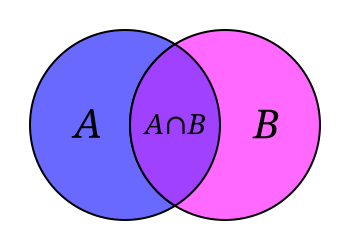
The shaded overlap shows outcomes belonging to both A and B, illustrating the intersection A ∩ B and clarifying how shared outcomes relate to the union of events. Source.
These shared outcomes belong to the intersection of A and B, written as A ∩ B, and they play an important role when unions are analyzed in more detail.
Intersection of Events: The set of outcomes that belong to both event A and event B simultaneously.
Though unions include the intersection, they should not be confused with it. The intersection represents the narrowest overlap between the events, while the union represents the broadest combination.
Visualizing Unions Conceptually
The union of two events is often visualized using a Venn diagram, where the collective shaded area of both circles illustrates all outcomes counted within A ∪ B.

The diagram highlights every outcome that falls in A, in B, or in both, representing the complete set of outcomes belonging to the union A ∪ B. Source.
The Probabilistic Meaning of a Union
Interpreting the union in a probabilistic context means translating the set of included outcomes into a measure of likelihood. The probability of A ∪ B quantifies how likely it is that at least one of the events occurs during the random process.
EQUATION
= Probability of the union of A and B
This interpretation supports the idea that unions help describe inclusive scenarios, where multiple outcomes are acceptable for the event of interest.
A single sentence must occur here before presenting another equation.
EQUATION
= Probability of event A
= Probability of event B
= Probability that both A and B occur
This structure ensures that shared outcomes are only counted once, preserving the accuracy and consistency of probability calculations.
Importance of Understanding Unions
A solid understanding of unions prepares students to apply more advanced rules that combine probabilities. Many real-world contexts involve situations where more than one event represents a successful outcome, and unions capture these combined possibilities clearly.
When Unions Are Used
Students will encounter unions in a wide variety of scenarios, including:
Situations with multiple acceptable outcomes, such as drawing certain types of cards or rolling particular numbers on a die.
Events involving overlapping conditions, where outcomes fulfill more than one requirement.
Broader probability statements, where interest lies in whether any one of several events occurs.
The Role of Unions in Broader Probability Concepts
Understanding unions forms a foundation for additional probability rules, including:
The Addition Rule, which builds directly on the union concept by combining probabilities while correcting for overlap.
Distinctions between mutually exclusive and non–mutually exclusive events.
The interpretation of probability statements that involve inclusive conditions.
Mastering the union of events helps students interpret uncertainty in a structured way and equips them to evaluate situations involving combined or overlapping outcomes with clarity and precision.
FAQ
The size of the union probability depends on how much the events overlap. If two events share many outcomes, the union probability will be smaller than the simple sum of their individual probabilities because a larger overlap must be subtracted.
If the overlap is small, the union probability will be close to the sum of the individual probabilities. Events that rarely occur together will therefore produce a larger union.
Without subtracting the intersection, the overlapping outcomes would be counted twice: once in the probability of A and again in the probability of B.
The subtraction ensures each outcome is counted only once in the final probability. This step preserves accuracy by preventing the union from exceeding the total possible probability of 1.
Yes, the union of two events is always at least as large as the probability of either individual event because it includes all outcomes from each event.
The only time the union equals the larger individual probability is when one event is entirely contained within the other, making the overlap equal to the smaller event.
If one event is impossible (probability 0), the union equals the probability of the other event because nothing is added.
If one event is certain (probability 1), the union will always be 1 because at least one of the events must occur in every trial.
Yes. Analysing the size of the union relative to the individual probabilities can give insight into how strongly the events co-occur.
For instance:
• A much smaller-than-expected union suggests a large intersection.
• A union nearly equal to the sum of the individual probabilities suggests very little overlap.
These comparisons help reveal patterns in the structure of the data.
Practice Questions
Question 1 (1–3 marks)
In a college survey, students were asked whether they play football (event A) or basketball (event B).
The probability that a randomly selected student plays football is 0.30, and the probability that they play basketball is 0.45.
The probability that a student plays both sports is 0.12.
Calculate the probability that a randomly selected student plays football or basketball.
Question 1 (3 marks total)
• Substitution into the union formula: P(A) + P(B) − P(A and B) – 1 mark
• Correct working: 0.30 + 0.45 − 0.12 – 1 mark
• Final answer: 0.63 – 1 mark
Question 2 (4–6 marks)
A research study records whether participants prefer reading (event A) or listening to audiobooks (event B).
The study reports the following probabilities:
• 52% prefer reading
• 39% prefer audiobooks
• 15% prefer both reading and audiobooks
(a) Explain what the event A union B represents in this context.
(b) Calculate the probability that a participant prefers reading or audiobooks.
(c) A participant is classified as “literary engaged” if they prefer at least one of these activities.
Explain why the probability found in part (b) gives the proportion of participants who are literary engaged.
Question 2 (6 marks total)
(a)
• Identifies that A union B represents participants who prefer reading, or audiobooks, or both – 1 mark
(b)
• Correct use of the union formula: 0.52 + 0.39 − 0.15 – 1 mark
• Correct calculation: 0.76 – 1 mark
(c)
• States that “literary engaged” includes participants who prefer at least one of the two activities – 1 mark
• Links this definition directly to the meaning of the union A union B – 1 mark
• Clearly states that the probability found in part (b) includes all such participants – 1 mark
