

AP Syllabus focus:
‘- Outlines the specific conditions that must be met for the application of the z-test for a population proportion, emphasizing the importance of independence and a sufficiently large sample size to approximate normality of the sampling distribution of p-hat.’
In this section, you will learn when the one-sample z-test for a population proportion is appropriate, focusing on independence, normality, and proper data collection conditions.
Conditions for the z-test for a population proportion
The one-sample z-test for a population proportion is used to test a claim about an unknown population proportion using sample data. However, this method is only valid if specific conditions for the z-test are satisfied. These conditions ensure that the test statistic follows a standard normal distribution closely enough for p-values and significance levels to be meaningful.
At a high level, you must check that the data arise from an appropriate design, that individual observations are independent, and that the sample size is large enough for the sampling distribution of the sample proportion to be approximately normal.
Appropriate data and study design
Before checking numerical conditions, confirm that the situation actually fits a one-sample proportion setting. The parameter of interest should be a single population proportion based on a categorical variable with exactly two outcomes (often labeled “success” and “failure”).
Population proportion: The long-run fraction of individuals in a population who have a specified characteristic, usually denoted by p.
In addition, the data should come from either a random sample from the population or from a randomized experiment. Randomness supports valid inference from the sample to the larger population or to the treatment groups in an experiment.
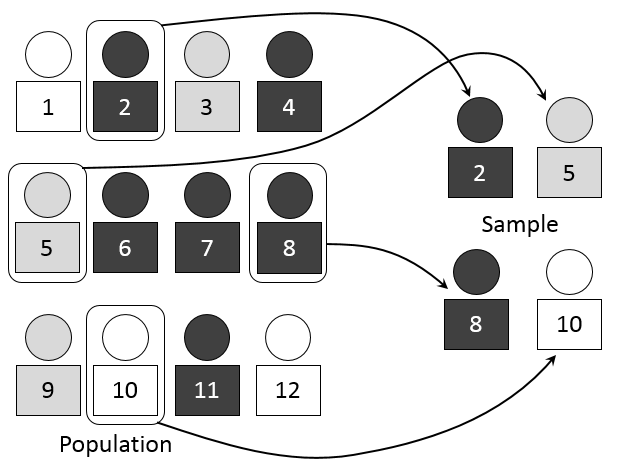
Simple random sampling illustration showing a randomly selected subset of units from a larger population. Each unit has an equal chance of selection, supporting the independence assumption. This visual highlights how valid inference begins with correctly randomized sampling procedures. Source.
Independence condition
The independence condition ensures that each observation in the sample does not influence any other observation in a way that would distort the variability of the sample proportion.
Independent observations: A set of observations where knowing the value of one observation gives no information about the value of another.
To justify independence in practice, AP Statistics relies on two main ideas:
Random process requirement
Data are collected through a random sample from the population, or
Participants are randomly assigned to treatments in an experiment.
This guards against hidden patterns or biases that would link observations.
10% condition (for sampling without replacement)
When sampling from a finite population without replacement, the sample size n should be at most 10% of the population size N.
Stated as: n ≤ 0.10N.
This keeps the dependence between observations small enough that treating them as independent is reasonable.
When these independence conditions hold, the model that underlies the z-test correctly reflects the variability of the sample proportion.
Large-sample (normality) condition
The normality condition ensures that the sampling distribution of the sample proportion is approximately normal. For the z-test, this depends on having a large enough sample size, measured by the expected counts of successes and failures under the null hypothesis.
Because the z-test evaluates the null hypothesis value p0, the normality condition is checked using p0 rather than the sample proportion.
EQUATION
= sample size
= hypothesized population proportion under the null hypothesis
If both the expected number of successes (np0) and the expected number of failures (n(1 − p0)) are at least 10, then the sampling distribution of the sample proportion is considered close enough to normal for the z-test to be appropriate.
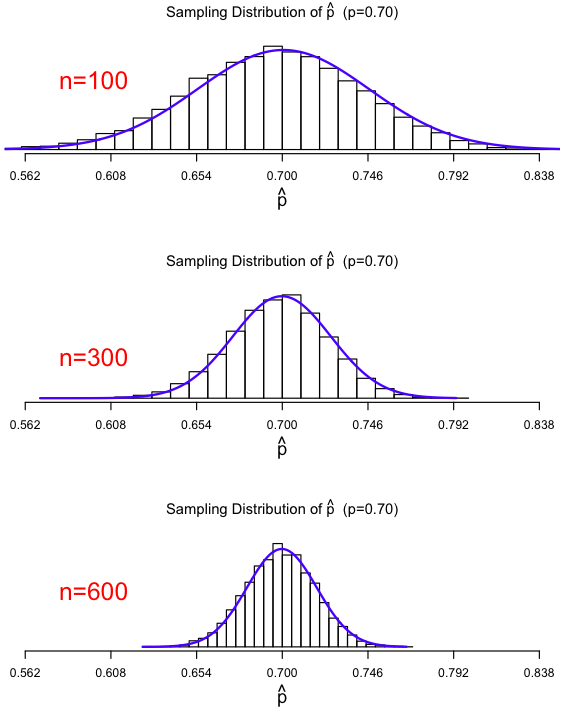
Three sampling distributions of the sample proportion are shown for increasing sample sizes, each approximated by a normal curve. As sample size grows, the distributions narrow and become more symmetric, illustrating the large-sample condition. Numerical labels included in the figure go beyond syllabus requirements but help visualize how sample size affects normality. Source.
When these expected counts are too small, the sampling distribution can be skewed or discrete in a way that makes normal-based methods unreliable.
Why these conditions matter
These conditions connect directly to the theoretical distribution used in the test:
Independence ensures that the variability of the sample proportion is correctly modeled by a binomial (and, approximately, normal) distribution.
The large-sample condition ensures that, through a normal approximation, the standardized test statistic (z) follows a standard normal distribution, which is required to compute accurate p-values.
Without these conditions, the z-test might give misleading p-values, leading you to incorrectly reject or fail to reject the null hypothesis.
The syllabus emphasis on a “sufficiently large sample size to approximate normality of the sampling distribution of p-hat” highlights that the z-test is a large-sample method, not a universal tool for every proportion problem.
Checklist for using the z-test in practice
When deciding whether you can use a one-sample z-test for a population proportion, it is helpful to run through a structured checklist:
One-proportion setting
The response variable is categorical with exactly two categories.
The parameter of interest is a single population proportion p.
Independence condition
Data arise from a random sample from the population
or from a randomized experiment.
If sampling without replacement, verify the 10% condition:
n ≤ 0.10N.
Large-sample (normality) condition
Assume the null hypothesis value p0 is true.
Compute the expected counts using p0:
np0 ≥ 10 (expected successes)
n(1 − p0) ≥ 10 (expected failures).
If both are satisfied, the sampling distribution of the sample proportion is approximately normal.
If any condition fails
Be cautious about using the z-test.
The method may not provide accurate p-values or significance decisions in that situation.
By systematically verifying these conditions, you align with the AP Statistics requirement to justify the use of the z-test for a population proportion and ensure that your inferences rest on appropriate assumptions.
FAQ
The z-test assumes the null hypothesis is true when modelling the sampling distribution of the test statistic. This means expected successes and failures must be calculated using p0, not the observed proportion.
Using the sample proportion instead would reflect the data rather than the hypothesised model, which could bias the decision about whether the z-test is appropriate.
If expected successes or failures fall below 10, the normal approximation becomes unreliable. In that case, alternative approaches may be used, such as:
• An exact binomial test
• Collecting a larger sample
• Reframing the research question to avoid small-proportion inference problems
The independence condition is generally robust when the 10% rule is satisfied and the sampling process is reasonably random. Minor dependence typically has limited impact on variability estimates.
However, strong clustering effects or patterned sampling can inflate or deflate variability, making the z-test unreliable even with a large sample.
Sampling without replacement causes each observation to slightly change the composition of the remaining population, creating small dependencies.
When sampling with replacement, each draw is fully independent, so the sample proportion genuinely follows a binomial distribution, and no adjustment is required.
A large sample helps satisfy the normality condition but does not guarantee independence. Poor sampling design, such as convenience sampling or cluster sampling without randomisation, can violate independence regardless of sample size.
Thus, a large n resolves only one of the required conditions, not both.
Practice Questions
Question 1 (1-3 marks)
A researcher plans to conduct a one-sample z-test for a population proportion. Identify the two conditions that must be checked before the test can be carried out. (1–3 marks)
Question 1
Identifies independence condition (random sampling or random assignment; and if sampling without replacement, sample size must be no more than 10% of the population). (1 mark)
Identifies large-sample (normality) condition (expected successes np0 and failures n(1 − p0) at least 10). (1 mark)
States both conditions clearly and correctly. (1 additional mark)
Question 2 (4 -6 marks)
A wildlife organisation claims that 40% of birds in a region carry a particular marker. A random sample of 120 birds is taken for a one-sample z-test of a population proportion.
(a) State the independence condition required for the validity of the test.
(b) Verify whether the independence condition is satisfied in this scenario.
(c) Check whether the large-sample (normality) condition for a z-test is met.
(d) Explain why these conditions must be satisfied before performing the z-test. (4–6 marks)
Question 2
(a)
States that observations must be independent, typically ensured through random sampling or random assignment. (1 mark)
States that if sampling without replacement, the sample must be no more than 10% of the population. (1 mark)
(b)
Identifies that the sample is random. (1 mark)
States that the 10% condition is satisfied, assuming the population of birds in the region is far larger than 120. (1 mark)
(c)
Calculates expected successes: 120 × 0.40 = 48 (≥10). (1 mark)
Calculates expected failures: 120 × 0.60 = 72 (≥10). (1 mark)
Concludes that the normality condition is met. (1 mark)
(d)
States that the conditions justify using the normal approximation for the sampling distribution of the sample proportion. (1 mark)
Explains that without these conditions, the z-test may give inaccurate p-values or misleading conclusions. (1 mark)
