AP Syllabus focus:
‘Limited government means power is not absolute and is restrained by separation of powers, checks and balances, federalism, and republicanism to prevent abuses of authority.’
American constitutionalism assumes political power is dangerous if concentrated. The Constitution therefore builds a system of limited government, using structural safeguards that slow action, divide authority, and create multiple opportunities to block abuses.
Limited Government: Core Idea
Limited government means officeholders cannot exercise unlimited authority; government must operate within constitutional rules and delegated powers rather than personal will.
Limited government: A principle that governmental power is restricted by law, especially a written constitution that both grants and limits authority.
Because the Constitution is enforceable law, limits can be invoked by institutions (for example, courts) and by the public through elections and political accountability.
Constitutional Safeguards That Restrain Power
Separation of Powers (Dividing Authority)
Separation of powers assigns different responsibilities to different institutions so no single branch controls all governing functions.
Legislative power is primarily the power to make laws.
Executive power is primarily the power to enforce laws.
Judicial power is primarily the power to interpret laws.
This division reduces the risk that one set of officials can both write the rules and apply them without oversight, a common pathway to authoritarianism.
Checks and Balances (Shared and Competing Powers)
Checks and balances give each branch tools to limit the others, ensuring that major actions typically require cooperation across institutions.
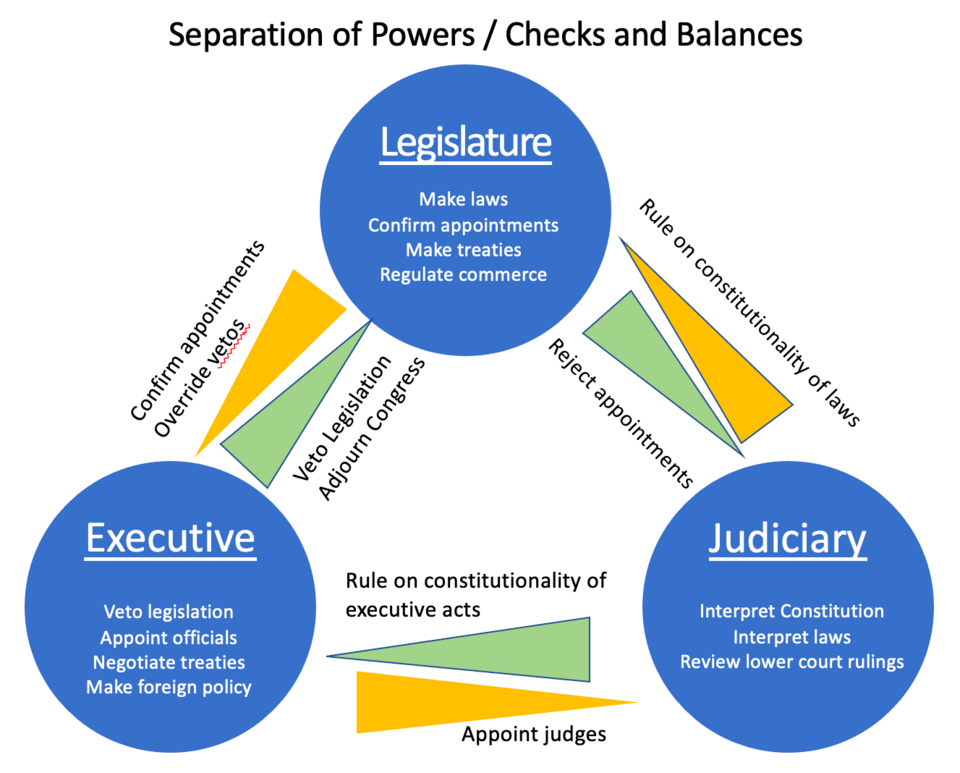
A labeled diagram of the U.S. separation of powers with arrows showing checks among the legislative, executive, and judicial branches. It highlights specific mechanisms (for example, vetoes, confirmations, and judicial review) that force interbranch cooperation and prevent any single branch from exercising unchecked authority. Source
Branches have shared powers (for example, lawmaking requires both legislative approval and executive participation, and laws must remain consistent with constitutional limits).
Branches have blocking powers that can stop or slow actions viewed as unconstitutional, unjust, or politically dangerous.
Overlapping authority encourages negotiation and makes rapid power grabs harder to sustain.
The practical effect is a system with many “veto points,” which can protect liberty by preventing sudden abuses, even while sometimes reducing efficiency.
Federalism (Dividing Power Between Levels)
Federalism divides governmental authority between the national government and state governments, creating an additional restraint on power by preventing complete centralisation.
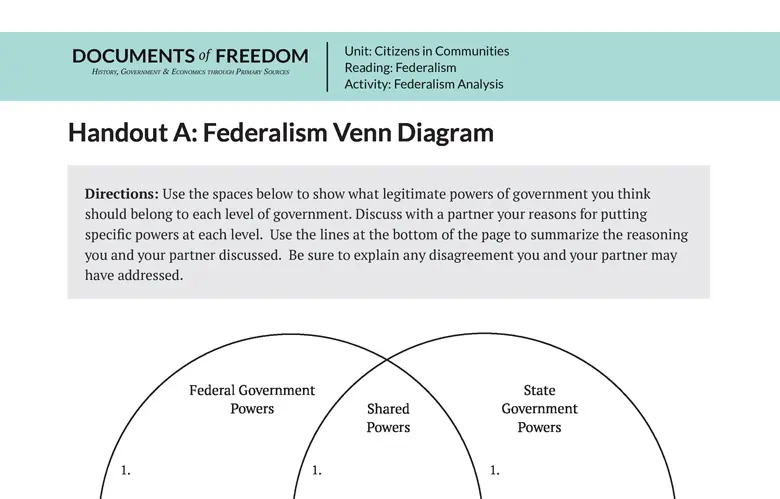
A federalism Venn diagram organizer that visually separates national powers, state powers, and shared powers. This layout supports the core federalism idea that authority is divided vertically, with overlapping responsibilities that create multiple centers of power and accountability. Source
Different levels may govern the same people simultaneously, limiting the chance that one level monopolises authority.
States can serve as alternative centres of political power, shaping policy and resisting overreach within constitutional boundaries.
This vertical division of power adds another layer of accountability, since officials answer to different electorates and institutions.
Republicanism (Filtered Popular Rule)
Republicanism is representative government in which the people rule indirectly by choosing officials to deliberate and act on their behalf.
Elections create consent-based authority while enabling the public to remove officials who abuse power.
Representation is intended to encourage deliberation rather than impulsive decision-making.
By filtering public preferences through institutions, republicanism aims to reduce domination by momentary passions or powerful individuals.
In combination, republicanism and constitutional structure seek to balance responsiveness to the public with protections against tyranny, including tyranny that could be carried out through government itself.
Preventing Abuses of Authority: How the Safeguards Work Together
The Constitution’s safeguards reinforce one another rather than operating in isolation.
Separated institutions make it harder to capture the whole government.
Checks and balances provide continuous oversight and opportunities to challenge improper actions.
Federalism multiplies decision-makers and complicates central coercion.
Republicanism ties authority to electoral legitimacy while constraining direct rule.
This design reflects the syllabus focus: government power is not absolute and is restrained by separation of powers, checks and balances, federalism, and republicanism specifically to prevent abuses of authority.
Practice Questions
(1–3 marks) Define limited government and identify two constitutional safeguards that restrain government power.
1 mark: Accurate definition of limited government (power restricted by law/Constitution).
1 mark: Identifies one safeguard (separation of powers OR checks and balances OR federalism OR republicanism).
1 mark: Identifies a second different safeguard.
(4–6 marks) Explain how two constitutional safeguards work to prevent abuses of authority. In your answer, refer to both (a) horizontal limits within the national government and (b) vertical limits between levels of government.
1 mark: Correctly explains a horizontal safeguard (separation of powers and/or checks and balances).
1 mark: Links the horizontal safeguard to preventing abuse (e.g., oversight, veto points, shared power).
1 mark: Provides a second accurate point developing the horizontal explanation.
1 mark: Correctly explains a vertical safeguard (federalism).
1 mark: Links federalism to preventing abuse (e.g., dispersed authority, competing power centres).
1 mark: Provides a second accurate point developing the vertical explanation.
FAQ
Not necessarily. It means power is bounded by law and structure.
A government can be large in scope yet still limited if actions remain constitutionally authorised and subject to effective restraints.
Emergency powers tend to expand executive discretion, testing constitutional limits.
Key pressure points include how long emergency authority lasts, what oversight exists, and whether courts and legislatures can realistically check rapid action.
A check is a tool one branch uses to restrain another’s action; a balance is the overall condition produced when powers are arranged so no branch can dominate.
In practice, the terms are often used together to describe the same system.
Yes. Representatives might entrench themselves through electoral manipulation or use broad mandates to justify rights restrictions.
Republican safeguards work best alongside competitive elections, transparency, and enforceable constitutional rules.
Multiple veto points can slow policy change even when problems are urgent.
This is a trade-off: the same friction that prevents swift abuses can also impede swift solutions.