AP Syllabus focus:
‘The Declaration of Independence restates natural rights and supports popular sovereignty; the U.S. Constitution functions as a social contract that establishes a system of limited government.’
These founding documents translate Enlightenment political theory into American governing principles. Understanding how the Declaration and Constitution express democratic ideals helps explain why US government claims legitimacy, limits power, and ties authority to the people.
Founding documents and democratic legitimacy
The Declaration of Independence and the US Constitution serve different purposes—one justifies independence, the other creates governing institutions—but both express core democratic ideals used to assess government legitimacy.
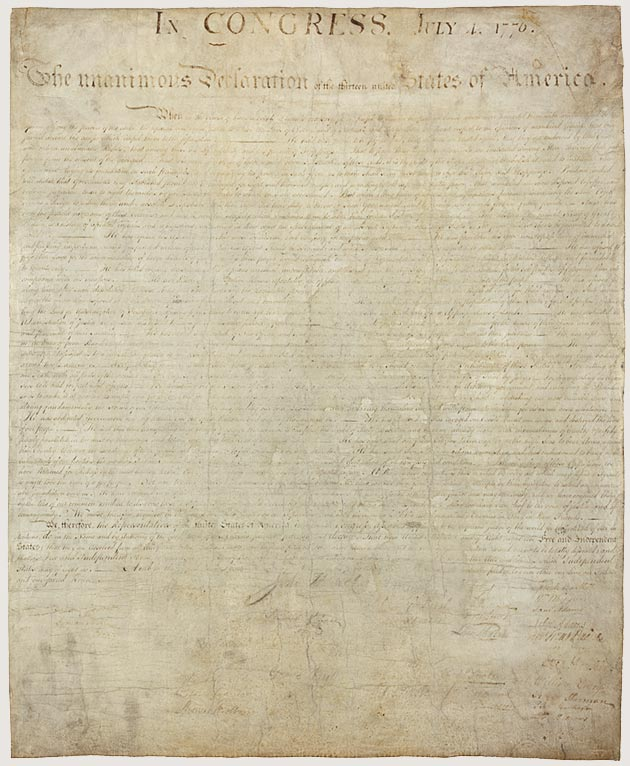
The engrossed (signed) Declaration of Independence (1776) as preserved by the U.S. National Archives. Seeing the full parchment emphasizes that the Declaration is both a philosophical argument about natural rights and consent and a concrete political act that asserts the people’s authority to alter or abolish government. Source
The Declaration explains why government is justified and when it becomes illegitimate.
The Constitution specifies how legitimate power is structured, exercised, and restrained.
Core ideals referenced in the founding documents
Natural rights: Rights people possess by virtue of being human (not granted by government), which government is created to protect.
Natural rights language frames government as a protector of preexisting rights, not their source, which helps justify limits on authority.
Social contract: An agreement in which people create government and accept some limits on their freedom in exchange for order and protection of rights.
The social contract idea connects the people’s consent to the government’s duty, implying that power is conditional and accountable.
The Declaration of Independence as an expression of democratic ideals
Restating natural rights
The Declaration’s famous claims about rights and equality articulate the idea that individuals possess rights that government must respect. Its logic implies:
Rights are inherent, not privileges.
Government exists to secure rights; it is instrumentally valuable, not inherently supreme.
By grounding legitimacy in rights, the Declaration provides a moral standard for judging government action. If government violates rights rather than protecting them, it fails its purpose.
Supporting popular sovereignty
The Declaration also supports popular sovereignty by asserting that legitimate government depends on the people.
Authority comes from the people, not heredity or divine right.
Political power is legitimate when it reflects consent.
When consent is withdrawn due to persistent abuses, political change is justified.
This emphasis links government authority to collective political will, making public consent central to democratic legitimacy.
Grievances and the principle of accountability
A major portion of the Declaration lists grievances against the British crown. This structure matters because it models a democratic claim: rulers are accountable to the people and may be judged against standards of rights and consent.
The grievances function as evidence that government has become destructive to rights.
The logic implies that political authority must be responsive and limited.
The US Constitution as a social contract and framework for limited government
The Constitution as a social contract
The Constitution functions as a social contract by establishing binding rules for governance that originate in the authority of the people (often summarised by the idea of “We the People”).
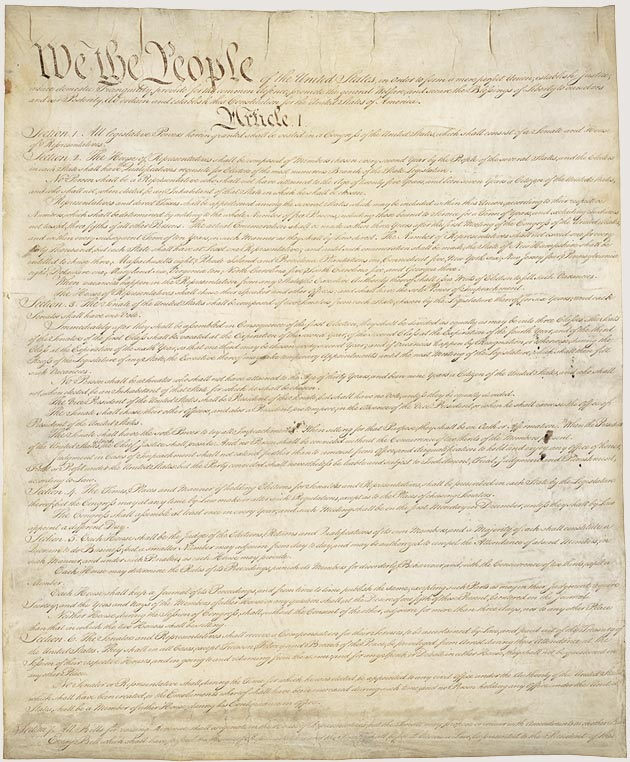
Page 1 of the U.S. Constitution, showing the Preamble beginning with “We the People” and the opening of Article I. This page visually connects popular sovereignty to institutional design: authority is claimed in the people’s name and then immediately channeled into specific governing powers and procedures. Source
It sets the terms under which power is granted to government officials.
It structures relationships between institutions and the public.
It defines lawful procedures for making policy and exercising authority.
Because it is a foundational agreement, the Constitution is treated as the highest source of legitimate governmental power, while also implying that government is constrained by the terms of that agreement.
Establishing limited government
The Constitution establishes limited government by creating a system in which power is divided, checked, and legally bounded.
Government may act only through powers the Constitution grants.
Officeholders must operate through authorised procedures.
The design aims to prevent arbitrary rule by making power harder to concentrate.
Limited government is therefore not only an ideal but also an institutional design: the Constitution turns the principle “power must be restrained” into enforceable structures and rules.
Connecting the two documents: ideals vs institutions
Complementary roles
The Declaration and Constitution work together as expressions of democratic ideals, but at different levels.
The Declaration articulates ends: rights, consent, and the moral basis of legitimate authority.
The Constitution supplies means: a practical governing framework consistent with those ends through a social contract that limits power.
How the documents are used in political argument
In US political life, these documents are often invoked differently:
The Declaration is cited to justify claims about rights and the proper purpose of government.
The Constitution is cited to justify claims about lawful authority, institutional power, and what government may or may not do.
Interpreting American democracy often involves connecting the Declaration’s ideals (rights and consent) to the Constitution’s operational commitments (a social contract that structures and restrains power).
Practice Questions
(2 marks) Explain one way the Declaration of Independence expresses a democratic ideal. Mark scheme:
1 mark: Identifies a relevant ideal (e.g., natural rights or popular sovereignty/consent).
1 mark: Explains how the Declaration expresses it (e.g., states government exists to secure rights; legitimacy comes from the people’s consent).
(6 marks) Compare how the Declaration of Independence and the US Constitution each support democratic legitimacy. In your answer, refer to natural rights, popular sovereignty, and the idea of a social contract. Mark scheme:
1 mark: Accurate explanation of how the Declaration restates natural rights.
1 mark: Accurate explanation of how the Declaration supports popular sovereignty/consent.
1 mark: Accurate explanation of the Constitution as a social contract (binding rules derived from the people).
1 mark: Accurate explanation that the Constitution establishes limited government (restrains and structures power).
1 mark: Clear comparison (different roles: ideals/justification versus institutions/rules).
1 mark: Uses appropriate supporting detail tied to legitimacy (e.g., conditional authority; government accountable to the people).
FAQ
No. The Declaration is primarily a philosophical and political justification for independence.
It is highly influential in American political culture, but it does not create enforceable governing institutions like the Constitution.
The grievances aim to demonstrate a pattern of rule that violates rights and undermines consent.
They also model an accountability claim: authority can be evaluated against public standards rather than accepted as absolute.
Consent is expressed through ratification by state conventions, which were designed to represent the people more directly than state legislatures.
This indirect consent became a key argument for the Constitution’s legitimacy as a foundational agreement.
Its binding nature as “supreme” governing law, its creation of offices with defined powers, and its emphasis on rule-based procedures.
Taken together, these features portray government as a human-made agreement rather than a natural or divinely mandated hierarchy.
Groups have invoked it to argue that certain rights claims align with America’s founding purposes.
Typical uses include asserting that government should expand protection of rights consistent with the Declaration’s stated ends, even when institutions lag behind ideals.