AP Syllabus focus:
‘Because power is shared, policy outcomes often depend on intergovernmental bargaining and implementation choices by states within areas of shared or overlapping authority.’
Intergovernmental bargaining explains why federal policy rarely looks identical across the country. Shared authority forces national, state, and local officials to negotiate goals, money, timelines, and enforcement, shaping what policies become in practice.
Core concept: bargaining in a shared-power system
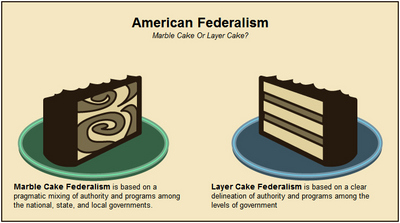
Dual (layer-cake) vs cooperative (marble-cake) federalism diagram. The visual contrast clarifies the structural reason bargaining is so common: in cooperative federalism, responsibilities are intentionally interwoven across levels of government rather than separated into clean jurisdictional layers. That overlap makes implementation details—standards, funding rules, and administrative discretion—central to what policy becomes in practice. Source
Intergovernmental bargaining: Negotiation among national, state, and local governments over policy design, funding, administration, and enforcement, especially where constitutional and statutory responsibilities overlap.
Bargaining is not just “politics”; it is built into policymaking whenever multiple levels of government must cooperate to produce results.
Where bargaining shows up most
Policy design: setting standards, eligibility rules, enforcement mechanisms, and timelines
Administration: who runs programs (state agencies, local governments, contractors), and with what discretion
Funding: how much money is provided, what conditions attach, and what happens if conditions are not met
Enforcement and oversight: reporting requirements, audits, penalties, and corrective plans
Why bargaining shapes policy outcomes
Intergovernmental bargaining matters because states are often key implementers, even when Congress sets the broad policy. Implementation choices can widen or narrow a program’s reach, alter who benefits, and determine compliance.
Key reasons outcomes depend on state choices
Administrative capacity varies: staffing, expertise, technology, and local knowledge affect performance
Political priorities differ: governors, legislatures, and agencies may support, resist, or reframe federal goals
Fiscal conditions differ: balanced-budget rules and revenue bases shape what states can sustain
Legal and institutional differences: state statutes, regulatory procedures, and courts influence rollout
Common bargaining tools and leverage points
National government leverage
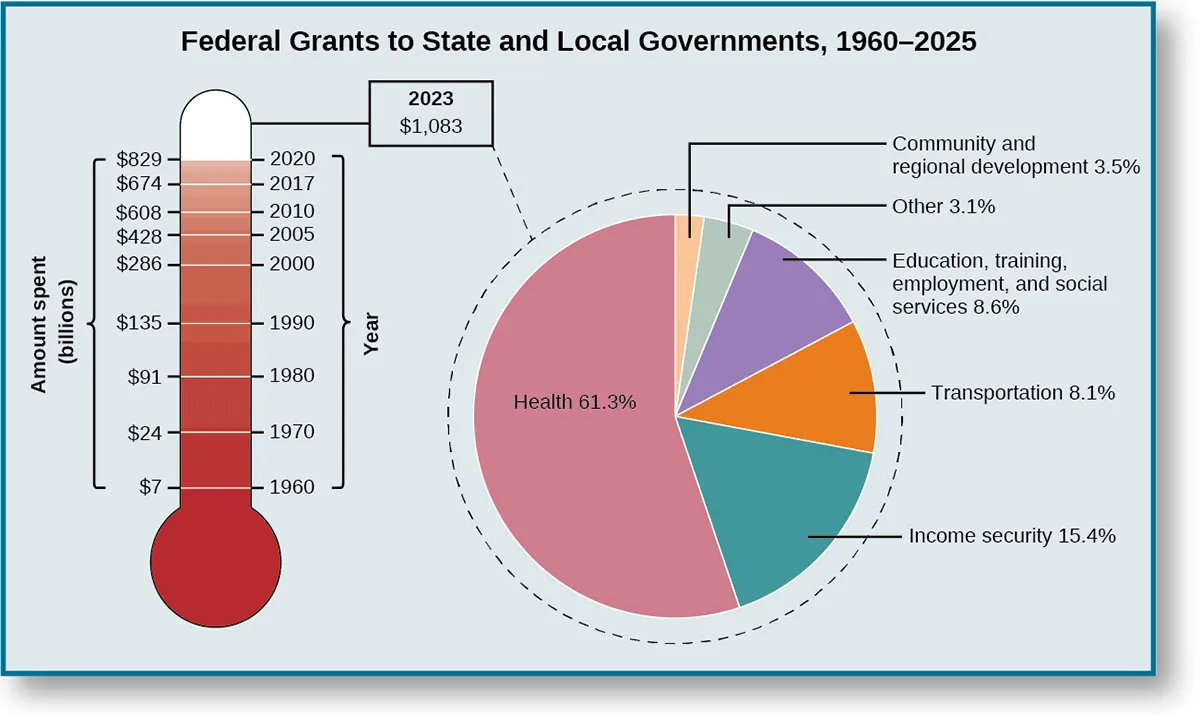
Federal grants to state and local governments over time (thermometer) and by category (pie chart). The graphic shows the long-run growth in federal grants and highlights that a large share of grant dollars flow through major policy areas (especially health), where states typically administer programs under federal rules. This is a concrete illustration of how funding streams create bargaining leverage through conditions, reporting, and oversight. Source
Funding conditions: money offered in exchange for meeting standards or reporting requirements
Deadlines and benchmarks: phased compliance schedules that pressure states to act
Oversight powers: audits, investigations, and withholding funds for noncompliance
Preemption threats: replacing state rules with federal rules when uniformity is prioritised
Waivers and flexibility deals: trading state innovation or political buy-in for measurable results
State and local government leverage
Implementation discretion: choices about enforcement intensity, staffing, and program design within federal boundaries
Collective pressure: multistate coalitions lobbying Congress or agencies for flexibility or more funding
Litigation and legal interpretation: challenging federal requirements or arguing limits on federal power
Information advantage: on-the-ground data used to negotiate timelines, exemptions, or rule adjustments
Partial compliance strategies: meeting minimum requirements while pursuing different policy priorities
Bargaining patterns that change real-world results
Cooperative bargaining (alignment and shared goals)
States may accept federal standards in exchange for resources and flexibility, producing relatively uniform outcomes.
National agencies may reward strong performers with greater discretion and faster approvals.
Conflict bargaining (misalignment and resistance)
States may delay, narrow, or challenge implementation, producing uneven coverage across states.
National officials may respond with stricter oversight, reduced flexibility, or alternative delivery routes.
Strategic bargaining (trade-offs and side payments)
Deals often involve trade-offs: states accept stricter reporting for more autonomy, or accept standards for higher funding.
Implementation rules can become the “real policy,” as agencies negotiate details after legislation passes.
How bargaining translates into policy outcomes
Variation across states
Because bargaining and implementation choices differ, outcomes often diverge in:
Access: who qualifies and how easily they can participate
Benefits and services: scope, quality, and geographic availability
Enforcement: how strictly rules are applied and how violations are handled
Equity: whether similarly situated residents receive similar treatment nationwide
Feedback effects on future policy
Implementation outcomes become evidence used in later bargaining:
Successes can justify expansion or new funding.
Failures can prompt tightened federal standards, new oversight, or redesigned programs.
State innovations can be adopted elsewhere, reshaping national expectations and bargaining baselines.
What to track when analysing intergovernmental outcomes
Who controls administration (state agency vs local delivery vs shared governance)
What discretion exists (rulemaking latitude, enforcement choices, waiver authority)
What incentives/penalties apply (money, deadlines, oversight, reputational pressures)
Whether outcomes are uniform or patchwork, and which bargaining choices produced that pattern
Practice Questions
Define intergovernmental bargaining and identify one way it can influence policy outcomes. (2 marks)
1 mark: Accurate definition of intergovernmental bargaining (negotiation among levels of government over policy design/funding/implementation).
1 mark: Identifies a valid influence on outcomes (e.g., state implementation discretion creates variation; conditions attached to funding alter compliance; waivers change program reach).
A federal programme sets national standards but relies on state agencies to administer it. Explain two ways intergovernmental bargaining could change the final policy outcomes across states. (6 marks)
2 marks (1+1): Explains bargaining over funding/conditions (e.g., states accept conditions for funds, or negotiate flexibility), linking to differences in generosity, coverage, or enforcement.
2 marks (1+1): Explains bargaining over administrative discretion/implementation (e.g., staffing, rulemaking, enforcement priorities), linking to variation in access or compliance.
2 marks (1+1): Applies each explanation to cross-state differences (explicitly connects bargaining choice to divergent outcomes between states).
FAQ
Agencies write regulations, approve plans, and interpret compliance.
They can also:
grant or deny waivers
set reporting metrics
prioritise enforcement, which changes states’ negotiating positions
Capacity and alternatives matter.
Stronger positions often come from:
administrative expertise and data
a large affected population (national political salience)
multistate coordination
budget flexibility to refuse or delay participation
Small administrative choices compound.
Differences in:
eligibility verification
outreach and application procedures
enforcement intensity
contracting and local delivery can substantially change who benefits and how effectively.
Aligned partisan control can reduce conflict and speed agreement.
Divided control often increases:
demands for flexibility
oversight disputes
symbolic resistance that still alters implementation details
Litigation can pause implementation, raise uncertainty, and pressure negotiation.
Even without a final victory, lawsuits can produce:
settlements
narrowed enforcement
revised regulations that reflect state preferences