AP Syllabus focus:
‘The allocation of powers between national and state governments creates multiple access points for stakeholders and institutions to influence public policy decisions.’
Federalism shapes U.S. policymaking by dividing authority across national and state governments. That division multiplies venues where policy can be proposed, blocked, implemented, challenged, and revised by different actors operating at different levels.
Core idea: Federalism creates many “doors” into policy
Federalism: A constitutional system in which power is divided and shared between a national government and state governments.
Because authority is split, policy rarely moves through a single chain of command. Instead, stakeholders can pursue outcomes through whichever institution or level has relevant power, political willingness, or administrative capacity.
Access point: A place in government where individuals or groups can attempt to influence public policy (for example, a legislature, executive agency, court, or state government venue).
Where the access points come from: allocation of powers
Constitutional division of responsibilities
Federalism’s access points exist because different levels have different kinds of authority, creating multiple paths to shape decisions:
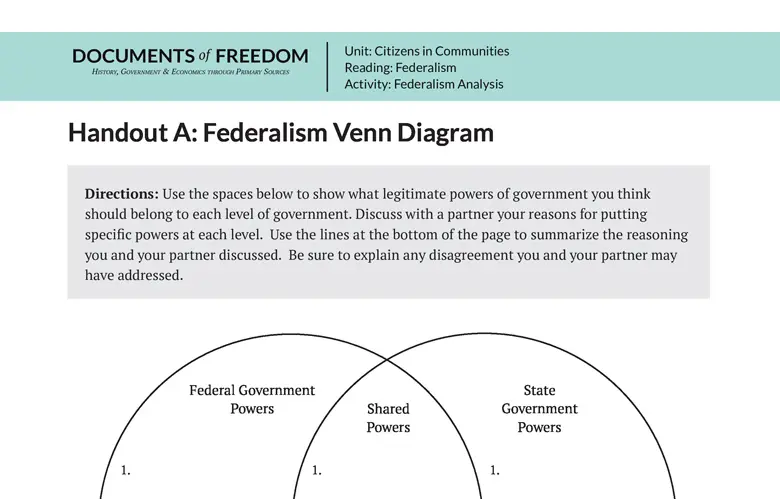
This Venn diagram visualizes the constitutional logic of federalism by separating powers into federal, state, and shared (concurrent) responsibilities. It helps you see why overlapping authority creates multiple “access points” for stakeholders to pursue policy through different levels of government. Source
National-level authority in areas assigned by the Constitution (for example, national regulation and national programmes) provides venues like Congress, the presidency, and federal agencies.
State-level authority over many domestic matters (often including elections administration, criminal justice, and many regulatory areas) creates venues like state legislatures, governors, and state courts.
Shared responsibilities create overlapping arenas where both levels matter, multiplying opportunities for influence during design and implementation.
Overlap creates bargaining, not a single “pipeline”
When policies require cooperation across levels, access points expand:
National actors may set broad goals, while states interpret, administer, or enforce within their systems.
States can respond with innovation, resistance, or adaptation, shaping what policy becomes “on the ground.”
Stakeholders can strategically shift efforts between levels (for example, from Congress to states, or from states to federal courts).
Key institutions that serve as federalism access points
National political institutions
Federalism does not replace separation of powers; it adds another layer. Stakeholders can seek change through:
Congress: agenda setting, authorising policy, and oversight of implementation.
The president and executive branch: priorities, enforcement choices, and administrative direction.
Federal administrative agencies: rulemaking, guidance, and enforcement that affect how broad laws operate in practice.
State political institutions
States are not just implementers; they are separate political systems. Access points include:
State legislatures: passing state laws that complement, expand upon, or (within limits) diverge from national approaches.
Governors and statewide executives: directing state agencies and shaping how policies are carried out.
State agencies: administering programs, setting state-level regulations, and enforcing standards.
Courts as cross-level access points
Courts connect federalism to rights and institutional limits.
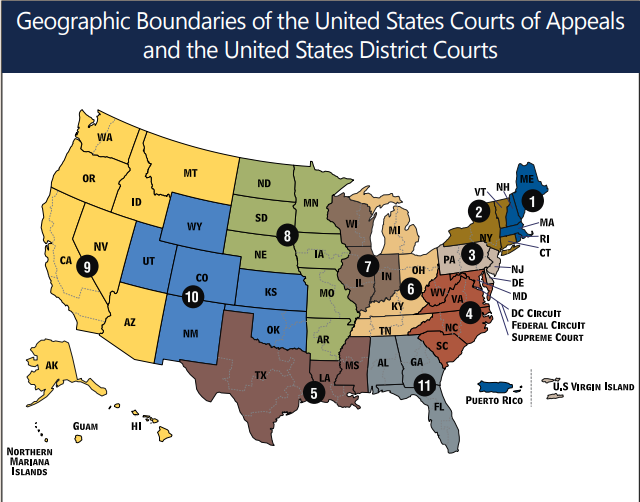
This map shows the geographic boundaries of the U.S. Courts of Appeals (circuits) and how they relate to federal district courts. It illustrates how the federal judiciary itself is structured into multiple regional venues—an institutional “access point” that shapes where lawsuits are filed and which appellate rulings govern different states. Source
Stakeholders often use litigation to:
Challenge whether a policy exceeds a government’s authority at a given level.
Contest state–national conflicts where different rules apply.
Seek injunctions or rulings that force changes in implementation.
How stakeholders use federalism’s access points
Venue shopping and strategy
Federalism encourages venue shopping—choosing the most favorable level or institution for a goal:
If national politics is gridlocked, groups may target statehouses.
If states vary widely, groups may pursue national standards.
If legislation fails, groups may turn to administrative rulemaking or courts.
Coalition building across levels
Because policy can be influenced in many places, stakeholders often build multi-level coalitions:
National organisations partner with state affiliates to pursue parallel strategies.
State officials coordinate with one another to amplify influence.
Local impacts (even when not the main venue) can generate pressure upward to state and national leaders.
Policy feedback and diffusion
Federalism can make policy change iterative:
State actions can function as models, creating momentum for broader adoption.
Variation across states can produce evidence, controversy, or comparisons that reshape national debate.
National actions can prompt state responses that refine outcomes through implementation choices.
Why these multiple access points matter for policy outcomes
Federalism’s structure means policymaking is often:
More open to participation: more institutions to contact, lobby, vote for, or litigate before.
More fragmented: more veto possibilities and slower, negotiated change.
More variable: outcomes can differ across states due to distinct political and administrative choices.
These dynamics reflect the syllabus focus: the allocation of powers between national and state governments creates multiple access points for stakeholders and institutions to influence public policy decisions.
Practice Questions
(1–3 marks) Define “access point” in the context of American federalism and identify one state-level access point. Mark scheme:
1 mark: Accurate definition of access point (a venue where policy can be influenced).
1 mark: Links definition to federalism (division of power across national and state levels).
1 mark: Identifies a valid state-level access point (e.g., state legislature, governor, state agency, state court).
(4–6 marks) Explain how the allocation of powers in federalism creates multiple access points for stakeholders to influence public policy, and analyse one consequence for policy outcomes. Mark scheme:
1 mark: Describes division of authority between national and state governments.
1 mark: Explains that this division creates multiple venues (national institutions and state institutions).
1 mark: Develops how stakeholders use different venues (e.g., venue shopping, lobbying, litigation, implementation pressure).
1 mark: Accurate consequence identified (e.g., policy fragmentation, variation among states, slower change, greater participation).
1–2 marks: Analysis linking the consequence to the existence of multiple access points (clear cause-and-effect, not just description).
FAQ
They often weigh political feasibility, legal authority, and timing.
Common considerations:
Which level clearly has jurisdiction
Likelihood of supportive majorities
Speed of change (statute vs regulation vs litigation)
Risk of pre-emption or court reversal
Vertical diffusion is the movement of policy ideas upward (state to national) or downward (national to state).
It matters because it turns state venues into testing grounds and creates new persuasion opportunities when actors cite outcomes from another level.
When national policy relies on state administration or enforcement capacity.
State choices that can reshape impact include:
Setting administrative priorities
Allocating staff and resources
Issuing implementing rules within state systems
They aggregate influence across multiple state venues to create national pressure.
Mechanisms include:
Coordinated legislative agendas across states
Shared legal strategies
Collective signalling that a policy has broad interstate support or opposition
More venues increase opportunities for participation and correction.
But because different states and institutions respond differently, outcomes can diverge across jurisdictions, producing uneven implementation and differing policy experiences depending on location.