AP Syllabus focus:
‘Plans to unify the national economy, including the American System, sparked debates over whether tariffs, a bank, and internal improvements favored agriculture or industry.’
Between 1815 and the 1830s, the American System shaped national political debate as leaders sought to strengthen the U.S. economy while arguing over whether federal support for infrastructure and finance unfairly favored certain regions.
The American System: Vision and Components
The American System was a national economic program associated most prominently with Henry Clay, a leading politician who aimed to promote economic growth and national unity through coordinated federal policies.
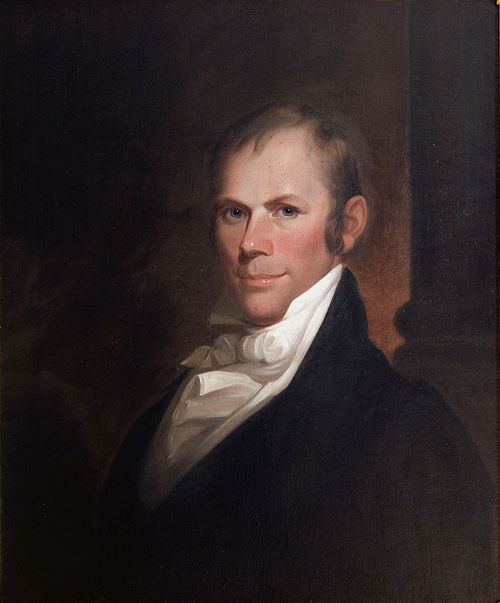
Portrait of Henry Clay, the chief advocate of the American System. Clay promoted a coordinated national program of protective tariffs, a national bank, and federally supported internal improvements. The painting reflects his status as a leading figure in debates over federal power and early 19th-century economic development. Source.
As the nation emerged from the War of 1812, many policymakers believed the United States needed stronger economic infrastructure to compete internationally and stabilize its domestic economy. Clay’s system rested on three interconnected pillars designed to foster national development and greater commercial exchange.
Core Pillars of the American System
Protective Tariffs: Tariffs were intended to shield young American industries—especially in the Northeast—from cheaper British imports.
A National Bank: A federally chartered bank would stabilize the currency, regulate credit, and support investment.
Internal Improvements: Federally funded roads and canals would connect regional markets, lower transportation costs, and stimulate trade.
Internal improvements referred to the construction of transportation infrastructure such as turnpikes, canals, and later railroads—projects believed to be essential for fostering national commercial growth.
Internal Improvements: Federally supported transportation infrastructure intended to facilitate economic exchange and national connectivity.
The three pillars of the American System were mutually reinforcing: tariffs generated revenue, the national bank managed fiscal stability, and internal improvements enabled goods to move efficiently across regions. This integration was meant to bind the national economy tightly enough to reduce regional rivalries.
The protective tariff, first significantly implemented through the Tariff of 1816, became a centerpiece of political debate as Northern manufacturers supported higher duties while Southern planters argued that tariffs raised the prices of imported goods they relied upon. Such conflicting reactions highlighted the sectional dimensions embedded in the American System.
Political and Sectional Support
Northern and Western Alignment
The North and West tended to support the American System because its measures aligned with regional economic priorities.
Northern manufacturers benefited from high tariffs that protected emerging factories from British competition.
Western farmers favored federal investment in infrastructure because new roads and canals linked them to Eastern markets.
The completion of projects like the Erie Canal demonstrated how internal improvements transformed regional economies.
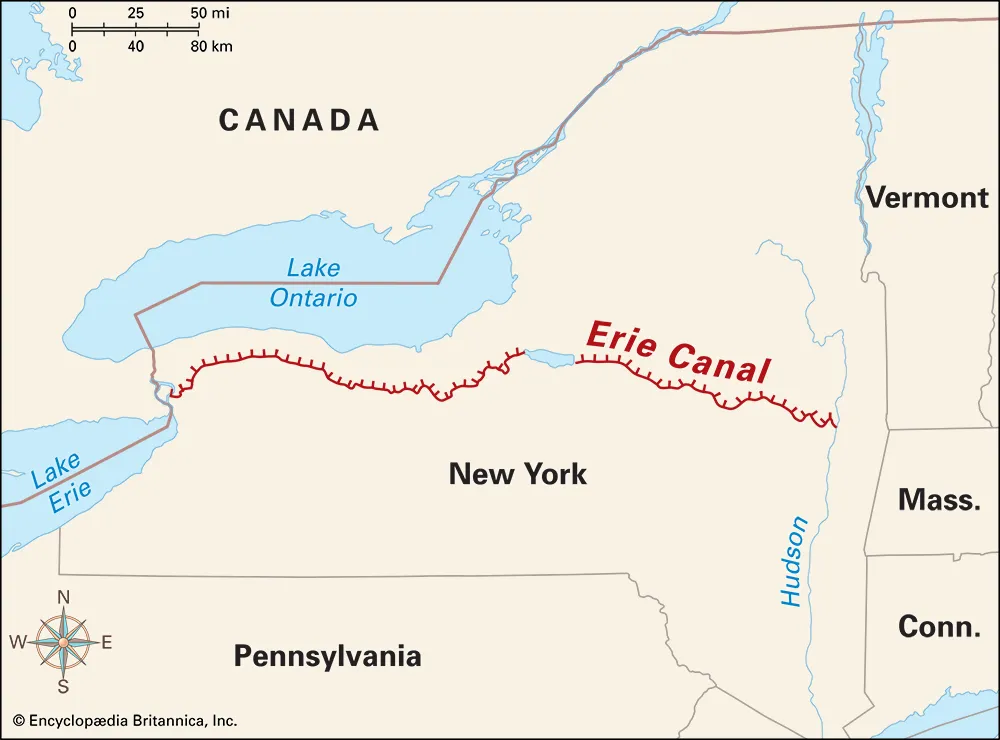
Map of New York showing the route of the Erie Canal from Buffalo to Albany. The canal linked the Great Lakes region to Atlantic trade through New York City. Although the map includes extra geographic details, these help illustrate the canal’s broad commercial reach. Source.
The canal reduced shipping costs, increased Western agricultural exports, and made New York City a national commercial hub, illustrating the economic promise of such projects.
Southern Opposition
Opposition was strongest in the South, where leaders argued that Congress lacked constitutional authority to fund internal improvements. Many Southern planters feared that strengthening federal power could later threaten slavery, their foundational economic and social institution. Additionally, they resented tariffs that raised consumer prices without directly supporting the export-driven cotton economy.
Political debates sharpened when Southern representatives portrayed the American System as a program that used Southern tariff payments to subsidize Northern industrial expansion. These disagreements revealed competing regional visions for the nation’s future.
Constitutional Arguments over Federal Power
Strict vs. Loose Construction
Federal funding for internal improvements raised constitutional questions about the scope of congressional authority. Strict constructionists, many of them Southern Democrats, argued that the Constitution did not explicitly grant Congress the power to build roads and canals. In contrast, loose constructionists, often National Republicans and later Whigs, maintained that such authority derived from the Necessary and Proper Clause, which allowed Congress to promote national welfare through implied powers.
Presidents frequently wrestled with the issue. James Madison vetoed the Bonus Bill in 1817 despite supporting internal improvements in principle, citing constitutional limits. James Monroe similarly doubted federal authority, even while recognizing the economic benefits of infrastructure expansion. These presidential decisions underscored the enduring tension between national development goals and strict constitutional interpretation.
The National Bank and Economic Coordination
A revived Second Bank of the United States played a central role in the American System by stabilizing the money supply and encouraging investment. However, distrust of centralized financial power persisted, particularly in the South and West. Critics feared the bank privileged wealthy Eastern interests and restricted credit to frontier farmers. Though the bank aimed to unify the nation’s fiscal structure, its existence intensified partisan conflict.
The Tariff Controversy and Regional Friction
Tariffs as a Spark for Resistance
Tariffs—essential to Clay’s vision—were increasingly divisive. Many planters believed that high tariffs hurt cotton-producing regions by inviting foreign retaliation and raising prices on imported manufactured goods. Northern industrialists, however, insisted high tariffs were essential to national economic independence.
By the 1820s and 1830s, tariff controversies became central to political identity, contributing to the rise of the Whig Party, which championed Clay’s developmental policies, and the Democratic Party, which often opposed federal economic intervention.
The Broader Significance of the American System
The American System shaped early 19th-century political debate by highlighting fundamental disagreements about federal power, regional priorities, and the direction of national economic development. Arguments over tariffs, the national bank, and internal improvements intensified sectional tensions and contributed to the evolving political landscape of the antebellum era.
Practice Questions
Question 1 (1–3 marks)
Explain one reason why the American System generated political controversy in the early nineteenth century.
Mark scheme
1 mark for identifying a valid reason (e.g., disagreements over federal power; sectional economic interests; constitutional concerns).
1 mark for describing how this reason contributed to controversy (e.g., Southern belief that tariffs harmed the cotton economy).
1 mark for providing specific contextual detail (e.g., reference to the Tariff of 1816, debates in Congress, or disagreements between strict and loose constructionists).
Question 2 (4–6 marks)
Evaluate the extent to which internal improvements associated with the American System strengthened economic integration between different regions of the United States during the period 1815–1830.
Mark scheme
1–2 marks for outlining the purpose of internal improvements within the American System.
1–2 marks for explaining how specific projects (e.g., the Erie Canal, federally supported roads) enhanced links between regions such as the North and West.
1–2 marks for providing evaluative judgement (e.g., noting limitations such as Southern opposition, uneven regional benefits, or constitutional objections that restricted federal involvement).
FAQ
Earlier disputes during the 1790s over Alexander Hamilton’s financial programme set precedents for suspicion of strong federal authority. Many opponents viewed the American System as a revival of Hamiltonian ideas, heightening fears that federal involvement in banking and infrastructure would centralise political and economic power.
This historical memory caused Southern and strict-constructionist politicians to resist internal improvements more strongly, believing they represented a long-term expansion of federal influence rather than merely practical economic development.
Western politicians often disliked high tariffs because they raised the prices of manufactured goods. However, they also recognised that internal improvements directly benefitted Western farmers by increasing access to eastern markets.
Most Western support reflected a trade-off:
Accepting tariffs in return for improved transportation links.
Believing federally funded infrastructure would increase land values and spur migration into the region.
The American System helped define the ideological split between the emerging Democratic and National Republican (later Whig) parties. Support for the System became a key marker of Whig identity, tied to beliefs in federal activism and economic development.
Democrats, in contrast, positioned themselves as defenders of limited government, portraying the American System as favouring wealthy northern interests and undermining local autonomy.
Supporters relied on broad interpretations of the Necessary and Proper Clause and the General Welfare Clause, arguing that promoting national commerce fell within Congress’s implied powers.
They also claimed that transportation infrastructure, by linking distant regions, served collective national interests rather than benefiting any single state, justifying federal financial support for such projects.
Yes. States such as New York, Pennsylvania, and Ohio launched ambitious infrastructure projects when federal support proved uncertain. New York’s funding of the Erie Canal became the most famous example, demonstrating that states could act when national political disagreements stalled federal action.
These state-led successes strengthened arguments that internal improvements were essential for economic growth, even if the federal government could not always take the lead.