AP Syllabus focus:
‘Anti-imperialists invoked self-determination and argued that isolationism and American principles should prevent the United States from acquiring overseas territory.’
Anti-imperialists resisted U.S. overseas expansion by challenging its morality, constitutional legitimacy, economic purpose, and global consequences, insisting that American traditions required restraint, self-determination, and rejection of colonial-style rule.
Major Foundations of Anti-Imperialist Thought
Anti-imperialist opposition emerged from a diverse coalition of political leaders, reformers, religious advocates, labor activists, and intellectuals who feared that overseas empire contradicted core American values. Their arguments centered on self-determination, isolationism, constitutional limits, racial and moral concerns, and the economic and political risks of administering foreign populations.
Self-Determination and Democratic Principles
A central claim of anti-imperialists was that imperialism violated the American commitment to self-government and republican ideals.
Self-determination: The principle that people have the right to choose their own political status and form of government without external coercion.
Anti-imperialists argued that ruling distant lands without the consent of the governed contradicted foundational American ideals dating back to the Revolution. Dominating populations in the Philippines, Puerto Rico, or Guam appeared to replicate the very form of imperial control the United States had once resisted.
They insisted that extending democracy at home required rejecting empire abroad, warning that undemocratic practices overseas might erode liberty domestically.
Isolationism and the Roots of Foreign Policy Restraint
Opponents of territorial acquisition invoked older traditions of isolationism, arguing that the nation’s historical success stemmed from political independence rather than participation in imperial rivalries.
Isolationism: A foreign policy approach favoring limited political, military, and economic involvement with other nations.
Anti-imperialists maintained that overseas colonies would entangle the United States in conflicts with European empires, threaten neutrality, and require a costly military presence. They portrayed imperial expansion as a dangerous departure from Washington’s warnings against foreign entanglements and the longstanding belief that the nation should model democratic ideals rather than impose them.
Political, Constitutional, and Moral Critiques
Anti-imperialist arguments extended beyond principle into structural concerns about what empire would mean for the Constitution and for the moral direction of the country.
Constitutional Limits and Citizenship Debates
Many argued that the Constitution did not permit the permanent governance of peoples who would not receive full rights. The question of whether residents of annexed territories would become citizens, or remain subjects, posed a threat to the equality and legal clarity essential to American governance.
Some feared that Congress would selectively apply constitutional protections, setting a precedent for unequal rights that could be used against marginalized groups within the United States.
Moral and Racial Arguments Against Empire
While some Progressives opposed imperialism on humanitarian grounds, believing U.S. rule would exploit rather than uplift colonized peoples, others rejected racialized imperial ideology itself. Anti-imperialists condemned notions that Americans had a “civilizing mission,” asserting that such claims masked economic exploitation or cultural domination.
Religious opponents argued that coercive conversion and imposed governance contradicted Christian ethics, while educators and reformers insisted that genuine improvement abroad required voluntary cooperation rather than military subjugation.
Economic and Strategic Concerns
Opposition also developed from Americans wary of the financial and military burdens associated with maintaining an empire.
Costs of Empire and Labor-Based Objections
Labor leaders feared that imperialism would expand access to cheap foreign labor, driving down U.S. wages and undermining workers’ bargaining power. They also warned that militarization required to maintain empire would divert public funds away from schools, infrastructure, and social reform.
Business critics argued that colonies did not guarantee profitable markets and could instead entangle the United States in costly conflicts fueled by nationalist resistance.
Risks of Militarism and Global Competition
Anti-imperialists warned that acquiring colonies would force the United States to maintain a larger army and navy, accelerating global arms races. They believed militarism threatened civil liberties, empowered the executive branch, and normalized foreign interventions.
They viewed the Philippine-American War as proof that imperial rule produced violence, instability, and opposition movements that contradicted claims of benevolent expansion.
The Anti-Imperialist League and Public Debate
The Anti-Imperialist League, founded in 1898, became the leading organization articulating these critiques. Its members—ranging from Andrew Carnegie to Jane Addams—represented a broad political spectrum united primarily by moral and constitutional objections.
The League distributed pamphlets, organized rallies, and sought to influence congressional debates over the annexation of the Philippines. Although it did not prevent U.S. expansion, its work shaped national debate by articulating clear alternatives to empire grounded in democratic tradition and restraint.
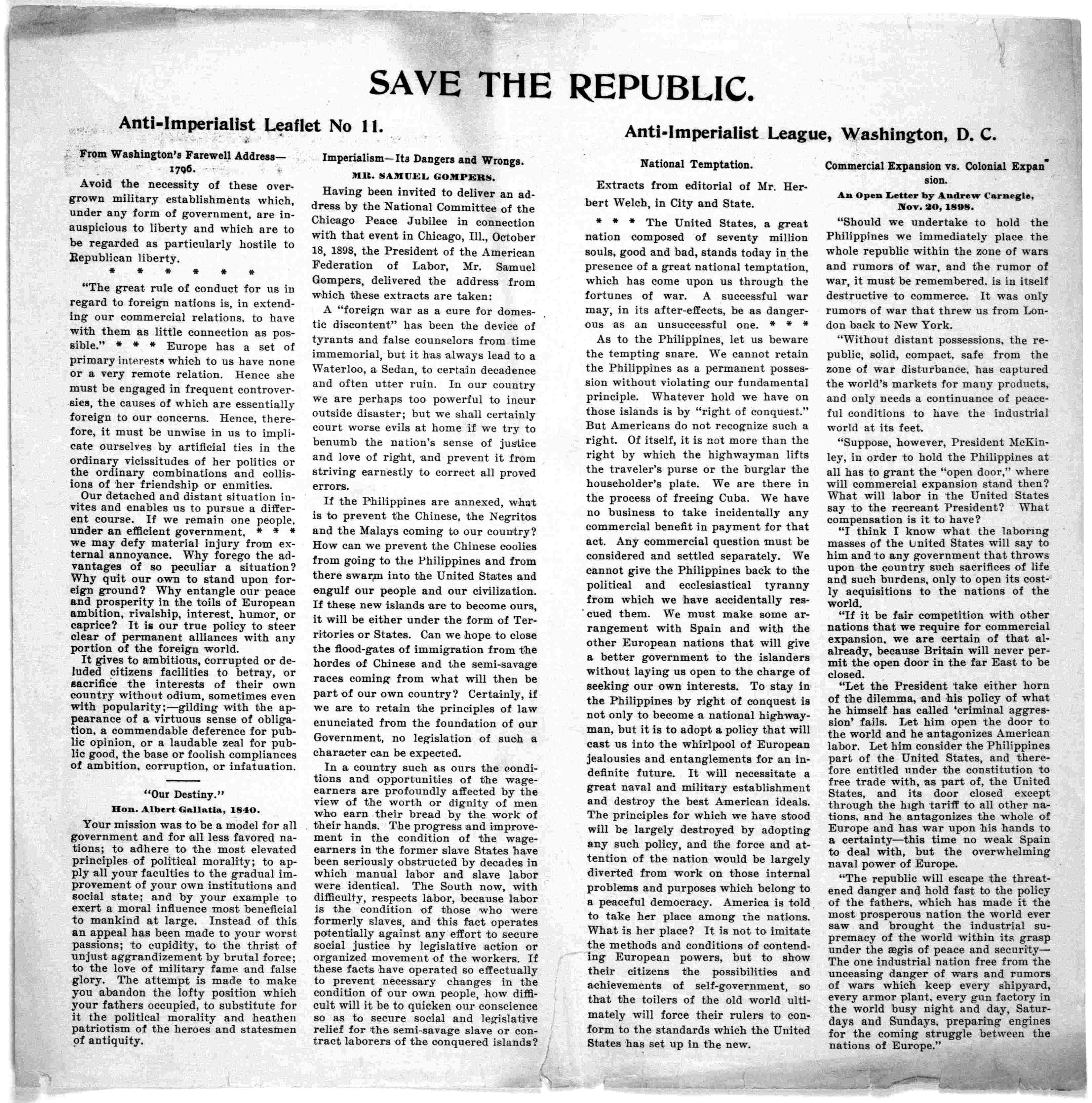
Front page of an Anti-Imperialist League pamphlet titled “Save the Republic,” published in 1899. The leaflet urges restraint in overseas expansion by appealing to American principles of self-government. It includes more textual detail than required for AP study but visually reinforces key anti-imperialist arguments. Source.
Lasting Impact of Anti-Imperialist Arguments
By presenting imperialism as incompatible with American principles, anti-imperialists contributed to ongoing debates over the nation’s global role. Their language of self-determination, constitutionalism, and anti-militarism influenced later critiques of U.S. interventions and shaped twentieth-century conversations about foreign policy, national identity, and the limits of American power.
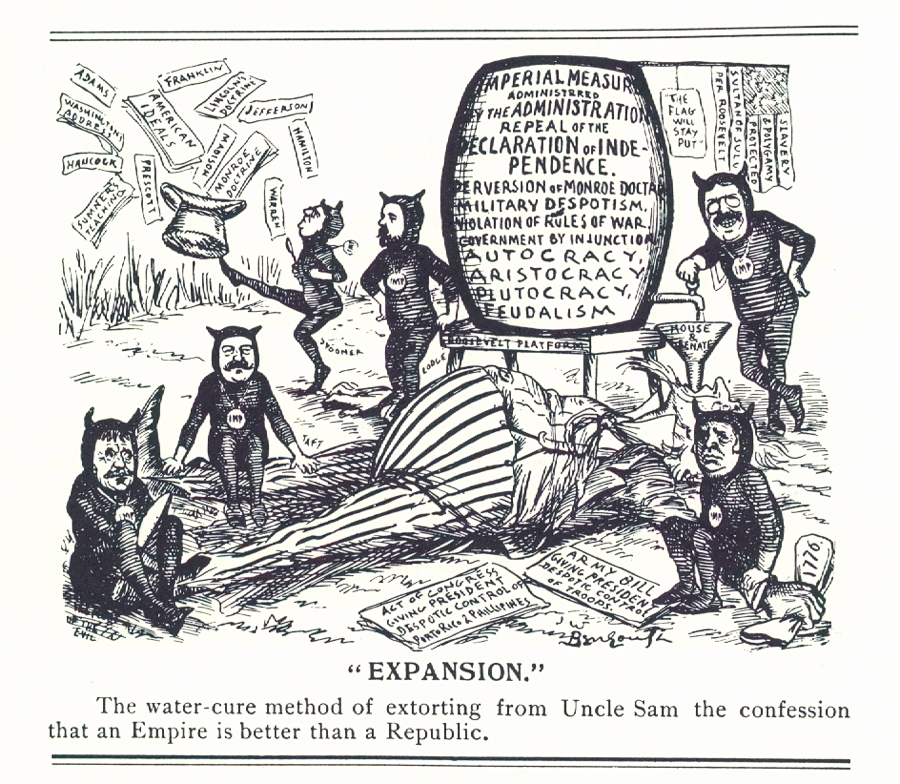
Political cartoon from 1902 depicting the “water-cure” torture used symbolically against Uncle Sam to force acceptance of empire over republicanism. It reflects anti-imperialist warnings about militarism and the erosion of constitutional principles. Contains historical figures not required by the syllabus but effectively illustrates moral and political critiques of empire. Source.
Practice Questions
Question 1 (1–3 marks)
Identify and briefly explain one argument used by anti-imperialists to oppose the acquisition of overseas territories by the United States in the late nineteenth and early twentieth centuries.
Question 1
1 mark
• Identifies a valid anti-imperialist argument (e.g., support for self-determination, constitutional objections, fears of militarism, economic concerns, or commitment to isolationism).
2 marks
• Provides a brief explanation of how the identified argument related to opposition to overseas expansion.
3 marks
• Offers a clear and historically accurate explanation showing how the argument connected to broader anti-imperialist beliefs or concerns about U.S. policy.
Question 2 (4–6 marks)
Evaluate the extent to which anti-imperialist arguments were rooted in traditional American political principles. In your answer, consider at least two different types of anti-imperialist reasoning.
Question 2
4 marks
• Identifies and explains at least two anti-imperialist arguments rooted in American political principles (e.g., republicanism, self-government, constitutional limits, avoidance of entangling alliances).
• Demonstrates accurate historical knowledge.
5 marks
• Shows analytical reasoning by linking these arguments to long-standing American ideals, such as those from the Revolution or early foreign policy traditions.
• Addresses the degree or extent to which these principles shaped the movement.
6 marks
• Provides a balanced evaluation considering both principle-based arguments and other motives (e.g., economic or racial concerns).
• Shows nuanced understanding that not all anti-imperialist arguments were purely ideological and assesses how central American political traditions were to the broader opposition movement.
FAQ
Anti-imperialists frequently drew parallels between the colonised peoples of the Philippines or the Caribbean and the American colonists under British rule. They argued that, just as Americans had rejected external control, so too should others have the right to govern themselves.
They also cited founding documents such as the Declaration of Independence to stress that liberty, consent, and equality were incompatible with ruling subject populations abroad.
Some wealthy industrialists, including Andrew Carnegie, opposed empire for strategic and moral reasons but also for economic ones. They feared that maintaining overseas colonies would increase military and administrative spending without guaranteeing profitable returns.
Carnegie in particular believed the United States should invest in domestic improvement rather than assume costly foreign obligations.
They used a wide network of pamphlets, mass-circulation newspapers, public lectures, and political cartoons to spread their message.
The Anti-Imperialist League coordinated national campaigns, petition drives, and letter-writing efforts, aiming to influence congressional debates and sway public opinion during annexation controversies.
Anti-imperialists challenged the racial assumptions behind these claims, arguing that ideas of a civilising mission masked economic exploitation and cultural domination.
Some emphasised that genuine moral or religious influence required voluntary engagement, not forced rule. Others warned that framing foreign peoples as inferior undermined democratic principles at home.
Labour leaders believed that incorporating overseas territories into the American economic sphere would open the door to cheaper labour markets.
They worried that this increased labour competition would depress wages, weaken bargaining power, and encourage employers to shift production abroad.
Many unions also opposed the higher taxes likely needed to fund a larger military, viewing these costs as a burden on working-class Americans.