AP Syllabus focus:
‘After initial neutrality, the United States entered World War I, departing from noninvolvement in Europe as Wilson framed the war as defending humanitarian and democratic principles.’
The U.S. shift from early neutrality to wartime intervention resulted from diplomatic, economic, and ideological pressures that reshaped national policy and redefined America’s global role during World War I.
The Foundations of Early Neutrality
At the outbreak of World War I in 1914, President Woodrow Wilson declared that the United States would remain neutral, reflecting long-standing traditions of avoiding European power struggles. This policy aligned with both public opinion and economic calculations during the conflict’s early years.
Neutrality: A foreign policy stance in which a nation chooses not to take sides in an international conflict or form military alliances with belligerents.
Despite this official position, neutrality was difficult to maintain. American trade patterns favored the Allied Powers, particularly Great Britain and France, which quickly became the principal purchasers of U.S. goods. This complicating economic relationship laid the groundwork for future diplomatic tensions.
Trade, Blockades, and Economic Entanglements
Britain’s naval blockade of Germany restricted commercial activity and provoked U.S. protests, but it did not halt the expanding American trade with the Allies. As financial ties deepened, American bankers extended large loans to the Allies, increasing the nation’s stake in an Allied victory.
• British blockade: Prevented U.S. goods from reaching Germany, raising legal and diplomatic disputes.
• Loans and credits: Strengthened U.S.–Allied economic interdependence.
• Growing imbalance: Contributed to perceptions that the U.S. was “neutral in name only.”
American economic prosperity during these years highlighted the limits of political neutrality in a globalized industrial economy.
Submarine Warfare and Rising Tensions
Germany’s adoption of unrestricted submarine warfare in 1915 transformed public sentiment. The sinking of civilian and commercial vessels directly threatened American lives and property. The most famous incident was the attack on the Lusitania, which killed 128 Americans and sparked national outrage.
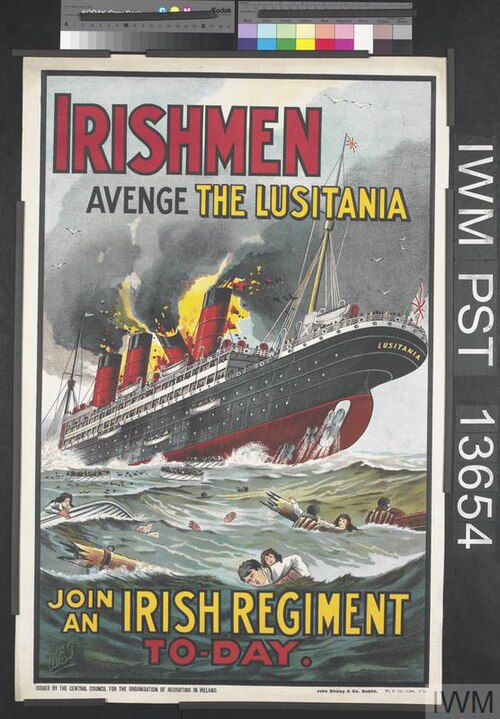
This British recruitment poster dramatizes the sinking of the Lusitania with vivid imagery of a burning ocean liner and drowning civilians. It illustrates how the event fueled international anger and generated calls for a stronger response to German submarine warfare. The reference to Irish regiments is additional context not required by the syllabus but helpful for understanding wider propaganda uses of the tragedy. Source.
Although Wilson secured the Sussex Pledge, a temporary German promise to limit submarine attacks, tensions remained high.
Unrestricted Submarine Warfare: A naval strategy in which submarines attack military and civilian ships without warning in designated war zones.
The continued threat to neutral shipping raised questions about whether the United States could maintain noninvolvement while protecting its citizens and maritime rights.
Wilson’s Diplomatic Idealism and the Shift Toward Action
Wilson initially campaigned for reelection in 1916 on the slogan “He kept us out of war.” However, he also articulated a vision of world order shaped by humanitarian and democratic principles, arguing that American values required engagement when international norms were violated. This emerging moral framework became essential to the administration’s growing skepticism about Germany’s intentions.
Between late 1916 and early 2017, several developments pushed Wilson toward advocating intervention:
• German resumption of unrestricted submarine warfare in 2017.
• The Zimmermann Telegram, in which Germany encouraged Mexico to join a war against the United States.
• Increasing recognition that American commercial and security interests were tied to the survival of democratic governments abroad.
These events altered the political climate and undercut arguments for continued neutrality.
Congressional Debate and Declaration of War
When Wilson addressed Congress in April 1917, he framed the conflict as one that demanded principled American leadership.
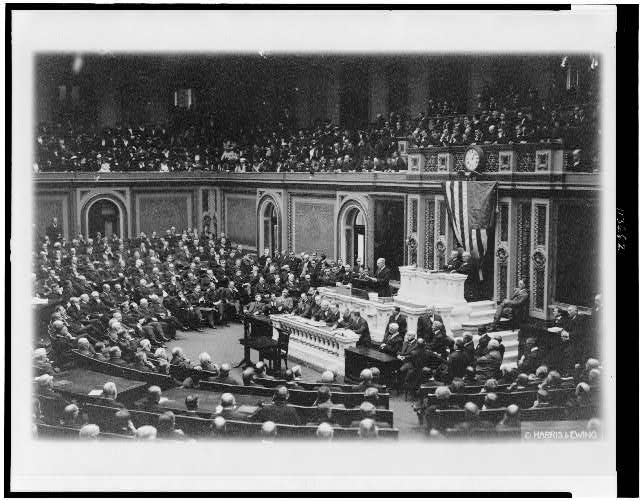
This photograph captures President Woodrow Wilson delivering his 1917 war message before Congress, marking the formal shift from neutrality to intervention. The packed chamber underscores the gravity of the moment and the national significance of the decision. Although the image does not include the text of Wilson’s famous “make the world safe for democracy” phrase, it shows the setting in which that argument was advanced. Source.
He asserted that the United States must fight to “make the world safe for democracy,” portraying intervention as a moral duty rather than an imperial ambition. This framing aligned closely with the specification’s emphasis on defending humanitarian and democratic principles.
Congressional deliberations reflected ongoing divisions:
• Supporters argued that Germany’s actions constituted hostile aggression requiring a firm response.
• Opponents cautioned against entangling the nation in European conflicts, emphasizing traditional noninvolvement.
• Progressive reformers were split, with some viewing war as an opportunity for international reform and others fearing militarism.
Congress ultimately approved the declaration of war, signaling the end of official neutrality.
The Significance of U.S. Intervention
The U.S. entry into World War I marked a sharp departure from earlier foreign policy traditions. While American forces would join the conflict later than other belligerents, the decision to intervene reflected deeper transformations in national identity and global strategy.
Key outcomes included:
• A new precedent for using military force to defend democratic ideals.
• Increased public debate over the limits of neutrality in an interconnected world.
• Long-term shifts toward international engagement, even as isolationist sentiment persisted after the war.
The transition from neutrality to intervention demonstrated how economic ties, security threats, and ideological commitments converged to reshape American foreign policy during a critical global crisis.
Practice Questions
Question 1 (1–3 marks)
Briefly explain ONE reason why the United States found it increasingly difficult to maintain neutrality between 1914 and early 1917.
Question 1 (1–3 marks)
Award up to 3 marks.
• 1 mark for identifying a valid reason (e.g., unrestricted submarine warfare, economic ties to the Allies, the Zimmermann Telegram).
• 1 additional mark for providing brief factual detail showing how this reason challenged neutrality (e.g., the sinking of the Lusitania endangered American lives; blockade trade imbalances created de facto support for the Allies).
• 1 additional mark for explaining the significance of the reason in pushing the United States closer to intervention.
Question 2 (4–6 marks)
Explain how President Woodrow Wilson justified the United States’ intervention in the First World War. In your answer, analyse both the international events that shaped his thinking and the ideological principles he invoked.
Question 2 (4–6 marks)
Award up to 6 marks.
• 1 mark for identifying that Wilson framed intervention as a defence of humanitarian and democratic principles.
• 1 mark for explaining how unrestricted submarine warfare contributed to Wilson’s argument.
• 1 mark for explaining the significance of the Zimmermann Telegram in altering U.S. public and political opinion.
• 1 mark for describing Wilson’s belief that the United States had a moral duty to ensure global stability or “make the world safe for democracy.”
• Up to 2 additional marks for analytical depth, such as linking events to broader shifts in U.S. foreign policy traditions or discussing tensions between past neutrality and emerging international responsibilities.
FAQ
Public opinion changed gradually as Americans encountered repeated evidence that neutrality offered little protection from the consequences of the war.
Early support for Wilson’s neutral stance weakened as reports of German atrocities in Belgium, submarine attacks, and interference with American trade accumulated.
Newspapers, patriotic groups, and preparedness advocates contributed to a climate in which non-involvement seemed increasingly unrealistic.
Many major firms expanded production to meet Allied demand, creating financial incentives that tied U.S. prosperity to an Allied victory.
• Banks extended substantial loans to Britain and France.
• Export industries flourished by supplying food, munitions, and raw materials.
When Germany’s actions threatened these economic relationships, business leaders lobbied for stronger government responses, indirectly bolstering arguments for intervention.
The sinking symbolised the vulnerability of civilians in modern warfare and made the conflict feel unavoidably close to home.
Although Wilson sought diplomatic solutions, the event remained a touchstone for critics of Germany.
It also heightened expectations that the government must take decisive action if American lives continued to be endangered.
Wilson emphasised universal principles rather than national grievances, framing intervention as a contribution to a just international order.
Previous leaders usually justified conflict through direct threats or territorial concerns.
Wilson instead argued that democratic values and humanitarian standards required defence beyond American borders, helping redefine the purpose of U.S. foreign policy.
The telegram demonstrated a willingness by Germany to undermine U.S. sovereignty and destabilise North America.
Its discovery confirmed fears that Germany intended to escalate hostilities regardless of U.S. neutrality.
The involvement of Mexico raised additional concerns, as past tensions during the Mexican Revolution made the proposal seem plausible, increasing the urgency for a firm response.