AP Syllabus focus: ‘American state systems included Maya city-states and the Mexica, demonstrating complex political organization and expanding influence.’
These notes examine how the Maya and the Mexica (Aztecs) built and maintained power in Mesoamerica from c. 1200 to c. 1450 through urban governance, warfare, alliances, and tribute-based systems.
Core idea: complex organisation and expanding influence
Both the Maya and Mexica developed durable political systems that coordinated labor, religion, and military power across multiple communities, allowing them to extend control beyond a single city.
What “city-state” politics looked like
City-state: An independent urban-centered polity controlling a surrounding hinterland, with its own ruler, elites, temples, and military forces.
Mesoamerican city-states competed for land, trade routes, captives, and prestige, but also formed alliances that could scale into regional empires.
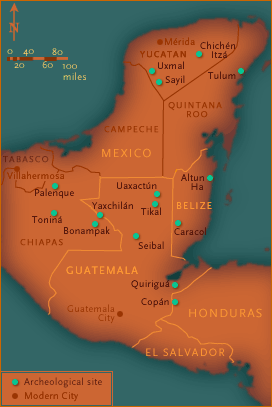
This map plots major Maya centers across Mesoamerica, highlighting the widely distributed urban landscape characteristic of Maya political life. As a study aid, it helps explain why Maya power often operated through inter-city rivalry, alliances, and exchange corridors rather than a single centralized imperial capital. Source
Maya city-states in the Postclassic (c. 1200–1450)
Political organisation and leadership
Postclassic Maya political life remained decentralised, with power distributed among multiple city-states rather than unified under one empire.
Rule was typically hereditary, supported by noble lineages and councils of elites.
Authority was reinforced through public ritual, calendrical ceremonies, and temple-centered urban spaces.
Rival cities used diplomacy and war to shape shifting spheres of influence.
How Maya states expanded influence
Maya “expansion” often meant increasing leverage through networks rather than direct annexation.
Alliance-building among city-states to check rivals and control corridors of movement.
Warfare and captive-taking, which enhanced legitimacy and religious prestige.
Trade connections linking inland and coastal communities, strengthening elite power through control of valuable goods.
Social structure and integration
Maya societies were hierarchical, and political stability depended on managing obligations.
Elites sponsored construction and ceremonies that displayed power and redistributed resources.
Commoners provided agricultural labor, craft production, and service obligations that sustained city life.
The Mexica (Aztecs) and imperial expansion (c. 1300s–1450)
From migrants to imperial power
The Mexica rose in Central Mexico by combining strategic alliances with aggressive military expansion. Their influence broadened quickly as they subordinated neighboring polities and structured relationships around regular payments.
Tribute and imperial administration
Tribute: Mandatory payments (goods, labor, or resources) extracted by a dominant power from subject communities, often used to fund armies, elites, and state ritual.
A tribute-based empire could expand without fully replacing local rulers.
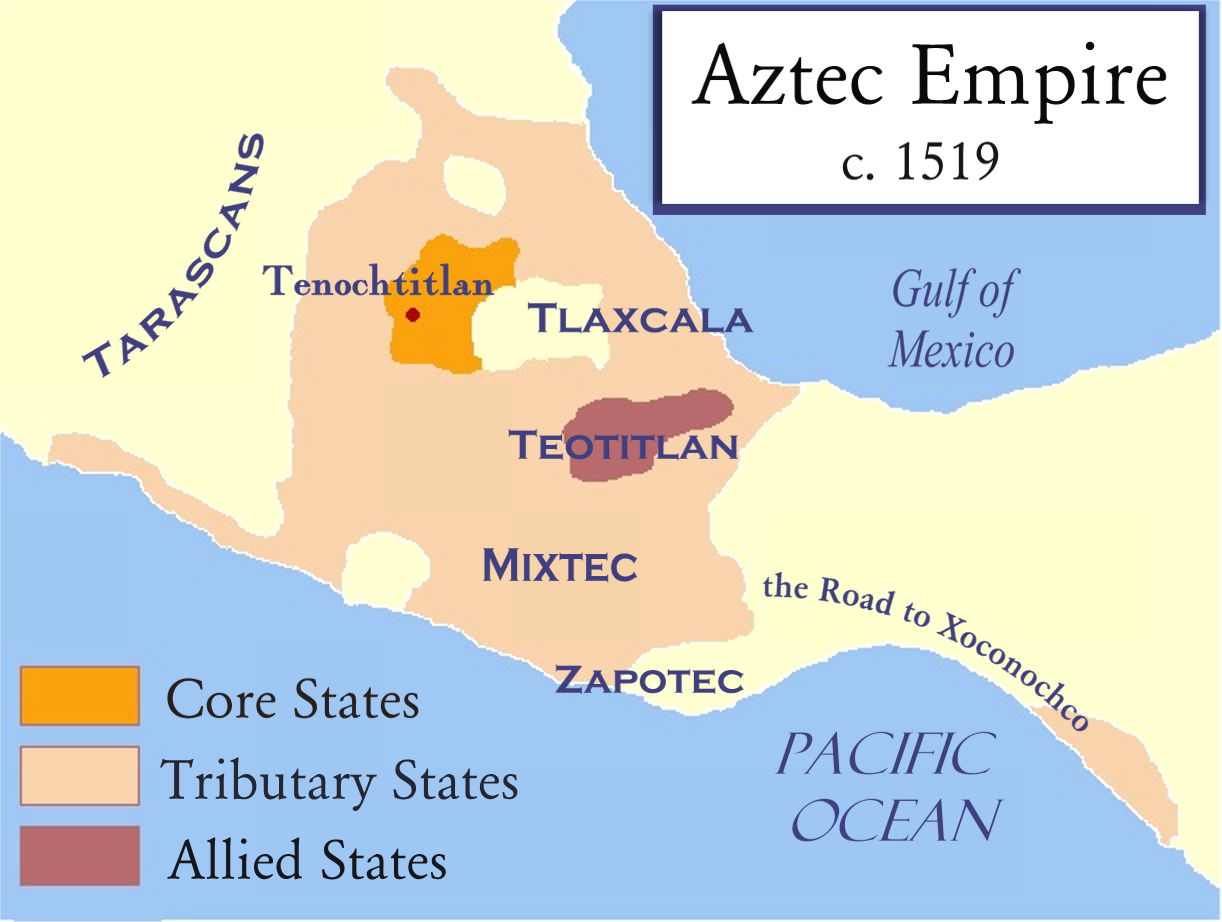
This map represents the Aztec Empire near the time of Spanish contact, differentiating the core of the Triple Alliance from allied and tributary regions. It provides a spatial way to grasp how Mexica power scaled through indirect rule: local polities could remain in place while being pulled into a wider network of obligations and extraction. Source
Subject cities often kept local leadership but owed scheduled deliveries to Mexica authorities.
Tribute lists and administrative oversight helped standardise what was collected and from where.
Tribute supported urban growth, elite consumption, and large-scale ritual life that legitimised rule.
War, legitimacy, and control
Mexica expansion relied on linking military success to sacred obligation.
Conquest created a reputation for power that encouraged additional submissions.
Control of strategic locations (markets, causeways, lake routes) increased regional leverage.
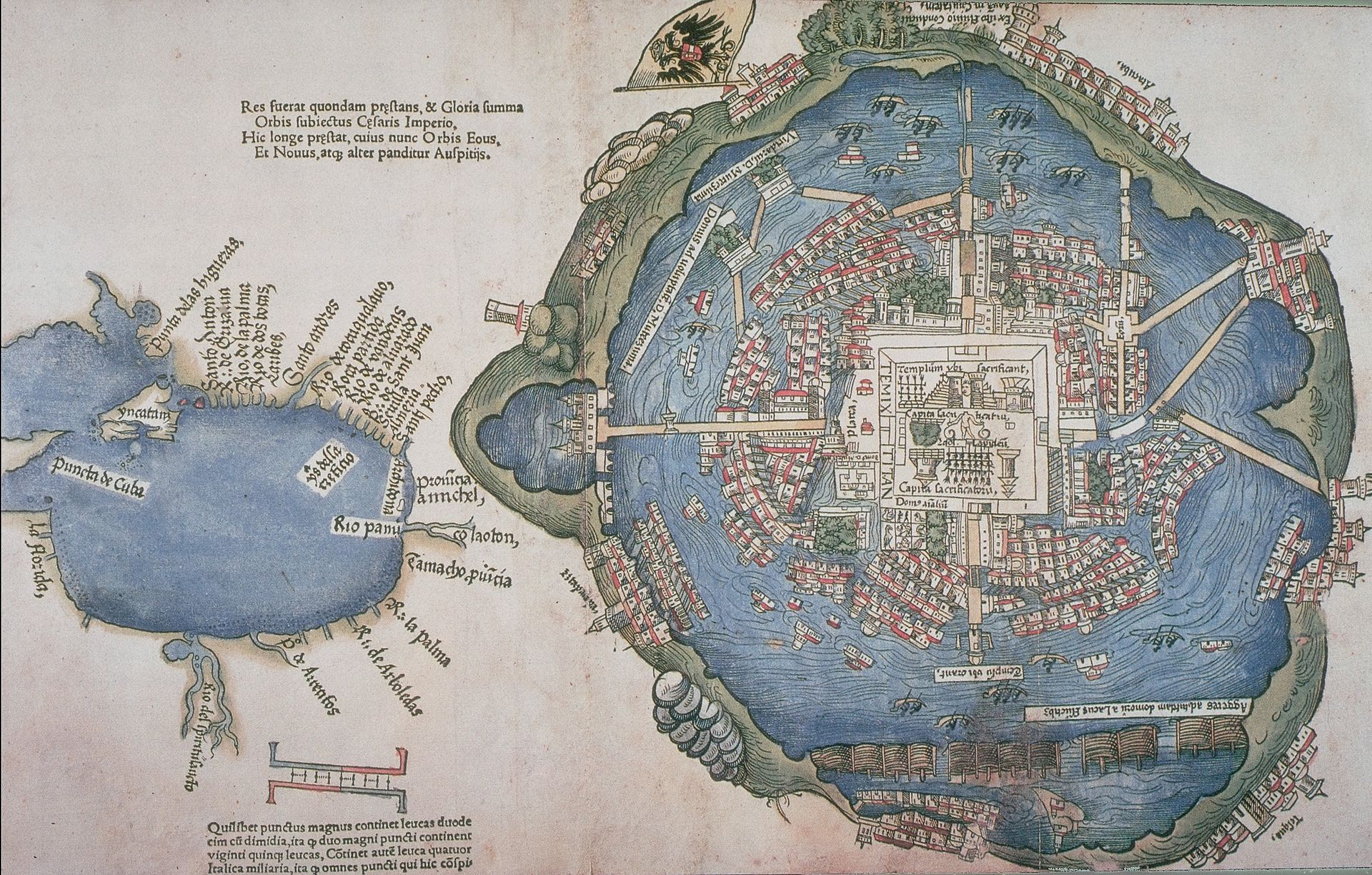
This 1524 printed map depicts Tenochtitlan as an island city connected to the mainland by major causeways, emphasizing how the Mexica capital leveraged lake geography for movement, trade, and defense. Even though it is a European woodcut, it foregrounds the built environment (causeways and dense urban core) that made imperial administration and military logistics workable at scale. Source
Punitive campaigns reinforced compliance when tribute or loyalty faltered.
Imperial scale through alliances
Mexica power expanded most effectively through coalition politics.
Alliances multiplied military manpower and enabled broader campaigns.
The empire’s reach grew through a mix of direct intimidation and negotiated submission, producing a patchwork of varying obligations across regions.
Comparing Maya city-states and Mexica empire-building
Shared features: complex organisation
Urban-based governance with elite leadership, monumental ritual spaces, and organised military forces.
Political authority tied closely to religion and public ceremony.
Regional influence grew through a combination of war, diplomacy, and economic control.
Key difference: political centralisation
Maya: many competing city-states; influence often networked and shifting.
Mexica: a more centralised, explicitly imperial system that scaled power through systematic tribute extraction and coordinated warfare.
Practice Questions
(1–3 marks) Identify ONE way the Mexica expanded their influence in Mesoamerica between c. 1200 and c. 1450.
1 mark: Identifies a valid method (e.g., conquest/warfare, alliances, tribute demands).
1 mark: Provides a brief, accurate description of how it expanded influence (e.g., subject cities paid regular tribute; alliances increased military capacity).
(4–6 marks) Compare the political organisation of Maya city-states with that of the Mexica, and explain how each system supported expanding influence.
1 mark: Describes Maya decentralised city-state organisation.
1 mark: Links Maya organisation to influence (e.g., alliances, trade networks, warfare among city-states).
1 mark: Describes Mexica imperial/tributary organisation.
1 mark: Links Mexica organisation to influence (e.g., tribute extraction, coordinated campaigns, enforcement).
1–2 marks: Provides a clear comparative statement (similarity and/or difference) supported by accurate evidence.
FAQ
Tribute was often tailored to local production and status.
Some areas sent staple goods, others luxury items or crafted products.
Obligations could change after rebellion, drought, or a new political agreement.
They relied on pictorial record-keeping traditions.
These could map subject communities and indicate expected deliveries through symbols, helping officials coordinate collection and communicate requirements across the empire.
Markets concentrated goods, information, and authority.
Control over major marketplaces let elites regulate exchange, collect fees or enforce rules, and strengthen a city’s regional pull without constant direct military occupation.
Lake-based transport corridors could be controlled and defended.
Command of causeways, canoe routes, and chokepoints helped move armies and tribute efficiently while projecting power over nearby city-states.
Shared cultural frameworks supported cohesion amid political fragmentation.
Common religious concepts, calendrical practices, and elite norms created recognisable legitimacy claims, even as cities competed and alliances shifted over time.