AP Syllabus focus: ‘Examples of state systems in the Americas included Chaco, Mesa Verde, and Cahokia, showing diverse forms of political and social organization.’
North American societies from c. 1200 to c. 1450 built complex communities adapted to local environments. Chaco, Mesa Verde, and Cahokia illustrate varied pathways to social hierarchy, coordinated labour, long-distance exchange, and religious-political authority.
Context: Complex Communities in North America
What “complex” meant in practice
These societies demonstrate diverse political and social organisation, including:
Planned ceremonial-urban spaces that coordinated community life
Social stratification (status differences visible in housing, burials, and access to prestige goods)
Regional networks linking smaller settlements to larger centers
Religious authority shaping public works and calendars
Chaco (Chaco Canyon): A Regional Ceremonial and Exchange Hub
Built environment and coordination
Chaco developed a distinctive landscape of “great houses” and ceremonial features that required organised labour and planning:

Chetro Ketl (Chaco Canyon) is shown from an overlook, emphasizing the scale of Chacoan construction and the planned layout of the great house, plaza, and surrounding architectural features. In the view, the great kiva’s position relative to the great house highlights how communal ritual spaces were integrated into elite-centered building programs and regional ceremonial life. Source
Multi-room masonry complexes (e.g., great houses) suggesting central places for storage, ritual, and governance
Great kivas (large, semi-subterranean ceremonial rooms) indicating communal ritual coordination
Engineered features and roads that connected outlying communities, reinforcing regional integration
Networks and influence
Chaco’s importance is closely tied to exchange and connectivity:
Movement of goods across long distances (including prestige materials) supported elite status and ritual authority
Outlying “great house” sites suggest a networked system rather than a single compact city-state
Mesa Verde: Cliff Communities and Local Adaptation
Settlement patterns and defence
Mesa Verde is known for cliff dwellings and aggregated settlements that highlight changing social priorities:

This Library of Congress record presents documentary-style images of Mesa Verde cliff dwellings, useful as visual evidence for how rooms and ceremonial features were constructed in masonry and organized in clustered blocks. Because the LOC files can be downloaded at very high resolution, the images also support close-looking: students can trace wall lines, room stacking, and the spatial density of the settlement. Source
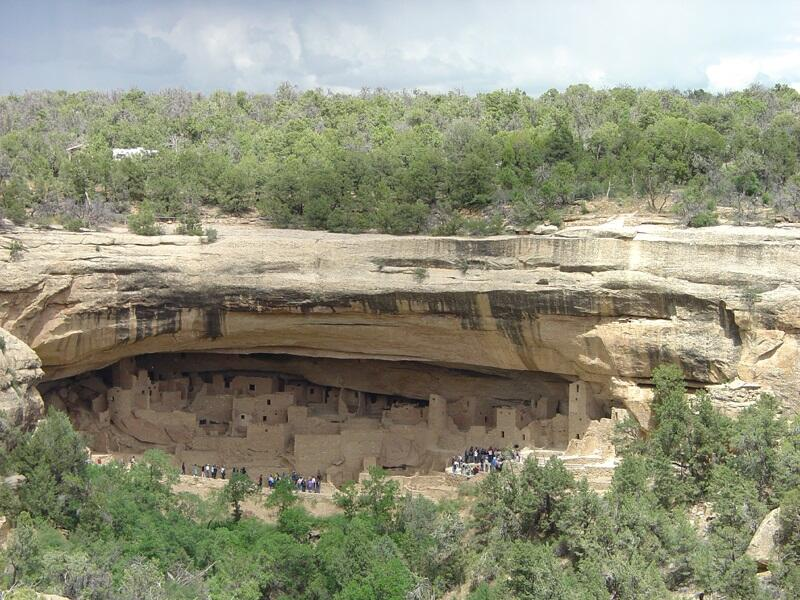
Cliff Palace at Mesa Verde is a densely built masonry village tucked beneath a rock overhang. The image helps illustrate how Ancestral Puebloan communities combined compact residential blocks with ceremonial spaces (including kivas) in a protected cliff alcove, reinforcing both community cohesion and controlled access. Source
Dense housing clusters and strategic locations supported community cohesion and, at times, defensibility
Storage and household organisation point to careful resource management in a challenging environment
Social organisation
Mesa Verde communities show complexity without uniform centralisation:
Local leadership and ritual life structured daily production, exchange, and decision-making
Craft production and household labour supported both subsistence and community needs
Cahokia: Mississippian Urbanism and Hierarchy
A major population and ceremonial center
Cahokia (near the Mississippi River) illustrates a different model: large-scale urban settlement with monumental construction.
Platform mounds and open plazas structured political-ritual space and public gatherings
Central precincts suggest stronger elite authority and organised labour than many smaller regional communities
DEFINITION
Term: Chiefdom: A hierarchical political system in which a central leader (chief) rules through ranked elites, often redistributing goods and organising labour for communal projects.
Economy and exchange
Cahokia’s location enabled extensive interaction:
Riverine transport supported regional trade networks
Agricultural productivity (especially maize-based farming) helped sustain specialists, elites, and large gatherings
Comparing Political and Social Organisation (Chaco, Mesa Verde, Cahokia)
Diversity across North America
These examples underscore the syllabus emphasis on diverse forms of political and social organization:
Chaco: regional ceremonial network with coordinated building and exchange
Mesa Verde: clustered communities shaped by environment, security, and local leadership
Cahokia: mound-centered urban complex with pronounced hierarchy and chiefly authority
Common threads
Despite differences, each society demonstrates:
Collective labour mobilised for construction and public space
Ritual life embedded in architecture and settlement planning
Networks connecting communities through goods, marriage ties, pilgrimage, and alliances
Change Over Time: Stress, Movement, and Reorganisation
Factors shaping transformation
By the later period, many communities experienced reorganisation due to overlapping pressures:
Climate variability and drought affecting agriculture and water access
Resource constraints (deforestation, soil depletion, local scarcity)
Conflict and insecurity contributing to aggregation, relocation, or defensive siting These forces often led to shifts in settlement patterns and political authority rather than uniform “collapse.”
Practice Questions
(2 marks) Identify TWO ways Cahokia demonstrates complex political or social organisation.
1 mark for identifying any valid feature of complexity (e.g., platform mounds/monumental construction; social hierarchy/elite precincts; planned plazas/ceremonial centre; organised labour).
1 mark for a second distinct valid feature.
(5 marks) Compare how Chaco and Mesa Verde illustrate different forms of political and social organisation in North America from c. 1200 to c. 1450.
1 mark for a relevant point about Chaco’s organisation (e.g., great houses/great kivas; regional road-linked network; exchange-focused ceremonial hub).
1 mark for a second Chaco-specific supporting detail.
1 mark for a relevant point about Mesa Verde’s organisation (e.g., cliff dwellings/aggregated settlements; local community organisation; defensive siting/resource management).
1 mark for a second Mesa Verde-specific supporting detail.
1 mark for a direct comparative statement (similarity or difference) using evidence from both.
FAQ
Chaco roads likely served multiple roles beyond routine trade.
Processional routes for ritual movement and pilgrimage
Political signalling: linking outliers to a shared ceremonial centre
Coordination of gatherings and redistribution during seasonal events
Interpretations vary because road use is inferred from archaeology rather than written records.
Hierarchy is inferred from patterned inequality.
Monument placement and restricted elite precincts
Burials with prestige goods versus simpler interments
Craft specialisation and controlled ceremonial spaces
These clues indicate ranked status even without formal written administration.
Cliff locations can reduce access points and improve visibility.
They may reflect heightened local tension, competition over resources, or the desire to protect stores.
However, cliff dwelling also relates to environmental practicality and community tradition, so defence is a strong hypothesis, not a single-cause certainty.
They look for non-domestic features and unusual scale.
Large plazas, great kivas, or mound complexes
High investment in public architecture relative to household space
Evidence of periodic large gatherings (food remains, large storage, repeated rebuilding)
Context across a region helps confirm the site’s role.
Rivers supported both food and connectivity.
At Cahokia, major waterways enabled bulk transport and dense agriculture on fertile floodplains.
In the Southwest, exchange existed but communities often faced tighter water constraints, shaping different settlement choices and political scales.