CIE Syllabus focus:
'Candidates should understand the financial statement effects of correcting errors and the benefits and limitations of control accounts and trial balances.'
Errors in receivables, payables, and ledger totals do more than create bookkeeping differences. They can change reported profit, asset and liability values, and the reliability of financial statements used by managers and external users.
Control accounts and why they matter
A control account is used to check the accuracy of entries made in individual personal accounts. In practice, the most common examples are the sales ledger control account and the purchases ledger control account.
Control account: A summary account in the general ledger that records the total of transactions and balances from a separate ledger, such as trade receivables or trade payables.
Because a control account shows the total balance that should agree with the list of individual ledger balances, it acts as an important internal check. If the control account total does not match the total of the personal accounts, there may be an error that must be investigated.
Financial statement effects of correcting errors
When profit is affected
Some errors affect income or expenses. When these are corrected, the statement of profit or loss changes.
If income was previously understated, correcting the error increases profit.
If income was previously overstated, correcting the error reduces profit.
If an expense was understated, correcting the error reduces profit.
If an expense was overstated, correcting the error increases profit.
A change in profit will also affect capital or equity, because profit for the year ultimately belongs to the owner or contributes to retained earnings.
This means a single correction can have a double impact:
on the statement of profit or loss
on the statement of financial position
When asset or liability values are affected
Some errors mainly affect balances in the statement of financial position.
An overstatement of trade receivables means current assets are too high.
An understatement of trade payables means current liabilities are too low.
Correcting these errors changes the reported financial position, even if profit is not affected.
This is especially important because users may make judgments about:
liquidity
the ability to collect receivables
the scale of short-term obligations
If receivables are overstated, the business may appear stronger than it really is. If payables are understated, the business may appear less indebted than it actually is.
Why the effect matters
Correcting errors improves the reliability of the financial statements. Until the error is corrected, decisions based on the accounts may be misleading. For example:
managers may judge working capital incorrectly
lenders may assess short-term solvency inaccurately
owners may believe profit is higher or lower than the true figure
So, when an error is corrected, the key question is: Which account balances were wrong, and which financial statement includes those balances?
Benefits of control accounts
Control accounts are useful because they strengthen the accounting system.
They provide an independent check on the accuracy of entries in personal accounts.
They help locate errors in the sales ledger or purchases ledger.
They make it easier to identify missing postings, duplicated entries, or incorrect totals.
They provide a quick total for trade receivables or trade payables without listing every individual account.
They support internal control, especially in larger businesses where different staff record transactions and maintain ledgers.
A further benefit is that control accounts can help maintain continuity if individual ledger balances are incomplete or one account is damaged or lost. The control account gives a summary figure that can assist investigation.
Limitations of control accounts
Despite their usefulness, control accounts do not guarantee complete accuracy.
If the same error appears in both the personal account and the control account, the totals may still agree.
They depend on the accuracy of the original source data. If the original figure is wrong, the control account may also be wrong.
They summarize totals, but they do not explain every underlying mistake.
They add extra work and may be less cost-effective for a very small business.
They focus mainly on arithmetical accuracy and completeness of posting, not on whether a transaction was recorded in the most appropriate account.
Therefore, agreement between a control account and the list of ledger balances is helpful, but it is not proof that no errors exist.
Trial balances: benefits and limitations
A trial balance is another checking device, but it has a different purpose from a control account.
Trial balance: A list of ledger balances extracted at a particular date to test whether total debits equal total credits.
A trial balance is useful because:
it checks the arithmetical balance of the double-entry system
it helps reveal one-sided entries or unequal postings
it provides a convenient basis for preparing financial statements
However, the limitations of a trial balance are significant.
A trial balance can still agree even when financial statements are wrong.
It does not show whether transactions were posted to the correct account.
It does not confirm that all transactions were recorded.
It cannot detect every error affecting profit, assets, or liabilities.
It does not assess the quality of accounting judgments, such as whether a balance is reasonable.
This means an agreed trial balance should be seen as a starting point, not final proof of accuracy.
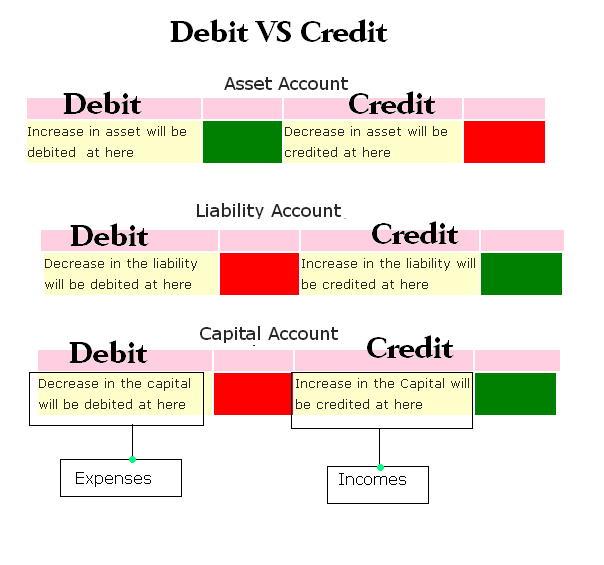
Debit-versus-credit rules summarized by account type (assets, liabilities, capital/equity, income, and expenses). This visual supports trial-balance technique by clarifying which side is the normal balance for each class of account, reducing the risk of placing ledger balances in the wrong column. Source
Control accounts and trial balances are both valuable, but each has limits. They improve confidence in accounting records, yet neither replaces careful checking, review of source documents, and prompt correction of discovered errors.
Practice Questions
State two limitations of a trial balance. (2 marks)
1 mark for any valid limitation, up to 2, such as:
It may agree even when errors still exist.
It does not detect all errors.
It does not show whether entries are in the correct accounts.
It does not prove that all transactions have been recorded.
Explain how correcting accounting errors may affect the financial statements and discuss two benefits and two limitations of using control accounts. (6 marks)
Up to 2 marks for explaining financial statement effects:
correction may change profit if income or expenses were wrong
correction may change assets or liabilities in the statement of financial position
correction may also change capital or equity through the profit figure
Up to 2 marks for two benefits of control accounts:
provide an internal check on personal ledger entries
help identify differences between ledger totals and control totals
give a quick total of receivables or payables
strengthen internal control
Up to 2 marks for two limitations of control accounts:
errors may appear in both the control account and personal accounts
they depend on correct original data
they do not identify every type of error
they increase clerical work
FAQ
A difference may remain because the investigation often requires checking several records, not just one ledger.
Common reasons include:
missing source documents
delays in posting from day books
uncertainty about which staff member made the entry
the need to compare totals from different dates
In a busy business, it may also be necessary to wait for updated schedules of receivables or payables before confirming the exact cause.
Yes.
A control account may be correct in total while one or more individual customer accounts are wrong. This happens when mistakes cancel each other out across the ledger.
For example:
one customer may be overstated
another may be understated
the total may still match the control account
That is why businesses should not rely only on the overall total when managing credit control.
Large volumes of credit sales and credit purchases create many personal accounts and frequent postings.
Control accounts help by:
reducing the need to inspect every account to get one total
making it easier to assign work between staff
spotting unusual movements in receivables or payables totals
supporting faster month-end review
They are most valuable where transaction numbers are high and the risk of posting mistakes is greater.
Yes.
If fraudulent entries are recorded using matching debit and credit entries, the trial balance may still balance. This means the trial balance does not test honesty or commercial reality.
Fraud may involve:
deliberate misclassification
false but balanced entries
omission of documents before recording
So an agreed trial balance is useful, but it is not a fraud-detection tool by itself.
There is no single rule, but the frequency should match the size and risk level of the business.
A business may choose:
daily checks for very high transaction volumes
weekly checks for active credit operations
monthly checks for smaller systems
More frequent checks usually mean errors are found earlier, which makes them easier to trace and correct. The best interval balances cost, staff time, and the importance of timely information.