

Edexcel Syllabus focus:
'Discuss potential ethical issues regarding the use of invertebrates in biological research.'
Invertebrates are widely used in biological research and teaching, but their use still raises important ethical questions about welfare, scientific value, and the duty to minimize unnecessary harm.
Why ethical issues arise
Research using invertebrates is sometimes seen as less ethically problematic than work on vertebrates, but that does not make it ethically neutral. Scientists still make decisions that may cause stress, injury, or death to living organisms, so the likely benefit of the work must be judged against the possible harm.
Ethical issue: A concern about whether an action is morally acceptable, especially when possible scientific benefit is weighed against harm to living organisms.
Many invertebrates are small, inexpensive, easy to culture, and often have short life cycles. These features make them useful for repeated investigations. However, those advantages can also encourage the idea that they are simply convenient research tools. Ethical discussion challenges that assumption and asks whether they are being used responsibly and only when justified.
Why invertebrates are often chosen
Invertebrates are used because they can show clear responses to environmental change, chemicals, and physical conditions. Large numbers may be available, and some can be kept with limited equipment. In some places, they also face fewer legal restrictions than vertebrates.
However, fewer regulations do not mean no moral responsibility. Ethics goes beyond what is legally permitted. A procedure may be allowed by law but still be questionable if it causes avoidable suffering or uses more organisms than necessary. This is especially important in education, where the main aim may be skill development rather than essential new scientific knowledge.
Main ethical concerns
Harm, stress, and death
Even simple investigations can interfere with an invertebrate’s normal physiology and behavior. Possible harms include:
rough handling during transfer
confinement in unnatural conditions
exposure to drugs or chemicals
changes in temperature, pH, light intensity, or oxygen availability
injury during observation or measurement
poor care before, during, or after the investigation
These effects may cause stress, reduced movement, abnormal behavior, injury, or death. Ethical concern is not limited to immediate killing. Short-term distress, recovery problems, and long-term effects on survival or reproduction also matter. Researchers should therefore consider the entire procedure, including collection, storage, testing, and what happens to the organism afterward.
Uncertainty about pain and sentience
A major ethical issue is uncertainty about whether some invertebrates can experience pain rather than only automatic responses to harmful stimuli.
Sentience: The capacity to have subjective experiences, including discomfort, distress, or pain.
Some invertebrates show nociception, meaning they detect damaging stimuli and react to them.
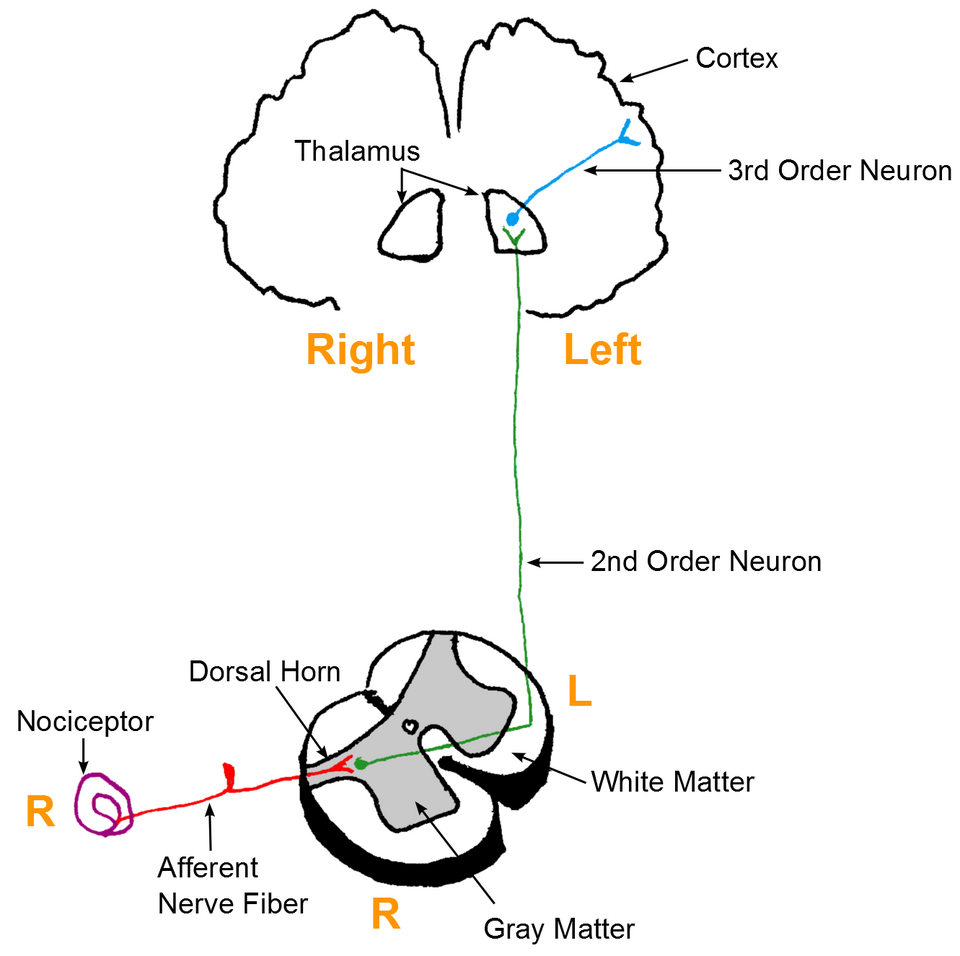
Simplified diagram of nociception pathways, showing how a damaging stimulus can be detected by sensory neurons and relayed through the nervous system. In ethics discussions, this helps distinguish measurable nociceptive processing from the harder-to-prove subjective experience of pain (sentience). Source
This does not by itself prove conscious suffering. However, incomplete evidence is not a good reason to ignore welfare. A cautious approach is often most ethical: if there is reasonable doubt, researchers should assume that suffering may be possible and reduce it as much as they can. This uncertainty makes careful planning and supervision important, even for practical work that seems minor.
Balancing scientific value and welfare
Ethical decisions involve asking whether the expected benefit justifies the likely harm. Benefits may include improved understanding, development of methods, or learning important biological skills. But not every investigation has equal value. If a study is poorly designed, has unclear aims, or gives little educational benefit, it is harder to justify using living organisms at all.
Useful questions include:
Is the investigation genuinely necessary?
Could existing data, video, or a computer model achieve the same goal?
Is the number of organisms large enough for valid results but no larger than needed?
Have all reasonable steps been taken to reduce stress and injury?
Are the people carrying out the work trained to handle the organisms properly?
This shows that good ethics and good science are closely linked. If research is unreliable, wasteful, or poorly controlled, the harm caused is even less justifiable.
Making invertebrate research more ethical
Replacement, reduction, and refinement
A useful ethical framework is the 3Rs:
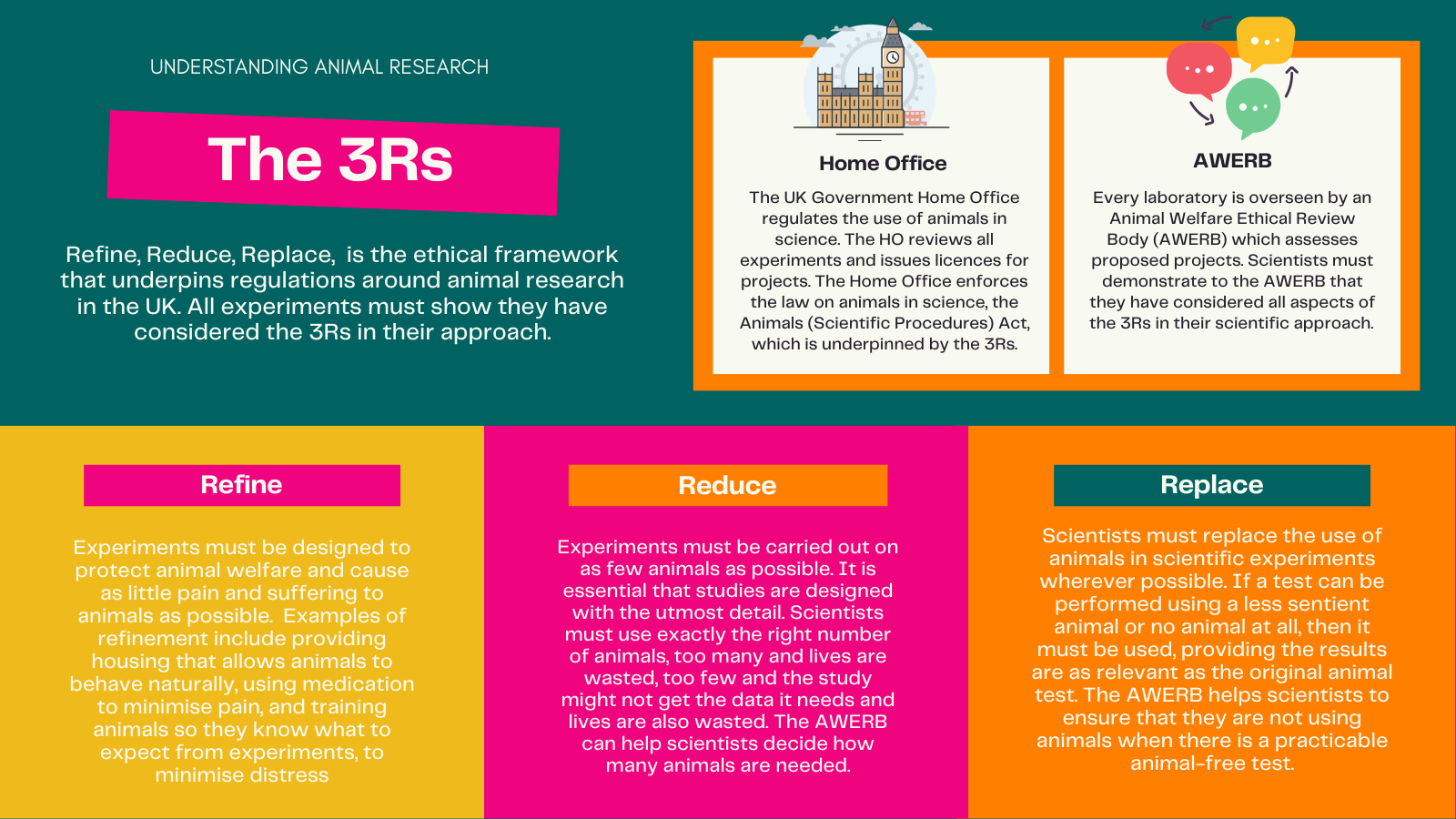
Infographic summarizing the 3Rs (Replacement, Reduction, Refinement) used to improve the ethics and scientific quality of animal research. It works well as a quick visual checklist for planning investigations, including classroom practicals, to minimize harm while maintaining valid outcomes. Source
Replacement: use non-living models, videos, simulations, or previously collected data instead of live invertebrates whenever possible.
Reduction: use the smallest number of organisms that will still produce valid results.
Refinement: change methods to minimize stress, injury, and discomfort.
In practice, refinement may include gentle handling, short exposure times, suitable environmental conditions, and avoiding unnecessarily extreme treatments. It may also involve monitoring organisms closely and stopping the investigation if severe distress is likely. These steps do not remove all ethical issues, but they show active consideration of welfare rather than treating it as an afterthought.
Responsibility in research and education
Ethical responsibility applies in laboratories, field studies, and classroom investigations. When invertebrates are used for teaching, the educational gain should be clear enough to justify any risk to the organisms. Teachers and researchers should prepare carefully, supervise closely, and ensure that procedures are carried out competently.
Public attitudes can differ widely. Some people are less concerned about invertebrates because they are small, unfamiliar, or very different from humans. Others argue that uncertainty about their experiences means caution is even more important. Because of this, ethical decisions should be based on evidence, welfare awareness, and clear justification, not only on habit or convenience.
Practice Questions
State two ethical issues that should be considered when using invertebrates in biological research. (2 marks)
1 mark for any valid ethical issue, up to 2 marks total.
Acceptable answers include:
possible pain, stress, or distress
injury or death caused by the procedure
uncertainty about whether the organism is sentient
using more organisms than necessary
poor handling or unsuitable conditions
lack of clear scientific or educational justification
Explain how a biologist could reduce ethical concerns when investigating the effect of an environmental factor on an invertebrate. (6 marks)
1 mark for stating that the investigation should have a clear scientific or educational purpose.
1 mark for suggesting a non-living alternative where possible, such as a model, video, or existing data.
1 mark for using the smallest number of organisms needed for valid results.
1 mark for gentle handling or trained supervision.
1 mark for keeping conditions suitable, for example appropriate temperature, oxygen, or light.
1 mark for limiting exposure to harmful conditions or stopping the investigation if distress is likely.
1 mark for any other valid refinement point, such as avoiding extreme concentrations or ensuring proper aftercare.
Maximum 6 marks.
FAQ
No. Legal protection varies between countries and sometimes between regions.
Some legal systems mainly focus on vertebrates, while others also protect certain invertebrates, especially groups thought more likely to experience pain, such as cephalopods. Schools, universities, and research organizations may also apply ethical review rules that go beyond the law.
This means a method that is legal in one place may require extra approval or be discouraged somewhere else.
Scientists look for more than a simple reflex.
Evidence that raises concern includes:
long-lasting changes in behavior after injury
protective actions directed at the injured body part
avoidance learning linked to harmful experiences
trade-offs, where the animal accepts risk or loses reward to avoid the harmful stimulus
reduced response after pain-relieving substances
No single sign proves pain, but several lines of evidence together make ethical caution more reasonable.
Not always.
Release may be inappropriate if the organism has been stressed, injured, exposed to chemicals, or kept in artificial conditions that reduce survival. Release can also be a problem if the species is non-native, laboratory-bred, or could spread disease to wild populations.
In some cases, continued care in culture or humane killing under approved guidance may be more ethical than release. The best option depends on welfare, biosecurity, and environmental impact.
A review committee would usually want evidence that the work is both justified and carefully planned.
It may ask:
What is the purpose of the study?
Why are live invertebrates necessary?
How many organisms will be used, and why?
How will stress, injury, and death be minimized?
What signs will be used to stop the procedure early?
Who is trained to handle the organisms?
What will happen to the organisms afterward?
These questions help ensure that ethical thinking happens before the work starts.
Yes. Ethical issues can arise during collection as well as during the investigation itself.
Possible concerns include:
disturbing habitats such as pond margins, leaf litter, or soil
removing large numbers from a local population
collecting breeding adults or juveniles at sensitive times
trapping non-target organisms by accident
causing stress during transport
Because of this, ethical planning should include how organisms are obtained, not just how they are used once they reach the lab or classroom.

