

Edexcel Syllabus focus:
'Core Practical 1: Investigate the effect of caffeine on heart rate in Daphnia.'
This practical investigates how a stimulant changes heart activity in a living organism while developing skills in observation, variable control, repeat measurement, and interpretation of biological data.
Purpose of the practical
The aim is to determine whether caffeine concentration changes heart rate in Daphnia. Daphnia are tiny freshwater crustaceans with transparent bodies, so the beating heart can be seen directly under a microscope. This allows a fast, non-destructive test of a physiological response.
The prediction is usually that caffeine, a stimulant, increases heart rate, but the investigation must test this using measured data rather than assumption.
Why Daphnia are suitable
transparent body allows direct observation of the heart
small size makes them easy to handle in a laboratory
rapid heartbeat produces measurable changes in a short time
Apparatus and setup
Typical apparatus includes:
living Daphnia in culture water
cavity slide
pipette
microscope
stopwatch
caffeine solutions of known concentration
water for a control
cotton wool fibers to reduce movement
Transfer one Daphnia in a small drop of culture water onto the cavity slide. Add a few cotton wool fibers so it remains in view without being damaged. Place the slide under low magnification and identify the heart, usually on the dorsal side of the body.
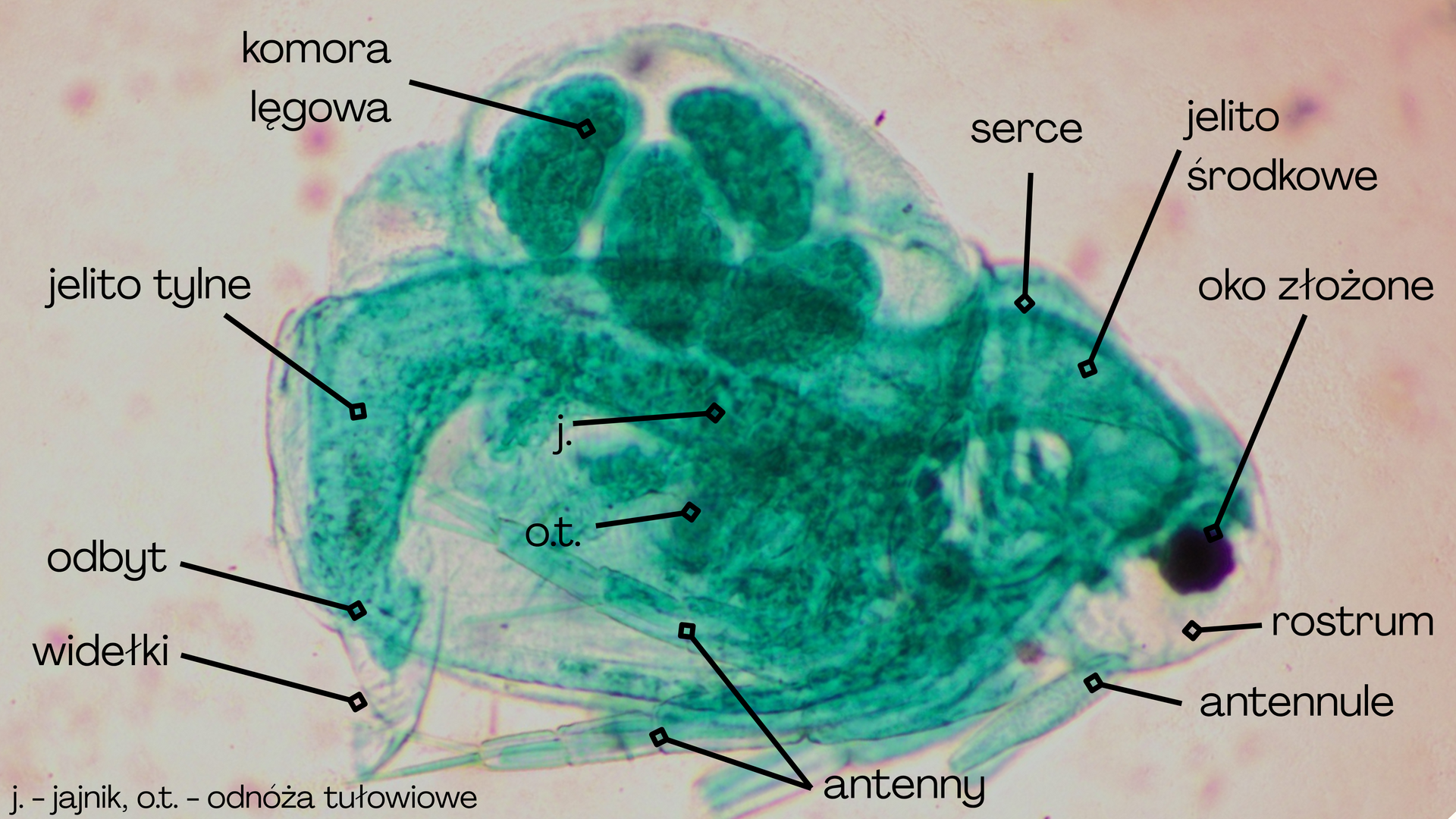
Labeled anatomical view of a Daphnia showing major internal and external structures, including the heart positioned dorsally. Use it as a reference map when you first scan the specimen under low power to orientate the head–thorax–abdomen and then pinpoint the heart region before counting beats. Source
A baseline heart rate should be measured in water first. Then add a known concentration of caffeine solution, wait a fixed time, and count the heart rate again. This can be repeated with several concentrations to see whether there is a pattern.
If the same Daphnia is used more than once, it should be handled consistently between trials. Repeated exposure can influence later readings, so the order of testing matters when results are evaluated.
Suggested method
place one Daphnia onto the slide in culture water
observe under the microscope and locate the heart
count beats for a fixed period, such as 15 or 30 seconds
add a measured volume of caffeine solution
wait the same time before counting again
repeat for a range of concentrations
carry out repeats and calculate a mean for each concentration
Variables and fair testing
The independent variable is caffeine concentration. The dependent variable is heart rate.
When planning the investigation, other factors must be kept constant.
Control variable: A factor kept the same in all trials so that any change in heart rate is due to caffeine rather than another variable.
Important control variables include:
temperature, because heart rate changes with temperature
light intensity, especially if the lamp warms the slide
volume of solution added
time interval between adding caffeine and counting
length of the counting period
the size or age of the Daphnia where possible
Keeping the counting period constant is particularly important because even a small timing error can affect the calculated heart rate.
A control treatment using water with no caffeine is also needed. This shows whether handling, added liquid, or time under the microscope affects heart rate by itself.
Recording and processing data
Because the heart beats quickly, it is practical to count for a short fixed time and convert the result to beats per minute.
= heart rate in beats per minute, bpm
= beats counted during the observation period
= observation period in seconds, s
Repeats are important because counting can be difficult and living organisms show natural variation. Mean values are more reliable than single readings. Results can be presented as concentrations with mean heart rates, or plotted on a graph to identify a trend.
A graph may show a steady increase, little change, or a less regular pattern at higher concentrations. A valid conclusion should be based on the overall pattern across repeats, not on one unusual result.
Sources of error and improvements
Common limitations include:
movement of the Daphnia, making the heart hard to follow
manual counting errors, especially at high heart rates
warming from the microscope lamp
natural variation between different Daphnia
uneven mixing of the caffeine solution around the organism
Possible improvements include:
using a cool LED light source
allowing the same acclimation time in every trial
testing more concentrations
using several Daphnia and calculating means
recording the heartbeat on video for slower playback
repeating any anomalous result
Using the same Daphnia for several concentrations can reduce variation between individuals, but earlier exposures may affect later measurements. Using a new Daphnia each time avoids this carry-over effect, but increases natural variation. This trade-off should be considered when evaluating the method.
If an anomalous result appears, the method should be checked first. Timing errors, poor visibility of the heart, or inconsistent mixing may explain an outlier better than biology alone.
Safety and organism care
Handle Daphnia gently and keep exposure to caffeine as short as possible. Do not trap or crush them under the slide setup, and return active organisms to fresh culture water after observation. Clean apparatus between trials to avoid contamination.
Caffeine solutions should be handled carefully, and spills should be wiped up promptly. Careful technique improves the quality of the data and reduces unnecessary stress to the organism.
Practice Questions
State one reason why Daphnia are suitable for investigating the effect of caffeine on heart rate and state one control variable in this investigation. (2 marks)
Any one reason, such as transparent body / heart visible under microscope / rapid heartbeat / easy to handle (1)
Any one control variable, such as temperature / light intensity / volume of solution added / time after adding caffeine / counting period / size or age of Daphnia (1)
A student wants to investigate the effect of caffeine concentration on heart rate in Daphnia. Describe how the student should carry out this investigation and how the results could be made reliable. (5 marks)
place a Daphnia in culture water on a cavity slide or similar setup (1)
locate the heart under a microscope and count beats for a fixed time to get a baseline reading (1)
add a known concentration or volume of caffeine solution and wait a fixed time before recounting (1)
repeat with a range of caffeine concentrations and include a control with no caffeine (1)
repeat measurements and calculate a mean, or keep control variables such as temperature and light intensity constant (1)
FAQ
If caffeine is prepared using a solvent other than water, such as a small amount of ethanol, that solvent could affect heart rate by itself.
A solvent control contains the same amount of solvent but no caffeine. This lets you separate the effect of caffeine from the effect of the solvent.
If the same Daphnia is tested repeatedly, an earlier exposure may affect later readings.
For example:
caffeine may still be present in or around the organism
handling stress may build up over time
prolonged microscope exposure may change heart rate
Testing concentrations in a fixed order can therefore bias the results.
Different life stages can have different baseline heart rates and different sensitivities to chemicals.
Possible reasons include:
differences in body size
different metabolic rates
different rates of diffusion of caffeine into the body
variation in general health or reproductive state
This is why using a similar size range can improve consistency.
Living organisms are naturally variable, and culture conditions can change over time.
Differences may result from:
water quality
feeding status
oxygen availability
temperature before the practical
age structure of the culture
This is one reason repeated trials and larger sample sizes improve confidence in the pattern.
A dose-response curve shows how heart rate changes across a wider range of caffeine levels.
This can help you identify:
the lowest concentration that causes a clear effect
whether the response increases steadily
whether the effect levels off
whether very high concentrations produce abnormal results
It gives a more informative picture than a simple low-versus-high comparison.

.png)