

Edexcel Syllabus focus:
'Understand that diffusion rate depends on surface area, diffusion distance and concentration difference, and can be calculated using Fick's Law of Diffusion.'
The speed of diffusion is crucial in biology because cells and tissues depend on rapid exchange of substances. Fick's Law shows which physical factors make diffusion faster or slower.
Understanding diffusion rate
Diffusion rate describes how quickly particles cross a membrane or exchange surface. Although individual molecules move randomly, there is an overall net movement from a region of higher concentration to a region of lower concentration. In biology, the important question is not just whether diffusion happens, but how fast it happens. The faster the rate, the more efficiently substances can move where they are needed.
Fick's Law links diffusion rate to three physical factors: surface area, concentration difference, and diffusion distance.
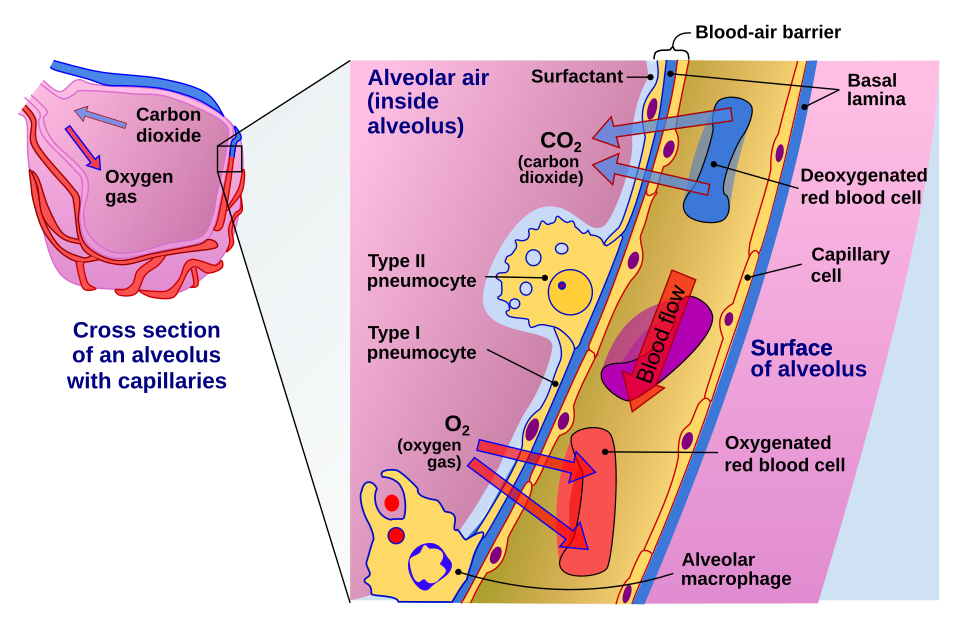
Cross-section of an alveolus and surrounding capillaries illustrating diffusion of into blood and out of blood. The diagram highlights a very large exchange surface and an extremely short diffusion path across the alveolar and capillary walls, which increases diffusion rate. It also reinforces how ventilation and blood flow help maintain a steep concentration difference to sustain rapid gas exchange. Source
It helps explain why some exchange surfaces are much more efficient than others.
Fick's Law of Diffusion: A relationship showing that diffusion rate increases with surface area and concentration difference, but decreases as diffusion distance increases.
Fick's Law is especially useful because it shows the direction of each effect. Two factors increase diffusion rate when they get larger, while one factor decreases diffusion rate when it gets larger.
Fick's Law of Diffusion
At A Level, Fick's Law is usually written in a simplified form that emphasizes the variables you need to compare. It does not usually include every physical constant, but it is very effective for biological reasoning.
= amount diffusing per unit time, unit
= area available for diffusion, unit
= difference in concentration across the surface, unit
= thickness of the barrier, unit
This relationship is often used to compare one situation with another. If one variable changes while the others stay constant, the effect on diffusion rate can be predicted directly from the equation.
Surface area
Larger surface area means more space is available for particles to cross at the same time. If twice as much membrane is available, then more molecules can diffuse simultaneously, so the rate increases. This is why folded, branched, or highly divided surfaces are often associated with fast diffusion.
Surface area is not the same as surface area to volume ratio. In Fick's Law, the relevant factor is the actual area across which diffusion occurs. A larger area gives more opportunities for molecules to pass at the same time.
Concentration difference
The concentration difference is the difference in concentration between the two sides of the exchange surface.
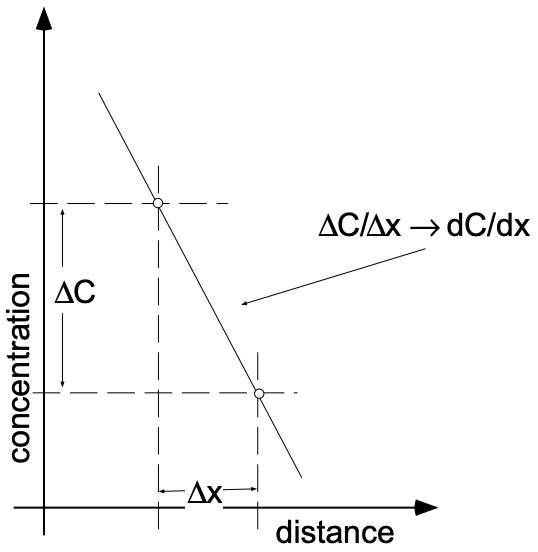
Graph of concentration versus distance showing a linear concentration gradient (slope), which is the driving basis for diffusion. It helps connect the idea of “concentration difference” to the spatial change in concentration across a barrier of thickness (diffusion distance). A steeper slope (larger Δc across the same distance) corresponds to faster net diffusion. Source
A steeper difference causes a faster net movement because there is a greater imbalance in particle distribution. More particles are available to move away from the side where concentration is higher, so the overall diffusion rate increases.
If concentrations on the two sides become similar, net movement slows. If both sides reach the same concentration, molecules still move randomly, but there is no net diffusion. Maintaining a large concentration difference is therefore important for rapid diffusion.
Diffusion distance
Diffusion distance means the thickness of the barrier or the length of the path that particles must travel. The shorter this distance, the faster diffusion occurs. If molecules only need to pass across a very thin barrier, they can reach the other side more quickly.
A greater diffusion distance reduces rate because particles take longer to move across it. In the equation, diffusion distance is in the denominator, so increasing it has the opposite effect to increasing surface area or concentration difference. This is why even a small increase in thickness can significantly slow diffusion.
Interpreting the equation
Fick's Law shows proportional relationships between the variables and the diffusion rate:
if surface area doubles, diffusion rate doubles
if concentration difference triples, diffusion rate triples
if diffusion distance doubles, diffusion rate is halved
if several factors change together, their effects combine
This makes the equation very useful for comparing biological situations. You do not always need exact numbers. Often, you only need to identify which change would speed diffusion up the most, or explain why diffusion has become slower.
Combining changes
When more than one variable changes, each effect must be considered. For example, a larger surface area may increase diffusion rate, but a greater diffusion distance may reduce it. The final rate depends on the balance between all three factors. This is an important exam skill: do not discuss one factor in isolation if the question describes changes in several variables.
Applying Fick's Law in biology
Fick's Law links structure to function. Any biological system that relies on fast diffusion will be more effective if it:
provides a large area for exchange
keeps the barrier thin
maintains a large concentration difference across the surface
This helps explain why diffusion can be rapid in some tissues but too slow in others.
Because Fick's Law is a simplified model, it is mainly used to explain trends. For Edexcel Biology, the key idea is clear: diffusion rate increases with surface area and concentration difference, and decreases with diffusion distance.
Common exam points
Surface area means the area available for diffusion.
Diffusion distance means barrier thickness or path length.
A larger denominator makes diffusion rate smaller.
Discuss all three variables if several conditions change.
Practice Questions
State the three variables in Fick's Law that determine the rate of diffusion. (3 marks)
1 mark for surface area
1 mark for concentration difference
1 mark for diffusion distance or thickness of barrier
A membrane has its surface area doubled, its concentration difference doubled, and its diffusion distance unchanged. Using Fick's Law, explain the effect on the diffusion rate. (5 marks)
1 mark for stating that diffusion rate is proportional to surface area
1 mark for stating that doubling surface area doubles the rate
1 mark for stating that diffusion rate is proportional to concentration difference
1 mark for stating that doubling concentration difference doubles the rate
1 mark for stating that the overall diffusion rate increases by a factor of 4 / quadruples because both increases combine and diffusion distance is unchanged
FAQ
The Edexcel version keeps only the three variables students use most: area, concentration difference, and distance.
In reality, exact diffusion also depends on factors such as temperature, the medium, membrane permeability, and the size of the molecule. That means the formula is excellent for explaining trends, but not always for giving an exact real-life rate.
A concentration difference is the difference between two specific points, often the two sides of a membrane.
A concentration gradient describes how concentration changes across a distance. In many A-Level questions the two ideas are closely related, but gradient is the broader term.
Even if surface area, thickness, and concentration difference are similar, the molecules themselves may behave differently.
Small or nonpolar molecules often pass more easily, while larger or charged molecules may move more slowly. So the surface can be the same, but the properties of the substances still matter.
Higher temperature gives particles more kinetic energy.
That means they move faster and collide more often, so diffusion usually happens more quickly. The simplified Edexcel equation leaves temperature out because the syllabus focuses on the main structural factors controlling diffusion across biological surfaces.
They often use it comparatively rather than absolutely.
For example, they may ask whether a change in thickness or area would increase or decrease diffusion, or which change would have the larger effect. This is useful in biology because relative comparisons are often enough to explain function.

