

Edexcel Syllabus focus:
'Know that effective gas exchange surfaces have a large surface area to volume ratio, a thin exchange surface and a maintained concentration difference.'
Gas exchange surfaces allow oxygen to enter and carbon dioxide to leave efficiently. Their success depends on three linked features that make diffusion rapid enough to meet the needs of living cells.
Why effective gas exchange surfaces are needed
All living cells carry out respiration, so they need a supply of oxygen and must remove carbon dioxide. In very small organisms, the body surface may be enough for this exchange. In larger multicellular organisms, however, the body surface alone is usually too limited to supply all internal cells quickly enough. This is why specialized gas exchange surfaces are needed.
When a gas exchange surface is effective, diffusion can occur fast enough to support metabolism. The important idea is not simply having a surface, but having one with the right properties for rapid exchange.
Gas exchange surface: A surface across which respiratory gases move between an organism and its environment by diffusion.
Different organisms have different structures, but effective gas exchange surfaces share the same basic features.
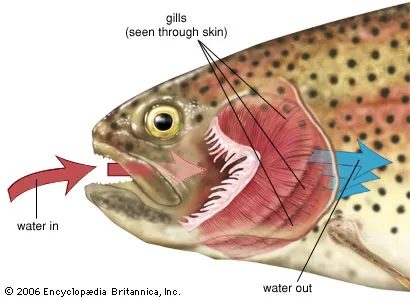
This diagram shows the location of fish gills and the direction of water flow used for gas exchange. It supports the idea that organisms use structural and flow adaptations (ventilation; and in many fish, countercurrent exchange) to help maintain a concentration difference across the exchange surface. Source
They must provide plenty of area for exchange, keep the barrier very short, and prevent the concentration difference from disappearing.
Large surface area to volume ratio
Why more area increases exchange
A large surface area to volume ratio means there is a lot of exchange surface compared with the amount of tissue or body that depends on it. This is important because diffusion happens at a surface. The larger the available area, the more gas molecules can cross at the same time.
Surface area to volume ratio: The amount of surface available for exchange compared with the volume of tissue or body that requires substances.
A surface with a high ratio is more efficient than a thick, bulky structure with little exposed area. This is why effective exchange surfaces are often spread out, folded, or divided into many small units. These arrangements increase the area available for diffusion without creating a large increase in volume.
This feature is especially important because internal tissues use oxygen continuously. If the area is too small, the amount of gas entering or leaving per second will be limited, even if the other properties are favorable. A large surface area to volume ratio helps ensure that exchange can keep up with demand.
Thin exchange surface
Why short diffusion distance matters
The exchange surface itself must be very thin. Gases move by diffusion, and diffusion is only rapid over short distances.
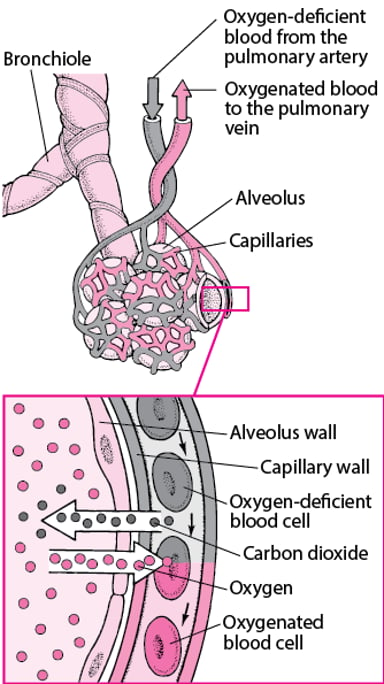
This diagram shows gas exchange at the alveolus–capillary interface, with oxygen diffusing from alveolar air into the blood and carbon dioxide diffusing from the blood into the alveolus. It reinforces that exchange occurs by diffusion across a very short barrier (the thin alveolar and capillary walls). Source
If the barrier between the environment and the cells is thick, oxygen and carbon dioxide take longer to cross it, so exchange becomes less efficient.
A thin surface reduces the distance each gas molecule must travel. In many biological systems, the exchange barrier is only one cell thick. This allows oxygen to reach cells more quickly, and carbon dioxide can leave just as rapidly.
The word thin does not just mean physically small. It specifically means that there is very little material for gases to pass through. Fewer cell layers, less extracellular material, and a short path between the two sides all help make diffusion faster.
If an exchange surface becomes thicker, gaseous exchange becomes slower. Even with a large area, a thick barrier can greatly reduce the overall effectiveness of the surface. This is why thickness and surface area must be considered together, not as separate ideas.
Maintained concentration difference
Why diffusion must continue
For diffusion to continue, there must be a concentration difference across the exchange surface.
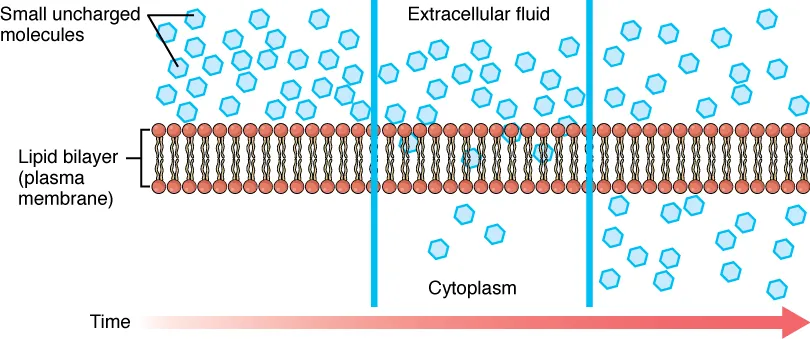
This figure illustrates diffusion down a concentration gradient, showing net movement from higher to lower concentration across a membrane until equilibrium is approached. It provides a clear visual definition of the “concentration difference/gradient” that drives gas exchange. Source
Oxygen must be at a higher concentration on one side than the other so it continues to move into the organism. Carbon dioxide must be at a higher concentration inside than outside so it continues to move out.
Concentration difference: A difference in the amount of a substance between two sides of a membrane or exchange surface.
If the concentrations on both sides become equal, there is no net movement of that gas by diffusion. This means exchange would slow down greatly or stop. An effective gas exchange surface therefore depends on a maintained concentration difference at all times.
This concentration difference is sustained because gases are constantly being used or produced by cells. Oxygen is removed from the internal side as it is used in respiration, while carbon dioxide is added as a waste product. At the outer side, conditions must also prevent gas concentrations from simply building up or being depleted next to the surface. The result is that diffusion can continue in the correct direction.
The phrase maintained concentration difference is important in exam answers. It shows that exchange is not a one-time movement, but a continuous process that depends on keeping the gradient steep enough for rapid diffusion.
How the three properties work together
These three features do not work independently. A very large surface area is less useful if the barrier is thick. A thin barrier is less useful if only a small area is available. Both of these are far less effective if the concentration difference is not maintained.
An effective gas exchange surface combines:
a large surface area to volume ratio, so many molecules can diffuse at once
a thin exchange surface, so the diffusion path is short
a maintained concentration difference, so net movement continues in the required direction
When all three are present, oxygen can enter quickly and carbon dioxide can leave quickly. This is the key principle behind all successful gas exchange surfaces, regardless of the organism.
Using precise biological language
In exam responses, it is important to be accurate with terminology.
Say diffusion rather than a general phrase such as “movement.”
Refer to a concentration difference or gradient rather than just “more gas.”
State large surface area to volume ratio, not only “large surface area,” because the ratio emphasizes efficiency.
Link each property to rapid gaseous exchange, not simply to “good transport.”
These details help show that you understand why the surface is effective, not just what its features are.
Practice Questions
State three properties of an effective gas exchange surface. (3 marks)
Large surface area to volume ratio (1)
Thin exchange surface / short diffusion distance (1)
Maintained concentration difference / steep concentration gradient (1)
Explain how each of the features of an effective gas exchange surface increases the rate of gaseous exchange. (6 marks)
Large surface area allows more gas molecules to diffuse at the same time (1)
Therefore increases the overall rate of exchange (1)
Thin exchange surface gives a short diffusion distance (1)
Therefore gases cross the surface more quickly (1)
Maintained concentration difference allows continued net diffusion (1)
Because gases move from higher concentration to lower concentration, and if the difference is lost diffusion slows or stops (1)
FAQ
Surface area increases with the square of length, while volume increases with the cube of length.
This means that when an organism gets bigger, its volume rises faster than its surface area. As a result, each unit of volume has relatively less surface available for exchange.
That is why larger organisms usually need highly specialized gas exchange surfaces rather than relying only on the body surface.
Yes. A very thin surface speeds up diffusion, but it also becomes more vulnerable.
Possible problems include:
tearing or physical damage
collapse if there is not enough support
greater water loss in air-exchanging organisms
less protection from infection or harmful substances
Biological systems therefore balance efficient diffusion with enough strength and protection to keep the surface functioning.
Equilibrium means the concentration of that gas is the same on both sides of the exchange surface.
At that point:
molecules still move randomly in both directions
movement continues
but there is no net diffusion
For gas exchange, this is a problem because there is no overall gain of oxygen or loss of carbon dioxide. Effective exchange surfaces must avoid equilibrium by keeping the concentration difference in place.
Highly active tissues respire faster, so they use oxygen more quickly and produce carbon dioxide more rapidly.
This means gas exchange surfaces must:
supply oxygen at a higher rate
remove carbon dioxide at a higher rate
maintain the concentration difference more effectively
If exchange cannot keep up, aerobic respiration becomes limited and performance falls. So the effectiveness of the gas exchange surface becomes especially important when metabolic demand is high.
A large surface area by itself does not guarantee efficient exchange. What matters is whether that area is enough for the amount of tissue that needs oxygen and produces carbon dioxide.
A structure could have a large area, but if it also has a very large volume, the area may still be insufficient overall.
The ratio compares supply potential with demand. That is why surface area to volume ratio is more informative than surface area alone when judging how effective a gas exchange surface is.
