

Edexcel Syllabus focus:
'Understand how the mammalian lung, including alveoli, ventilation and blood supply, is adapted for rapid gaseous exchange.'
Gas exchange in mammals must be fast enough to supply oxygen for respiration and remove carbon dioxide continuously. The lungs achieve this through specialized structure, constant ventilation, and an extensive blood supply.
The mammalian lung as a gas exchange system
The main function of the mammalian lung is to allow rapid exchange of oxygen and carbon dioxide between the air and the blood. Air travels through the trachea, bronchi, and bronchioles until it reaches the alveoli, which are the main sites of gaseous exchange.
Alveolus: A tiny air sac in the lungs where gases diffuse between air and blood.
The lungs are adapted so that diffusion happens quickly and continuously. These adaptations depend on three linked features named in the specification:
alveoli
ventilation
blood supply
These features work together. Alveoli provide the exchange surface, ventilation refreshes the air, and blood flow carries gases to and from the tissues.
Alveoli as specialized exchange surfaces
Very large surface area
The lungs contain millions of alveoli. Because each alveolus is very small but there are so many of them, together they create a very large total surface area. A large surface area allows more oxygen to diffuse into the blood and more carbon dioxide to diffuse out at the same time.
This is important because mammals have a high metabolic demand. Cells use oxygen in aerobic respiration, so the lungs must be able to absorb large amounts of oxygen quickly. The many alveoli greatly increase the area available for diffusion compared with a simple, smooth-walled lung.
The alveoli are also arranged in clusters, which helps pack a very large exchange surface into the relatively small volume of the chest cavity.
Thin exchange surface
Each alveolus has an alveolar epithelium that is only one cell thick.
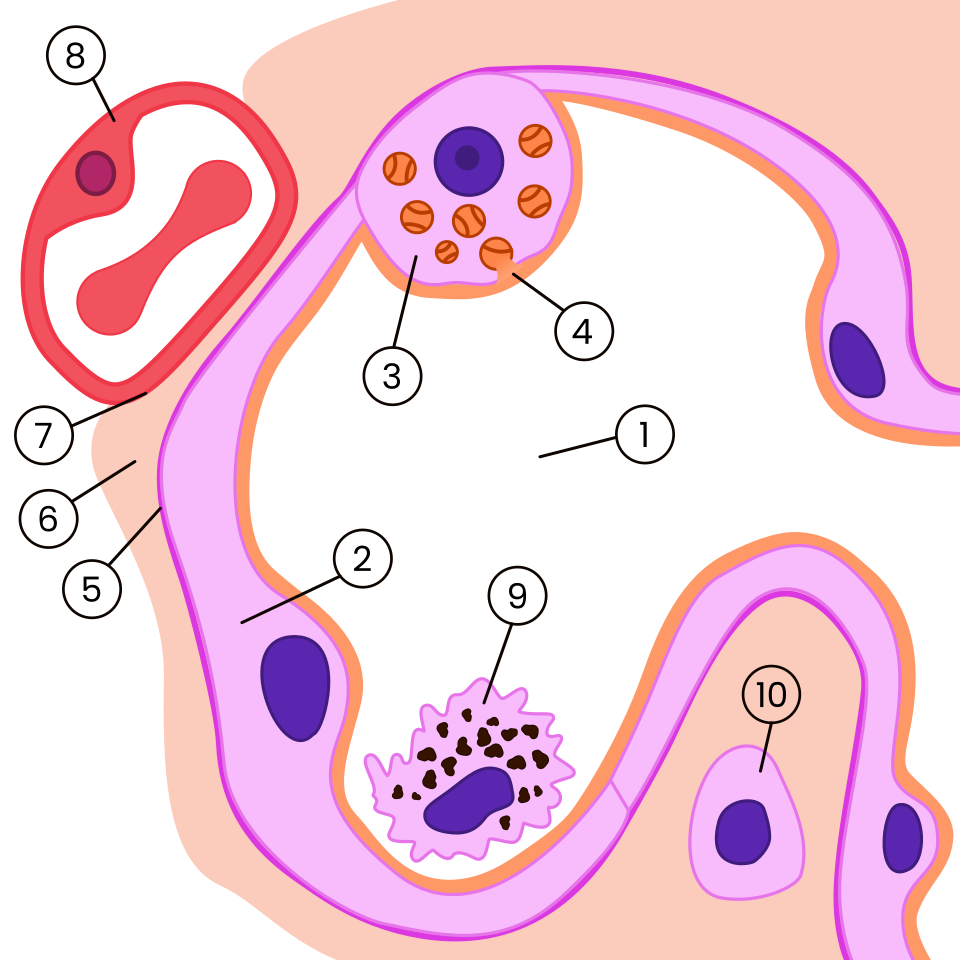
Cross-section of the alveolar–capillary membrane labeling the alveolar air space, type I pneumocyte, capillary endothelium, basement membranes, and surfactant layer. This visualization makes the ‘thin exchange surface’ adaptation concrete by showing how few layers separate alveolar air from blood in the capillary. Source
The capillaries surrounding the alveolus also have walls that are only one cell thick. This means the distance between the air in the alveolus and the blood in the capillary is extremely short.
A short diffusion distance allows gases to move rapidly:
oxygen diffuses from alveolar air into the blood
carbon dioxide diffuses from the blood into the alveolus
The thinness of both surfaces is a major adaptation for rapid exchange. If the barrier were thicker, diffusion would be slower.
Moist lining
The alveoli have a moist lining. This is important because gases must dissolve before they can diffuse across cell membranes. Oxygen dissolves in the moisture on the alveolar surface and then diffuses across the alveolar wall and capillary wall into the blood.
Without moisture, gas exchange would be much less efficient. However, the lining is very thin, so it does not create a large barrier to diffusion.
Ventilation and concentration gradients
Ventilation keeps air moving
Ventilation is the movement of air into and out of the lungs. It continually replaces the air in the alveoli.
Ventilation: The movement of air into and out of the lungs.
Ventilation is essential because it helps maintain a steep concentration gradient for both gases:
alveolar air remains relatively high in oxygen
alveolar air remains relatively low in carbon dioxide
This means oxygen continues to diffuse from the alveoli into the blood, while carbon dioxide continues to diffuse from the blood into the alveoli.
If air in the alveoli was not refreshed, oxygen concentration would fall and carbon dioxide concentration would rise. Diffusion would then slow down because the concentration differences would become smaller.
Why constant air renewal matters
The body is always using oxygen and producing carbon dioxide. Because of this, the air in the lungs must be renewed continuously rather than occasionally. Breathing ensures that the alveoli do not become stagnant spaces where diffusion quickly reaches equilibrium.
Ventilation therefore supports rapid gaseous exchange by preventing the buildup of carbon dioxide in alveolar air and preventing a large drop in oxygen concentration. The greater the difference in concentration between alveolar air and blood, the faster diffusion can occur.
The branching system of the airways also helps distribute air to many alveoli efficiently, so a large proportion of the lung surface can take part in exchange.
Blood supply and rapid gaseous exchange
Dense capillary network
Each alveolus is surrounded by a dense network of capillaries.
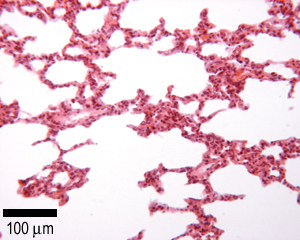
Diagram of an alveolar sac showing multiple alveoli and the dense capillary network wrapped around them. It reinforces how short diffusion distances and a rich blood supply help maintain steep oxygen and carbon dioxide gradients across the exchange surface. Source
This gives the alveolus a rich blood supply and brings blood very close to the air in the alveolar space.
A good blood supply helps in several ways:
it brings deoxygenated blood to the alveoli
it removes oxygenated blood quickly
it delivers blood containing carbon dioxide for removal
it helps maintain steep concentration gradients
Because blood is constantly flowing through the capillaries, oxygen that enters the blood is carried away. This prevents oxygen from building up next to the alveolar wall. At the same time, fresh deoxygenated blood keeps arriving with a lower oxygen concentration and a higher carbon dioxide concentration.
Continuous exchange between air and blood
The interaction between ventilation and blood flow is what makes the mammalian lung so effective. Ventilation refreshes the air side of the exchange surface, and blood flow refreshes the blood side.
As a result:
oxygen concentration stays higher in alveolar air than in the blood
carbon dioxide concentration stays higher in the blood than in alveolar air
This allows diffusion to continue rapidly in the correct directions.
The capillaries are also narrow, so red blood cells pass through very close to the capillary wall. This reduces the distance between the blood and the air in the alveolus even further. Together, the large number of alveoli, their thin moist walls, constant ventilation, and rich capillary supply make the mammalian lung highly adapted for rapid gaseous exchange.
Practice Questions
State two features of alveoli that make them efficient for gaseous exchange. (2 marks)
Large surface area due to many alveoli (1)
Walls are one cell thick / very thin exchange surface (1)
Accept: moist lining (1) if given instead of one of the above
Explain how alveoli, ventilation, and blood supply adapt the mammalian lung for rapid gaseous exchange. (5 marks)
Many alveoli provide a large surface area for diffusion (1)
Alveolar wall and capillary wall are each one cell thick, giving a short diffusion distance (1)
Moist alveolar lining allows gases to dissolve before diffusing (1)
Ventilation refreshes alveolar air, maintaining a high oxygen concentration and low carbon dioxide concentration in the alveoli (1)
Rich capillary blood supply removes oxygen and brings carbon dioxide, maintaining steep concentration gradients (1)
FAQ
Alveoli are helped by two important features:
elastic fibers in lung tissue help them stretch during inhalation and recoil during exhalation
surfactant reduces surface tension inside the alveoli
Without surfactant, the moist inner surfaces would attract strongly and make collapse much more likely, especially in small alveoli.
This matters because collapsed alveoli would reduce the available surface area for gas exchange.
A sac-like shape helps pack many exchange surfaces into a small volume. This creates an enormous total surface area inside the lungs.
It also allows each alveolus to be surrounded closely by capillaries, so blood can be brought near the air space from many directions.
In addition, the rounded shape helps spread forces more evenly across the wall, which supports repeated expansion and recoil during breathing.
During exercise:
breathing rate increases
breathing depth increases
blood flow through the lungs increases
These changes refresh alveolar air more quickly and move blood past the alveoli faster. As a result, concentration gradients can be maintained even when muscles are using much more oxygen and producing more carbon dioxide.
The lungs therefore meet higher demand without needing a different gas exchange surface.
A very thin moist lining is useful, but excess fluid is a problem because it increases the distance gases must move through.
This slows diffusion of oxygen into the blood. Oxygen transfer is affected more strongly than carbon dioxide transfer because oxygen is less soluble.
If fluid builds up, gas exchange becomes less efficient and the body may not receive enough oxygen, especially during activity.
The close contact reduces the distance between air and blood to a minimum. Red blood cells can pass through capillaries almost pressed against the capillary wall, which speeds diffusion.
This arrangement also means a large volume of blood can be exposed to alveolar air very quickly.
The result is fast uptake of oxygen and rapid removal of carbon dioxide across a very short path.

