

CIE Syllabus focus:
'Know the structure of atoms in terms of protons, neutrons and electrons, including the relative mass and relative charge of each subatomic particle.'
Atoms are built from three subatomic particles. Understanding where these particles are found and how their masses and charges compare is the foundation for all later work in chemistry.
The atom as a structured particle
An atom is not a solid, featureless sphere. It has internal structure, made from protons, neutrons, and electrons.
Atom: The smallest particle of an element that can exist while retaining the chemical identity of that element.
In simple atomic structure, the atom has a tiny central nucleus and particles outside it.
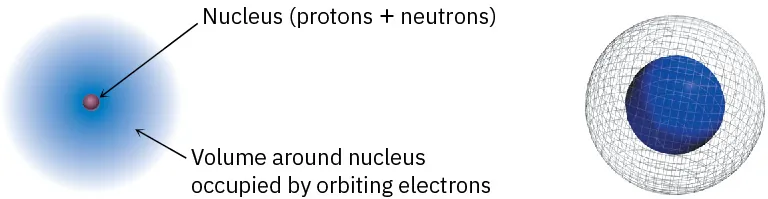
Schematic diagram of atomic structure showing a dense central nucleus surrounded by electrons, paired with a 3D electron-density surface view. The figure emphasizes the spatial separation between nucleus and electrons, and why the nucleus contains nearly all of the atom’s mass. Source
The nucleus contains protons and neutrons. Electrons occupy the space around the nucleus. This means the three subatomic particles are not all found in the same place. Because protons and neutrons are packed into the nucleus, this small central region contains almost all of the atom’s mass.
The nucleus is the dense central part of the atom.
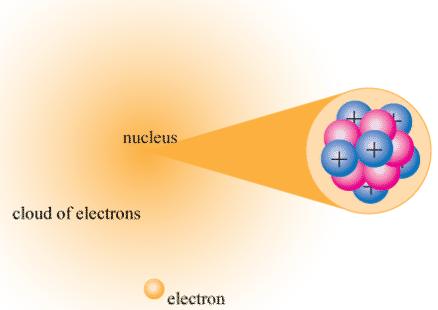
Diagram of the nuclear atom highlighting the small central nucleus and the surrounding electron cloud/region where electrons are found. It supports the exam point that positive charge (protons) is confined to the nucleus, while electrons occupy most of the atom’s volume. Source
It is positively charged because it contains protons, which each have a positive charge. Neutrons in the nucleus do not affect the charge because they have no charge. Electrons are negatively charged and are found outside the nucleus, attracted to it by electrostatic attraction. The attraction between the negative electrons and the positive nucleus helps hold the atom together.
The three subatomic particles
Protons
A proton is a positively charged subatomic particle found in the nucleus.
Relative charge: +1
Relative mass: 1
Location: nucleus
Because protons carry positive charge, they make the nucleus positively charged overall. In chemistry, the proton is used as a useful reference point when comparing the mass and charge of the other subatomic particles.
Neutrons
A neutron is an uncharged subatomic particle found in the nucleus.
Relative charge: 0
Relative mass: 1
Location: nucleus
Neutrons add mass to the atom but do not add charge. At this level, the neutron is taken to have the same relative mass as a proton, even though their actual masses are not exactly identical.
Electrons
An electron is a negatively charged subatomic particle found outside the nucleus.
Relative charge: -1
Relative mass:
Location: outside the nucleus
Electrons have a much smaller mass than protons or neutrons. Their relative mass is so small that, in many comparisons, it is treated as negligible. However, electrons still matter greatly because their negative charge is essential to atomic structure.
Relative mass and relative charge
When chemists compare subatomic particles, they often use relative values rather than actual masses in kilograms or charges in coulombs.
Relative values make comparison easier because the true values are extremely small. Actual values exist, but relative values are much easier to use when describing atomic structure.
Relative charge: The charge of a particle compared with the charge on a proton, which is taken as +1.
Using this scale, a proton has charge +1, an electron has charge -1, and a neutron has charge 0.
Relative mass: The mass of a particle compared with the mass of a proton, which is taken as approximately 1.
Using this scale, both the proton and neutron are assigned a relative mass of 1, while the electron has a relative mass of . This shows clearly that nearly all of an atom’s mass comes from particles in the nucleus.
What these values tell you about atomic structure
The relative charges and masses are not just facts to memorize. They explain important features of the atom and help you describe it accurately in exam answers.
Since protons and electrons have equal but opposite charges, their charges balance when present in matching amounts.
Since neutrons have no charge, they change mass without changing charge.
Since protons and neutrons each have relative mass 1, they account for almost all the atom’s mass.
Since electrons have a very small relative mass, they contribute very little to the total mass of an atom.
This is why the nucleus is both the heaviest part of the atom and the part that contains all of its positive charge. The space outside the nucleus contains electrons, which are much lighter but still essential as negatively charged particles.
Key facts you should know accurately
For Edexcel A-Level Chemistry, you should be able to recall the properties of each subatomic particle precisely. Examiners often expect these values to be stated exactly, especially the electron’s very small relative mass and the neutron’s zero charge.
Proton: found in the nucleus, relative charge +1, relative mass 1
Neutron: found in the nucleus, relative charge 0, relative mass 1
Electron: found outside the nucleus, relative charge -1, relative mass
You should also be able to describe an atom as having:
a central nucleus
protons and neutrons inside the nucleus
electrons outside the nucleus
Common misunderstandings
Some errors appear often in early atomic structure questions.
A neutron is not negative. It has no charge.
An electron is not found in the nucleus.
A proton and neutron do not have zero mass; both have relative mass 1.
The electron does have mass, but it is much smaller than the mass of a proton or neutron.
Relative mass and relative charge are comparison values, not the actual masses and charges in standard SI units.
If you learn the location, charge, and relative mass of each subatomic particle together, atomic structure becomes much easier to remember accurately.
Practice Questions
State the relative charge and relative mass of an electron.
[2 marks]
Relative charge = -1 (1)
Relative mass = (1)
Describe the structure of an atom in terms of protons, neutrons, and electrons. Include the location of each particle and state the relative charge and relative mass of each one.
[6 marks]
Atom has a central nucleus (1)
Nucleus contains protons and neutrons (1)
Electrons are found outside the nucleus (1)
Proton: relative charge +1 and relative mass 1 (1)
Neutron: relative charge 0 and relative mass 1 (1)
Electron: relative charge -1 and relative mass (1)
FAQ
Its relative mass is only $1/1836$ compared with a proton. That means electrons add very little to the total mass of an atom.
In most chemistry at this level, ignoring that tiny contribution makes almost no practical difference. In very precise physics measurements, though, electron mass is still important.
This is a simplification that makes atomic structure easier to compare and remember. Their real masses are very close, so at A-Level the difference is not usually significant.
The neutron is actually slightly more massive than the proton, but the gap is too small to matter in most introductory chemistry questions.
It does not mean electrons are fixed like tiny planets on rigid tracks. It means they occupy regions of space around the nucleus.
At this stage, the key idea is simply that electrons are not in the nucleus. More detailed models of where electrons are likely to be found are studied later.
The nucleus contains most of the mass, but it occupies only a very small central region. Electrons are found in the space around it.
So the atom’s mass is concentrated in the middle, while much of its size comes from the region occupied by electrons.
A simple charge model shows attraction between electrons and the nucleus, but real electrons do not behave like tiny balls falling inward.
They exist in allowed energy states around the nucleus. That is why atoms can remain stable instead of collapsing, although the full explanation belongs to later atomic theory.
