

CIE Syllabus focus:
'Know the meanings of atomic (proton) number and mass number, and determine the number of protons, neutrons and electrons in atoms, molecules and ions.'
Accurate particle counting is foundational in chemistry because formulas, ionic charges, and nuclear notation all depend on distinguishing protons, neutrons, and electrons in atoms and combinations of atoms.
Atomic number and mass number
Every atom has a nucleus containing protons and neutrons, with electrons found outside the nucleus.
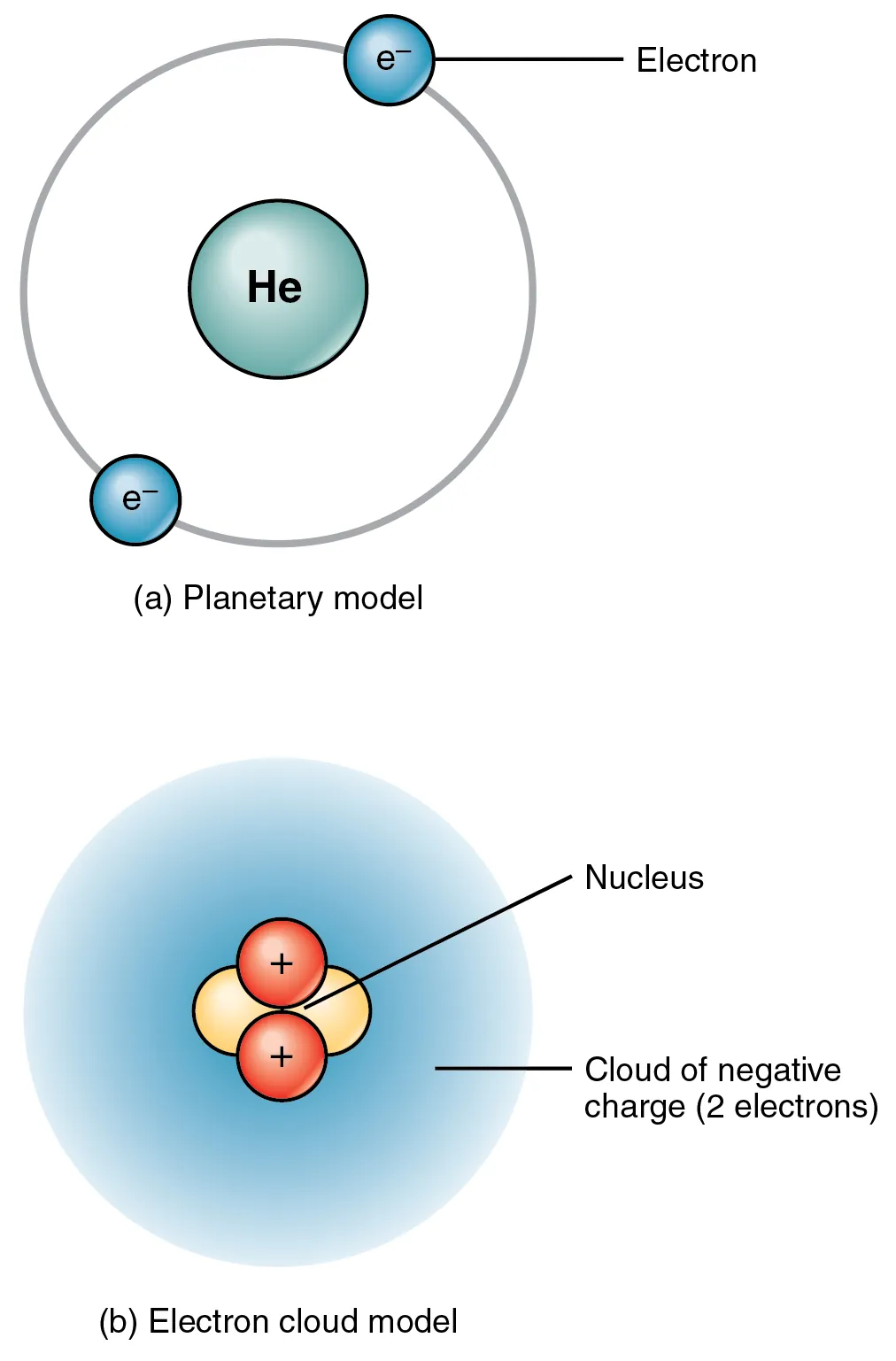
This figure contrasts a simple ‘planetary’ picture of electrons with an electron-cloud model, while keeping the nucleus (protons and neutrons) central. It reinforces the idea that mass number counts nuclear particles only, whereas electrons occupy space outside the nucleus and determine charge balance in neutral atoms and ions. Source
To describe an atom clearly, chemists use two important numbers: the atomic number and the mass number.
Atomic number: The number of protons in the nucleus of an atom.
The atomic number is sometimes called the proton number. It identifies the element, because every atom of a given element has the same number of protons. If the number of protons changes, the element changes.
Mass number: The total number of protons and neutrons in the nucleus of an atom.
The mass number counts nucleons only, so electrons are not included. This is important because electrons have a very small mass compared with protons and neutrons, and mass number is based on particles in the nucleus.
Atoms are often written in nuclide notation as '', where:
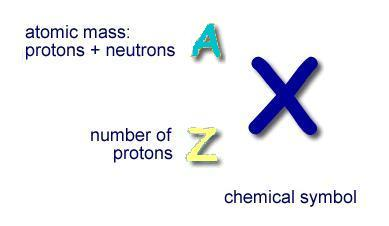
This diagram summarizes standard nuclide notation: the chemical symbol , the atomic number (protons), and the mass number (protons + neutrons). It helps students see at a glance why neutron number is found by , and why electrons are not part of . Source
'' is the mass number
'' is the atomic number
'' is the chemical symbol
From these two numbers, you can work out the number of neutrons in one atom.
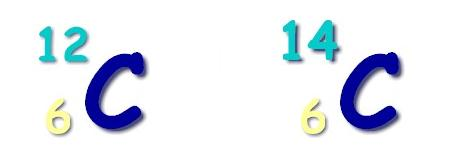
This side-by-side comparison shows two isotopes of carbon written in nuclide notation, emphasizing that stays constant while changes between isotopes. The visual makes it straightforward to infer that the neutron number differs even though the element (proton number) is unchanged. Source
= number of neutrons in one atom
= mass number
= atomic number
This relationship only applies to a single atom, because atomic number and mass number are properties of individual atoms, not of whole compounds.
Determining particle counts in atoms
Neutral atoms
A neutral atom has no overall charge. This means the total positive charge from protons is balanced by the total negative charge from electrons.
For any neutral atom:
number of protons = atomic number
number of electrons = atomic number
number of neutrons = mass number minus atomic number
This gives a simple method:
read the atomic number to find protons
use the lack of charge to find electrons
subtract atomic number from mass number to find neutrons
When a symbol is written without a charge, assume the species is neutral unless told otherwise.
Ions
An ion is formed when an atom or group of atoms gains or loses electrons.
Ion: A charged species formed when electrons are gained or lost.
When an ion forms, the nucleus does not change. That means:
the number of protons stays the same
the number of neutrons stays the same
only the number of electrons changes
For ions:
a positive ion has lost electrons
a negative ion has gained electrons
So:
for a '' ion, electrons = protons minus 1
for a '' ion, electrons = protons minus 2
for a '' ion, electrons = protons plus 1
for a '' ion, electrons = protons plus 2
The charge tells you the difference between the number of protons and electrons. A positive charge means there are fewer electrons than protons. A negative charge means there are more electrons than protons.
Determining particle counts in molecules
A molecule contains two or more atoms bonded together. To find the total number of subatomic particles in a molecule, you must consider every atom in the formula.
Total protons, neutrons, and electrons
For a neutral molecule:
find the number of protons, neutrons, and electrons in one atom of each element
use the formula to see how many of each atom are present
multiply each particle count by the number of that atom
add the totals
In a neutral molecule, the total number of electrons equals the total number of protons, because the overall charge is zero.
A formula subscript applies only to the symbol immediately before it. If more than one type of atom is present, each must be counted separately before totals are added.
It is important not to treat the mass number as if it belongs to the whole molecule. Mass number refers to one atom only. A molecule does not have one single atomic number or one single mass number in the same way an atom does.
Determining particle counts in ions made of more than one atom
Some ions contain more than one atom, such as polyatomic ions. The method is similar to that for molecules, but the overall charge must be included when counting electrons.
Use this approach:
calculate the total number of protons from all atoms present
calculate the total number of neutrons from all atoms present
calculate the total number of electrons for the neutral set of atoms
adjust the electron total using the overall ionic charge
For a polyatomic ion:
a positive overall charge means electrons have been removed
a negative overall charge means electrons have been added
The key idea is that ionic charge changes only the electron count. Proton count and neutron count are fixed by the atoms present.
Common mistakes to avoid
Confusing atomic number with mass number
Atomic number counts only protons. Mass number counts protons and neutrons.Including electrons in the mass number
Electrons are not part of the nucleus, so they are not included.Changing the number of protons when an ion forms
Ion formation involves gaining or losing electrons only.Forgetting to multiply by subscripts in molecules or polyatomic ions
Particle counts must match the full formula.Assuming a charge changes neutron number
Charge affects electrons, not neutrons.
Practice Questions
An atom of aluminum has atomic number 13.
State the number of:
(a) protons
(b) electrons in a neutral aluminum atom
(2 marks)
(a) 13 protons = 1 mark
(b) 13 electrons = 1 mark
An oxide ion is written as .
(a) State the number of protons, neutrons, and electrons in this ion. (3 marks)
A molecule of ammonia, , is formed from one nitrogen-14 atom and three hydrogen-1 atoms.
(b) Determine the total number of protons in one molecule of . (1 mark)
(c) Determine the total number of neutrons in one molecule of . (1 mark)
(5 marks)
(a) protons = 8 (1 mark)
(a) neutrons = 10 (1 mark)
(a) electrons = 10 (1 mark)
(b) total protons = 10 (1 mark)
(c) total neutrons = 7 (1 mark)
FAQ
You can still find the number of protons from the atomic number in the Periodic Table.
However, you cannot know the exact number of neutrons unless a specific mass number is given for that atom.
For example:
the symbol $Cl$ tells you chlorine has 17 protons
it does not tell you whether the atom has 18 neutrons or 20 neutrons
So exact neutron counts require a stated nuclide, such as $^{35}_{17}Cl$.
First count the atoms correctly:
$Ca(NO_3)_2$ contains 1 calcium atom
2 nitrogen atoms
6 oxygen atoms
The subscript outside the parentheses multiplies everything inside them.
After that:
find the particles for one atom of each element
multiply by the number of those atoms
add the totals
This is especially important in polyatomic ions and salts, where missing the bracket multiplier gives the wrong answer.
Yes. Species with the same number of electrons are called isoelectronic.
For example:
$Ne$ has 10 electrons
$Na^+$ has 10 electrons
$O^{2-}$ has 10 electrons
They are not the same species because they still have different numbers of protons.
So when identifying a species, electron count alone is not enough. You must also know the atomic number or the chemical symbol.
This layout separates nuclear information from electronic information.
left side: atomic number and mass number describe the nucleus
right side: the charge shows whether electrons have been gained or lost
This makes the symbol easier to read:
the element identity comes from the proton number
the mass number gives total nucleons
the charge shows the electron imbalance
It is a compact way to show three different pieces of information at once.
Ordinary chemical reactions do not change atomic number, because the nucleus is unchanged.
They usually do not change mass number either, since protons and neutrons remain in the nucleus.
Chemical reactions involve:
breaking and making bonds
rearranging electrons
Changes to atomic number or mass number happen in nuclear processes, not standard chemical reactions. That is why an element keeps its identity during normal reactions, even when it forms ions or compounds.
