

CIE Syllabus focus:
'Understand isotopes as atoms of the same element with different numbers of neutrons, and consider how atomic models have developed as new experimental evidence became available.'
Atoms were once thought to be simple, indivisible particles. This topic links two major ideas: isotopes show that atoms of one element can differ in mass, and atomic models changed as evidence improved.
Isotopes
Atoms of the same element always have the same number of protons. However, they can contain different numbers of neutrons in the nucleus.
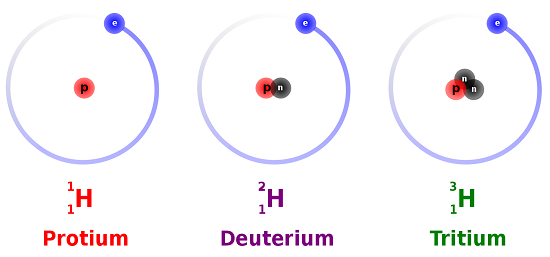
Diagram comparing hydrogen’s three common isotopes (protium, deuterium, and tritium) by showing their nuclei and electrons. It highlights that the proton number stays the same (so the element is still hydrogen) while the neutron number changes, increasing mass number. Source
Isotope: Atoms of the same element that have the same number of protons but different numbers of neutrons.
This means isotopes are still atoms of the same element, because the proton number has not changed. If the proton number changes, the element changes as well.
Isotopes of an element usually have very similar chemical properties. This is because chemical behavior depends mainly on the arrangement of electrons, and neutral atoms of isotopes have the same number of electrons. The main difference between isotopes is their mass, since neutrons add mass to the nucleus. Because of this, some physical properties may vary slightly, even though the chemical identity remains the same.
The existence of isotopes was scientifically important because it showed that atoms of the same element are not always identical in every way. Early atomic theory treated all atoms of a given element as the same, but isotopes showed that this idea was too simple. They provided evidence that the internal structure of atoms had to be understood more carefully.
Scientific models and evidence
An atomic model is a scientific description used to explain the structure of the atom. A model is accepted only as long as it fits the available evidence. When observations cannot be explained by the current model, scientists must test new ideas and improve the model.
This process is central to chemistry. Atomic theory did not appear all at once. Instead, it developed in stages, with each stage based on experimental evidence. New discoveries did not just add detail; sometimes they completely changed how scientists pictured the atom.
Development of atomic models
Dalton’s model
John Dalton suggested that matter is made of tiny, solid, indivisible particles called atoms. In his model:
atoms could not be broken into smaller parts
atoms of the same element were identical
atoms of different elements were different
Dalton’s model was useful because it helped explain why elements combine in fixed ratios. However, later discoveries showed that atoms are divisible and contain smaller particles. The discovery of isotopes also showed that atoms of one element are not always identical in mass. Dalton’s model was therefore an important starting point, but it was incomplete.
Thomson’s plum pudding model
J. J. Thomson investigated cathode rays and found evidence for negatively charged particles later called electrons. This was a major breakthrough because it proved that atoms contain smaller particles and are not indivisible.
Thomson proposed the plum pudding model:
the atom was a sphere of positive charge
negative electrons were embedded within this positive sphere
the overall atom was neutral
This model explained the presence of electrons, but it did not include a nucleus. It was accepted for a time because it matched the evidence then available.
Rutherford’s nuclear model
Rutherford’s team carried out the alpha scattering experiment using a thin sheet of gold foil.
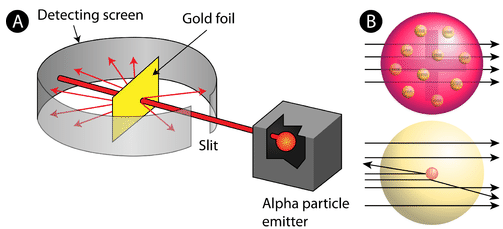
Schematic of Rutherford’s gold foil experiment showing an alpha source aimed at thin metal foil and a surrounding detection screen. The diagram visualizes why ‘mostly straight through’ implies empty space, while rare large-angle deflections imply a small, dense, positively charged nucleus. Source
Their observations were surprising:
most alpha particles passed straight through
some were deflected by small angles
a very small number were deflected through large angles or bounced back
These results could not be explained by the plum pudding model. Rutherford concluded that:
most of the atom is empty space
nearly all the mass is concentrated in a tiny central nucleus
the nucleus is positively charged
electrons are outside the nucleus
This was a major change in atomic theory. The positive charge was no longer thought to be spread throughout the atom. Instead, it was concentrated in the nucleus.
Bohr’s model
Rutherford’s model explained the nucleus, but it did not explain how electrons were arranged. Niels Bohr improved the model by suggesting that electrons occupy fixed energy levels around the nucleus.
In Bohr’s model:
electrons can exist only in certain allowed energy levels
electrons move between levels by gaining or losing fixed amounts of energy
This helped explain line spectra, where atoms emit specific wavelengths of light rather than a continuous range.
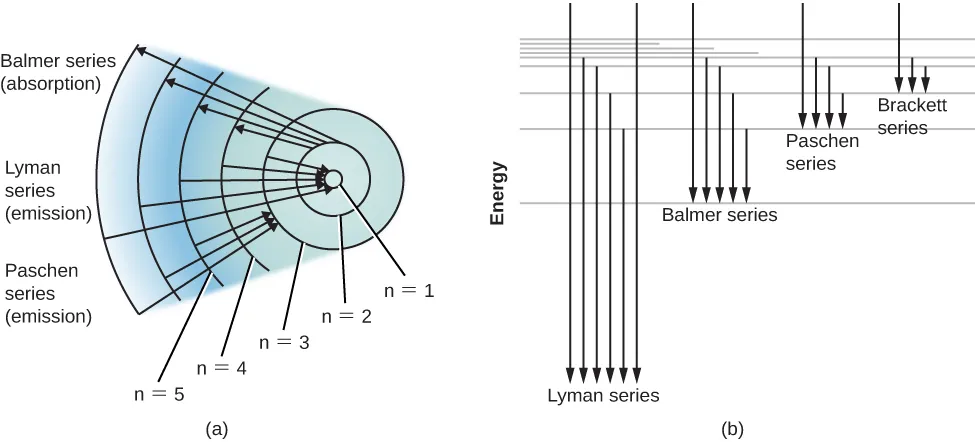
Energy-level diagram for hydrogen showing allowed electron energy levels and example transitions between them. The labeled series (e.g., Lyman and Balmer) link discrete energy changes to emission/absorption at specific wavelengths, illustrating why spectra appear as lines rather than a continuum. Source
The spectra showed that electron energies are not random. Bohr’s model therefore brought atomic theory closer to the modern view by giving structure to the arrangement of electrons.
Chadwick and the neutron
Even after the proton was identified, there was still a problem. The nucleus contained positive charge, but the measured mass of atoms was greater than could be explained by protons alone. Also, scientists needed an explanation for isotopes: how could atoms of the same element have different masses if they had the same number of protons?
James Chadwick discovered the neutron, a neutral particle in the nucleus. This was crucial because it explained both problems at once:
neutrons add mass to the atom
neutrons do not change the element, because they have no charge
atoms of the same element can contain different numbers of neutrons, producing isotopes
The discovery of the neutron completed the basic nuclear model needed to explain isotopes properly.
How isotopes fit the modern atomic model
In the modern atomic picture for this level:
the nucleus contains protons and neutrons
electrons are found outside the nucleus
an element is identified by its number of protons
isotopes are different atoms of the same element because they have the same proton number
isotopes have different masses because they contain different numbers of neutrons
So, the idea of isotopes depends directly on the development of atomic theory. Isotopes make sense only when the atom is understood as a structure containing subatomic particles, especially neutrons in the nucleus.
Practice Questions
Define the term isotope. (2 marks)
1 mark for stating that isotopes are atoms of the same element or have the same number of protons
1 mark for stating that they have different numbers of neutrons
Describe how experimental evidence led to changes in the atomic model from Dalton’s model to the model including the neutron. (5 marks)
1 mark: Dalton proposed atoms as solid, indivisible particles
1 mark: Thomson’s work gave evidence for electrons, showing atoms contain smaller particles
1 mark: Thomson proposed the plum pudding model
1 mark: Rutherford’s alpha scattering experiment showed a small, dense, positively charged nucleus and that most of the atom is empty space
1 mark: Bohr proposed electrons in fixed energy levels or shells
1 mark: Chadwick discovered the neutron, explaining extra atomic mass or the existence of isotopes
Maximum 5 marks.
FAQ
Their electron arrangements are the same, so their overall chemistry is very similar.
However, atoms with different masses move and vibrate slightly differently. This can affect bond breaking and bond forming, especially when very light atoms such as hydrogen are involved. This is called an isotope effect.
For most reactions involving heavier elements, the difference is very small.
The neutron has no charge, so it is not attracted to positive plates or deflected by electric or magnetic fields.
That made it harder to detect directly. Charged particles often reveal themselves through clear paths or deflections, but neutrons have to be detected indirectly through the effects they have on other particles.
This is one reason the neutron was discovered later than the electron.
The foil had to be extremely thin so that most alpha particles would pass through after interacting with only a small number of atoms.
If the metal had been thick, many particles would have been absorbed or scattered several times, making the results much harder to interpret.
Gold was useful because it can be hammered into very thin sheets without breaking.
Hydrogen has only one electron, so its behavior is much simpler to model.
Bohr’s idea of fixed energy levels matched hydrogen’s line spectrum very well. In atoms with many electrons, electron-electron repulsion makes the situation more complicated.
That is why Bohr’s model was an important step forward, but not the final atomic model.
No. Dalton’s theory was not useless; it was just incomplete.
He was correct that matter is made of atoms and that different elements contain different kinds of atoms. What changed was the idea that all atoms of one element are identical in every respect.
Isotopes showed that atoms of the same element can differ in neutron number and mass while still remaining the same element.
