

CIE Syllabus focus:
'Know that electronegativity is an atom's ability to attract bonding electrons, and understand that ionic and covalent bonding are extremes of a continuum determined by electronegativity differences.'
Electronegativity explains how strongly different atoms pull on a shared pair of electrons. It is the key idea behind seeing ionic and covalent bonding not as separate categories, but as opposite ends of one scale.
Electronegativity
Electronegativity is used when atoms are bonded together. It describes the attraction an atom has for the bonding electrons in a covalent bond. A more electronegative atom pulls the shared electron pair more strongly toward itself.
Electronegativity: The ability of an atom to attract the bonding electrons in a covalent bond.
Electronegativity is a relative measure. It does not tell you the actual charge on an atom, and it does not have units in the way mass or energy do. Instead, it allows you to compare atoms in a bond and decide which atom has the stronger pull on the shared electrons.
This idea matters because bonding electrons are negatively charged. If one nucleus attracts them more strongly than the other nucleus does, the electron density is no longer shared equally. That change in electron distribution is what links covalent bonding to ionic bonding.
What affects electronegativity?
An atom’s electronegativity depends mainly on how strongly its nucleus can attract a bonding pair and how far that pair is from the nucleus. Three important factors are:
Nuclear charge: more protons usually mean stronger attraction
Distance from the nucleus: bonding electrons farther away are less strongly attracted
Shielding: inner electrons reduce the pull felt by outer electrons
These factors explain the main periodic trends in electronegativity:
Across a period, electronegativity generally increases
Down a group, electronegativity generally decreases
Across a period, nuclear charge increases while shielding does not increase very much, so atoms attract bonding electrons more strongly. Down a group, atoms become larger and shielding increases, so the nucleus has less attraction for bonding electrons. This is why fluorine is one of the most electronegative elements, while metals such as sodium are much less electronegative.
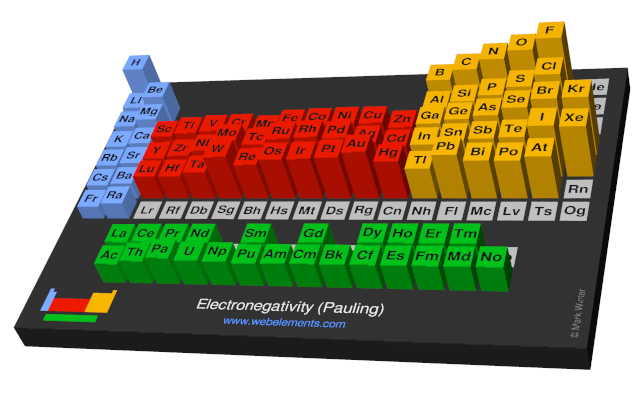
A periodic-table heatscale (with a 0–4 Pauling key) highlights the overall electronegativity gradient across the table. The strongest electron-attractors (top-right) are visually separated from electropositive metals (left and lower regions), making the trend easy to remember. This supports quick qualitative predictions of bond polarity before using exact numerical values. Source
Electronegativity Differences and Bond Type
The most important use of electronegativity at this level is to compare the electronegativities of two bonded atoms. The difference in electronegativity tells you how equally or unequally the bonding electrons are shared.
A useful way to think about this is as a continuum:
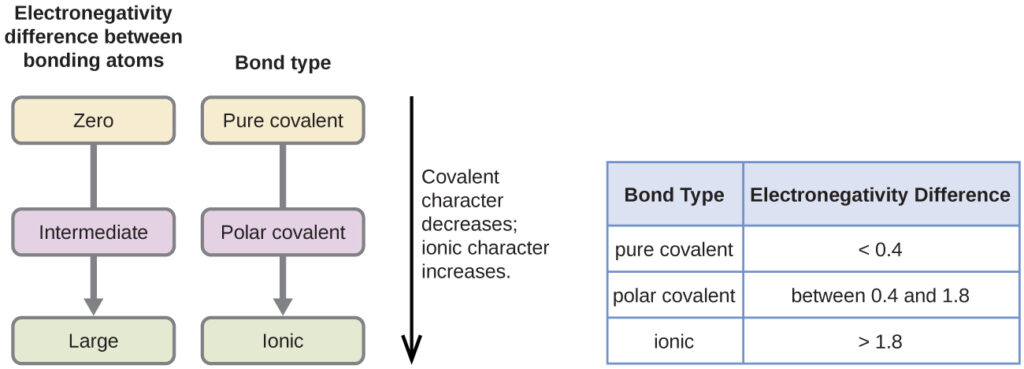
A continuum diagram connects electronegativity difference () to bond character, showing how increasing shifts bonding from pure covalent toward ionic. The figure emphasizes that “polar covalent” occupies the middle of the scale, reflecting unequal electron sharing rather than complete electron transfer. The included threshold ranges provide a practical (approximate) guide for classifying bonds while still reinforcing that real bonding changes gradually. Source
If the difference is zero, the bonding electrons are shared equally
If the difference is small, the electrons are shared almost equally
If the difference is moderate, the electrons are shared unequally
If the difference is very large, electron transfer is a better model and the bond is mainly ionic
The covalent end
At the covalent end of the continuum, atoms share electrons. In a pure covalent bond, the sharing is equal. This happens when the two bonded atoms have the same electronegativity, as in molecules made from identical atoms such as H2 or Cl2.
In these bonds, neither atom has a greater attraction for the bonding electrons than the other. The shared pair lies between the two nuclei, and the bond is fully described as covalent.
Between the extremes
Most bonds between different elements are not pure covalent. One atom usually attracts the bonding electrons more strongly than the other. The electrons are still shared, so the bond is still covalent, but the sharing is unequal. This means the bond has some ionic character.
For example, in hydrogen chloride, chlorine is more electronegative than hydrogen. Chlorine attracts the bonding electrons more strongly, so the bond is not shared perfectly evenly. This bond sits between the pure covalent and ionic extremes.
The ionic end
When the electronegativity difference becomes very large, the attraction of one atom for electrons is so much greater that electron transfer is the best simple description. One atom loses electrons and another gains them, forming oppositely charged ions. The strong electrostatic attraction between these ions is then described as ionic bonding.
A compound such as sodium chloride is much closer to the ionic end of the continuum than a molecule such as hydrogen chloride. Sodium has low electronegativity, while chlorine has much higher electronegativity, so the difference between them is large.
Why it is called a continuum
The word continuum is important. It means there is no sharp dividing line where all bonds suddenly change from covalent to ionic. Instead, bond character changes gradually as the electronegativity difference changes.
This means that ionic and covalent bonding are best thought of as ideal extremes. Real substances often lie somewhere between them. A bond can be mostly covalent with a little ionic character, or mostly ionic with a little covalent character.
Using the Continuum in Chemistry
When explaining bond type, always link your answer to the difference in electronegativity between the bonded atoms. A larger difference means a stronger pull by one atom on the bonding electrons, so the bond becomes more uneven in electron distribution and moves toward the ionic end of the continuum.
A clear explanation usually includes these ideas:
compare the electronegativities of the two atoms
state whether the bonding electrons are shared equally or unequally
link a larger difference to greater ionic character
recognize that ionic and covalent are extremes, not completely separate categories
A useful pattern is that bonds between two nonmetals are usually covalent because their electronegativities are often closer together, while bonds between a metal and a nonmetal are often ionic because the difference is usually larger. However, this is a general trend, not an absolute rule, so the best explanation is always based on electronegativity difference itself.
Practice Questions
Define electronegativity and identify which atom in HCl attracts the bonding electrons more strongly. (2 marks)
Defines electronegativity as the ability of an atom to attract bonding electrons / the shared pair in a covalent bond. (1)
States that chlorine attracts the bonding electrons more strongly. (1)
Explain, using electronegativity differences, why Cl2, HCl, and NaCl can be placed at different positions on the continuum between covalent and ionic bonding. (5 marks)
Cl2 contains two identical atoms with the same electronegativity. (1)
Therefore the bonding electrons are shared equally in Cl2 / Cl2 is pure covalent. (1)
In HCl, chlorine is more electronegative than hydrogen. (1)
Therefore the bonding electrons are shared unequally in HCl / HCl has some ionic character but is still covalent. (1)
In NaCl, the electronegativity difference is much larger, so electron transfer is the best model / NaCl is near the ionic end of the continuum. (1)
FAQ
Electronegativity is not measured in one single direct experiment, so chemists use different scales.
Common scales include:
Pauling
Mulliken
Allred-Rochow
The numbers may differ slightly between scales, but the overall pattern is the same. For A-Level Chemistry, the trend and comparison between atoms matter more than the exact numerical value.
Fluorine has a very strong pull on bonding electrons because:
it has a high nuclear charge for its small size
its outer shell is close to the nucleus
there is relatively little shielding compared with larger atoms
This combination makes the bonding electrons feel a strong attraction toward the fluorine nucleus.
Electronegativity is defined for atoms that are taking part in bonds.
Many noble gases form very few stable covalent compounds, especially the lighter ones such as helium and neon. Because of that, there is less bonding data available to assign reliable electronegativity values.
Some heavier noble gases can be given values, but they are less commonly used at this level.
Yes. The quoted electronegativity of an element is a useful average, but the exact electron distribution in a real bond depends on the chemical environment.
Factors can include:
oxidation state
the atom it is bonded to
the surrounding structure
This does not make electronegativity useless. It just means it is a model for comparison, not a perfect fixed property in every situation.
Hydrogen sits in an unusual position because it can bond to both metals and nonmetals.
With very electronegative nonmetals, hydrogen is the less electronegative atom.
With very electropositive metals, hydrogen can be the more electron-attracting atom.
So hydrogen does not behave like a typical metal or a typical nonmetal in every bond. This makes it a helpful element for showing how bond character depends on comparison, not just on element type alone.
