

CIE Syllabus focus:
'Explain and predict shapes and bond angles using electron-pair repulsion theory for BeCl₂, BCl₃, CH₄, NH₃, NH₄⁺, H₂O, CO₂, PCl₅(g), SF₆(g), related species and simple organic molecules.'
Predicting shape and bond angle depends on the arrangement of electron pairs around a central atom. By counting bonding pairs and lone pairs, you can reliably work out the shape and the approximate bond angle.
Using electron-pair repulsion theory
To predict a shape, first identify the central atom and count the regions of electron density around it. Each single bond, double bond, triple bond, or lone pair counts as one region. These regions arrange themselves to minimize repulsion, and this gives the basic geometry from which the molecular shape is named.
Electron-pair repulsion theory: Electron pairs around a central atom arrange themselves as far apart as possible because they repel each other.
When using the theory, remember that the named shape is based on the positions of the atoms only. Lone pairs affect bond angles, but they are not included in the shape name.
A useful method is:
draw a simple outer-electron structure
identify the central atom
count the number of bonding pairs and lone pairs around that atom
use the total number of regions to predict the arrangement
adjust the bond angle if lone pairs are present, because lone pairs repel more strongly than bonding pairs
This method allows you to explain both the shape and the bond angle for the species named in the specification.
Standard shapes and bond angles
Two regions of electron density
If the central atom has two regions of electron density, the pairs arrange themselves opposite each other. This gives a linear shape with a bond angle of 180°.
BeCl₂ is linear because the Be atom has two bonding regions and no lone pairs.
CO₂ is also linear because the C atom has two bonding regions, even though each bond is a double bond.
In electron-pair repulsion theory, a double bond still counts as one region, so CO₂ behaves like a two-region molecule.
Three regions of electron density
If the central atom has three regions of electron density and no lone pairs, the shape is trigonal planar with bond angles of 120°.
BCl₃ is trigonal planar because the B atom has three bonding regions and no lone pairs.
This arrangement keeps all three bonding pairs as far apart as possible in one plane.
Four regions of electron density
If the central atom has four regions of electron density and no lone pairs, the shape is tetrahedral with bond angles of 109.5°.
CH₄ is tetrahedral.
NH₄⁺ is also tetrahedral.
These two species are important examples of related species: even though one is neutral and one is an ion, the central atom in each has four bonding regions and no lone pairs, so the shape is the same.
If there are still four regions in total, but one or more are lone pairs, the shape and angle change.
NH₃ has four regions around N: three bonding pairs and one lone pair. Its shape is trigonal pyramidal and the bond angle is about 107°.
H₂O has four regions around O: two bonding pairs and two lone pairs. Its shape is bent or non-linear and the bond angle is about 104.5°.
The angles in NH₃ and H₂O are smaller than 109.5° because lone pairs repel more strongly than bonding pairs.
Five regions of electron density
If the central atom has five regions of electron density and no lone pairs, the shape is trigonal bipyramidal.
PCl₅(g) has this shape.
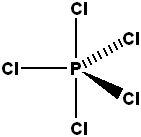
Diagram of trigonal bipyramidal geometry for PCl, highlighting the distinct axial and equatorial positions. This supports why PCl(g) has both (axial–equatorial) and (equatorial–equatorial) bond angles in the VSEPR model. Source
In trigonal bipyramidal molecules:
three bonds are equatorial and are 120° apart
two bonds are axial
the angle between an axial bond and an equatorial bond is 90°
So the important bond angles for PCl₅(g) are 90° and 120°. The gas-state symbol matters because this shape refers to discrete PCl₅ molecules in the gas phase.
Six regions of electron density
If the central atom has six regions of electron density and no lone pairs, the shape is octahedral.
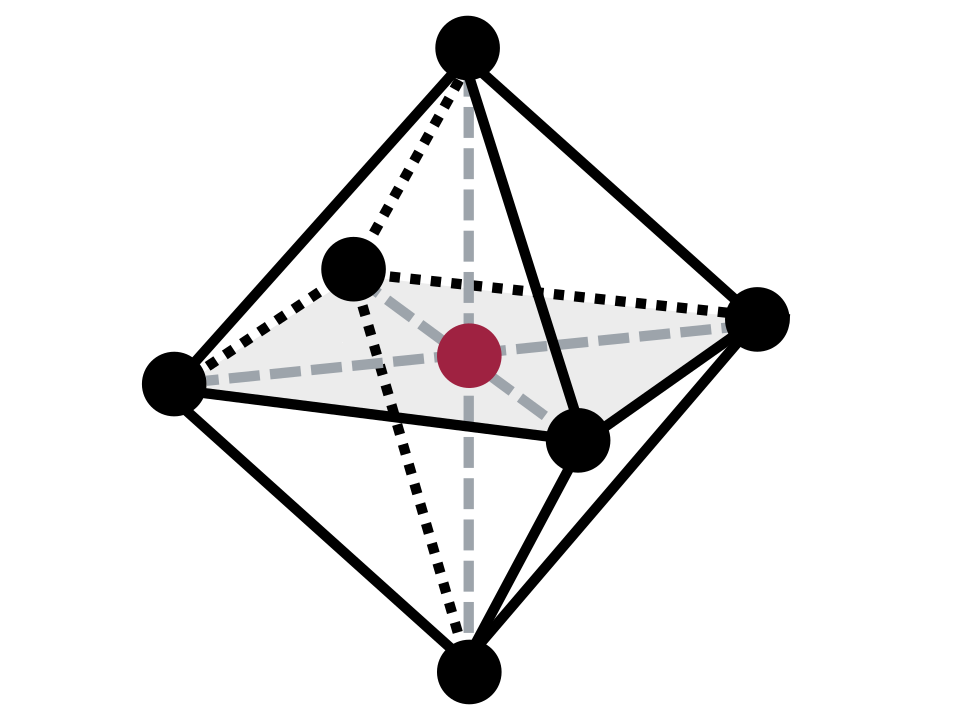
Octahedral molecular geometry showing six positions arranged symmetrically around a central atom. This directly illustrates the bond angles expected for species such as SF(g) when there are six bonding regions and no lone pairs. Source
SF₆(g) is octahedral.
The bond angles in an octahedral molecule are 90°. All six bonding regions are arranged symmetrically around the central atom.
Why bond angles change
Not all electron pairs repel equally. The order of repulsion is:
lone pair-lone pair repulsion is greatest
lone pair-bond pair repulsion is intermediate
bond pair-bond pair repulsion is least
A lone pair occupies more space than a bonding pair because it is attracted to only one nucleus, rather than shared between two nuclei. This extra repulsion pushes bonding pairs closer together and reduces the bond angle.
This explains the sequence:
CH₄: 109.5°
NH₃: 107°
H₂O: 104.5°
As the number of lone pairs increases, the bond angle decreases further. These angles are usually given as approximate values, because real molecules are not perfectly rigid.
Related species and simple organic molecules
A major skill is recognizing when different species have the same arrangement around the central atom.
BeCl₂ and CO₂ are both linear.
CH₄ and NH₄⁺ are both tetrahedral.
For simple organic molecules, predict the shape around a particular atom rather than trying to give one shape for the whole molecule.
A carbon atom with four single bonds is usually tetrahedral, about 109.5°.
A carbon atom in a double bond has three regions of electron density, so it is usually trigonal planar, about 120°.
A carbon atom in a triple bond has two regions of electron density, so it is usually linear, 180°.
This means that shape questions in organic chemistry are often answered by focusing on the local arrangement around the atom being considered, especially carbon atoms in single, double, and triple bonding environments.
Practice Questions
State the shape and bond angle of CO₂.
(2 marks)
1 mark for linear
1 mark for 180°
Use electron-pair repulsion theory to explain the shapes and bond angles of CH₄, NH₃, and H₂O. (6 marks)
1 mark for stating that CH₄ has four bonding pairs and no lone pairs
1 mark for tetrahedral, 109.5°
1 mark for stating that NH₃ has three bonding pairs and one lone pair
1 mark for trigonal pyramidal, about 107°, with the idea that the lone pair repels more strongly than bonding pairs
1 mark for stating that H₂O has two bonding pairs and two lone pairs
1 mark for bent/non-linear, about 104.5°, with the idea that two lone pairs cause greater repulsion and a further reduction in bond angle
FAQ
Predicted angles come from an ideal electron-pair arrangement, but real molecules are affected by extra factors.
These include:
different sizes of surrounding atoms
different bond types
uneven electron distribution
measurement conditions
So a shape may be correct, but the real bond angle can be slightly different from the ideal value.
The shape trigonal bipyramidal refers to individual PCl₅ molecules in the gas phase.
In the solid state, PCl₅ does not exist simply as separate trigonal bipyramidal molecules. It forms ionic species such as:
PCl₄⁺
PCl₆⁻
That is why the gas-state symbol is important when naming its molecular shape.
For basic shape prediction, a single bond, double bond, and triple bond each count as one region of electron density.
However, multiple bonds contain more electron density than single bonds, so they can sometimes repel a little more strongly.
This means they may cause small changes in bond angles, even though the overall shape prediction still uses the same counting rule.
Shape depends on the number of electron regions around the central atom, not simply on whether the species is charged.
In both NH₄⁺ and CH₄:
there are four bonding regions around the central atom
there are no lone pairs on the central atom
So both species are tetrahedral. The overall charge does not automatically change the shape if the electron-pair arrangement is the same.
For standard A-Level shape prediction, you focus on the electron pairs around the central atom only.
Lone pairs on outer atoms usually do not change the basic named shape around the center.
They can, however, cause small experimental differences in bond angles because they influence electron distribution and the size of the bonded atoms. So they matter less than central-atom lone pairs, but they are not always completely irrelevant.

