

CIE Syllabus focus:
'Understand how electronegativity differences create polar bonds, and predict whether molecules are polar by considering bond polarity and molecular shape.'
Small differences in electronegativity can strongly affect how electrons are shared in a bond. To predict molecular polarity accurately, you must consider both individual bond dipoles and the overall three-dimensional arrangement of atoms.
Bond Polarity
When two atoms form a covalent bond, the atom with the higher electronegativity attracts the shared pair of electrons more strongly. The electron density is pulled toward one end of the bond rather than being shared perfectly equally. This uneven sharing produces small partial charges.
Polar bond: A covalent bond in which the bonding electrons are shared unequally, producing a permanent dipole with and ends.
A polar bond does not mean full electron transfer has occurred. The bond is still covalent, but one end is slightly positive and the other slightly negative. If the atoms have the same electronegativity, as in or , the bond is nonpolar because the shared pair is attracted equally.
The greater the difference in electronegativity, the greater the bond polarity is usually taken to be. At A-Level, this is treated qualitatively: you compare atoms and judge whether the bond will be nonpolar, slightly polar, or strongly polar.
Recognizing Bond Dipoles
A bond dipole has size and direction.
The direction is toward the more electronegative atom.
The positive end is on the less electronegative atom.
Partial charges are shown as and .
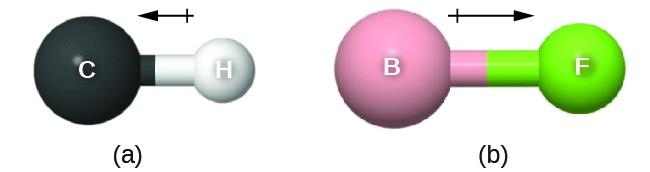
This diagram illustrates the conventional dipole arrow notation: the arrow points toward the more electronegative atom (electron-rich end) and the crossed tail marks the electron-poor end. It also shows how larger electronegativity differences correspond to larger dipole vectors, providing a visual basis for qualitative bond-polarity comparisons. Source
Bond dipoles matter because molecular polarity depends on how these individual dipoles combine in space.
From Bond Polarity to Molecular Polarity
Looking only at one bond is not enough to decide whether an entire molecule is polar. A molecule can contain polar bonds and still be overall nonpolar if the bond dipoles cancel each other out.
Molecular polarity: The overall uneven distribution of charge in a molecule caused by the vector sum of its bond dipoles and its molecular shape.
To decide whether a molecule is polar, think of each bond dipole as a vector. If the vectors act symmetrically and cancel, there is no overall dipole. If they do not cancel, the molecule has a permanent dipole and is polar. This is why molecular shape is essential.
A molecule with just two atoms is easy to judge. If the bond is polar, the molecule is polar. For larger molecules, cancellation becomes the key idea.
Why Shape Matters
In a linear molecule such as , each bond is polar. However, the two bond dipoles are equal and point in opposite directions. Because the molecule is straight, they cancel exactly, so is nonpolar.
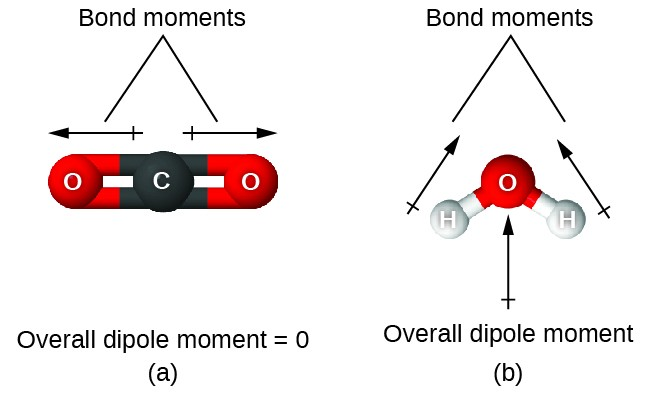
This figure compares dipole-vector addition in (linear) and (bent). In , equal and opposite bond dipoles cancel to give an overall dipole of zero, whereas in bent the bond dipoles add to a resultant dipole. Source
In , each bond is polar, but the molecule is bent.
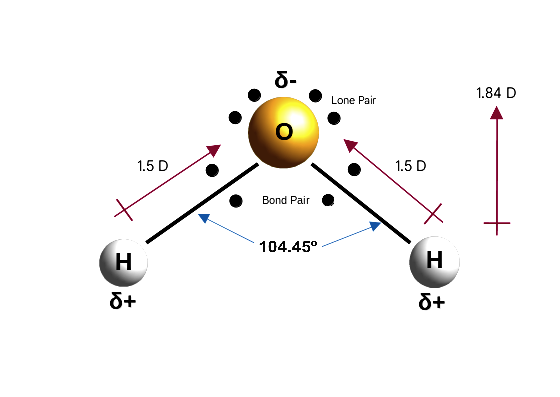
This diagram shows water’s bent molecular geometry and the two bond dipoles pointing toward oxygen (the more electronegative atom). Because the bond dipoles are not collinear, their vector sum produces a nonzero resultant (net) dipole moment, so is polar. Source
The two bond dipoles do not point directly opposite each other, so they do not cancel. Water therefore has an overall dipole and is polar.
The same idea applies to other shapes.
has three polar bonds, but its trigonal planar shape is symmetrical, so the dipoles cancel and the molecule is nonpolar.
has polar bonds and a trigonal pyramidal shape, so the dipoles do not cancel and the molecule is polar.
has four polar bonds, but its tetrahedral shape is symmetrical, so the molecule is nonpolar.
is tetrahedral around carbon, but the atoms around the central carbon are not all the same. The bond dipoles do not balance, so the molecule is polar.
Lone pairs are important indirectly. They are not bond dipoles, but they change the shape of a molecule. That change in shape often prevents cancellation and makes overall polarity more likely.
How to Predict Whether a Molecule Is Polar
A reliable method is to follow the same order every time.
Identify which bonds are polar by comparing the electronegativities of the bonded atoms.
Decide the three-dimensional shape of the molecule.
Consider the direction of each bond dipole.
Ask whether the dipoles cancel because of symmetry.
If they cancel completely, the molecule is nonpolar.
If there is a remaining overall dipole, the molecule is polar.
Symmetry is the main shortcut. A molecule with identical outer atoms and a symmetrical shape is often nonpolar, even when each individual bond is polar. An asymmetrical molecule is more likely to be polar.
Common Mistakes and Exam Tips
A very common error is to state that a molecule is polar just because it contains a polar bond. This is incomplete. Examiners usually expect both ideas: bond polarity and shape.
Another mistake is forgetting that identical polar bonds can cancel. You should always picture the molecule in three dimensions rather than as a flat formula on the page.
When writing an explanation, use precise language:
say unequal sharing of electrons creates a bond dipole
say partial charges develop, written as and
say dipoles cancel or do not cancel
then state whether the molecule is polar or nonpolar
Always base the final decision on the overall molecular shape, not on one bond in isolation.
Practice Questions
State whether the molecule is polar. Explain your answer. (2 marks)
is polar. (1)
The bonds are polar and the bent shape means the bond dipoles do not cancel. (1)
Both and contain polar bonds. Explain why is nonpolar but is polar. (5 marks)
Oxygen is more electronegative than carbon and sulfur, so each bond is polar / each bond has a dipole. (1)
is linear. (1)
In , the two bond dipoles are equal and opposite, so they cancel. (1)
is bent / non-linear. (1)
In , the bond dipoles do not cancel, so the molecule has an overall dipole / is polar. (1)
FAQ
Chemists measure dipole moment, which describes the overall separation of charge across a molecule.
A larger dipole moment usually means a more polar molecule. If the dipole moment is zero, the bond dipoles cancel completely. At A-Level, you usually predict polarity qualitatively rather than calculate dipole moments.
Yes. Different isomers can arrange the same atoms in different ways, changing the symmetry of the molecule.
If one isomer is more symmetrical, its bond dipoles may cancel more completely. A less symmetrical isomer may have a permanent dipole. This is one reason why shape is just as important as bond polarity.
A dipole arrow shows both polarity and direction in one symbol.
The crossed end marks the positive side, and the arrow points toward the more negative end. This can make it easier to see whether several bond dipoles in a molecule will cancel or combine.
Bond polarity depends on electronegativity difference, but molecular polarity depends on more than that.
The final result also depends on shape and symmetry. A molecule can contain strongly polar bonds and still be nonpolar overall if those dipoles cancel exactly. So no single electronegativity cutoff can decide molecular polarity by itself.
Yes, in some molecules it can. Rotation changes the relative positions of bond dipoles.
If the dipoles line up differently after rotation, the amount of cancellation can change. In many simple A-Level molecules, this effect is not the main focus, but in larger molecules different conformations can have different overall polarities.

