

CIE Syllabus focus:
'Understand the nature of London forces caused by instantaneous and induced dipoles, and the attractions between molecules with permanent dipoles.'
Intermolecular forces are much weaker than covalent or ionic bonds, but they strongly affect physical properties. At this level, focus on how London forces form and how permanent molecular dipoles create additional attractions.
Intermolecular forces
Intermolecular forces are forces of attraction between separate molecules or atoms. They do not involve sharing or transfer of electrons in the way chemical bonds do. Even though they are relatively weak, they help explain why substances can exist as liquids or solids and why some need more energy than others to separate their particles.
When a liquid boils or a simple molecular solid melts, the molecules themselves usually stay chemically unchanged. The energy supplied is used mainly to overcome the forces between molecules.
London forces
London forces: Weak intermolecular forces caused by the attraction between an instantaneous dipole in one particle and an induced dipole in a neighboring particle.
London forces arise because electrons are always moving. At any instant, the electron distribution in an atom or molecule may be uneven. This creates an instantaneous dipole, where one side becomes slightly negative and the other side becomes slightly positive for a very short time.
That temporary dipole can repel electrons in a nearby particle, distorting its electron cloud. This produces an induced dipole in the neighboring particle.
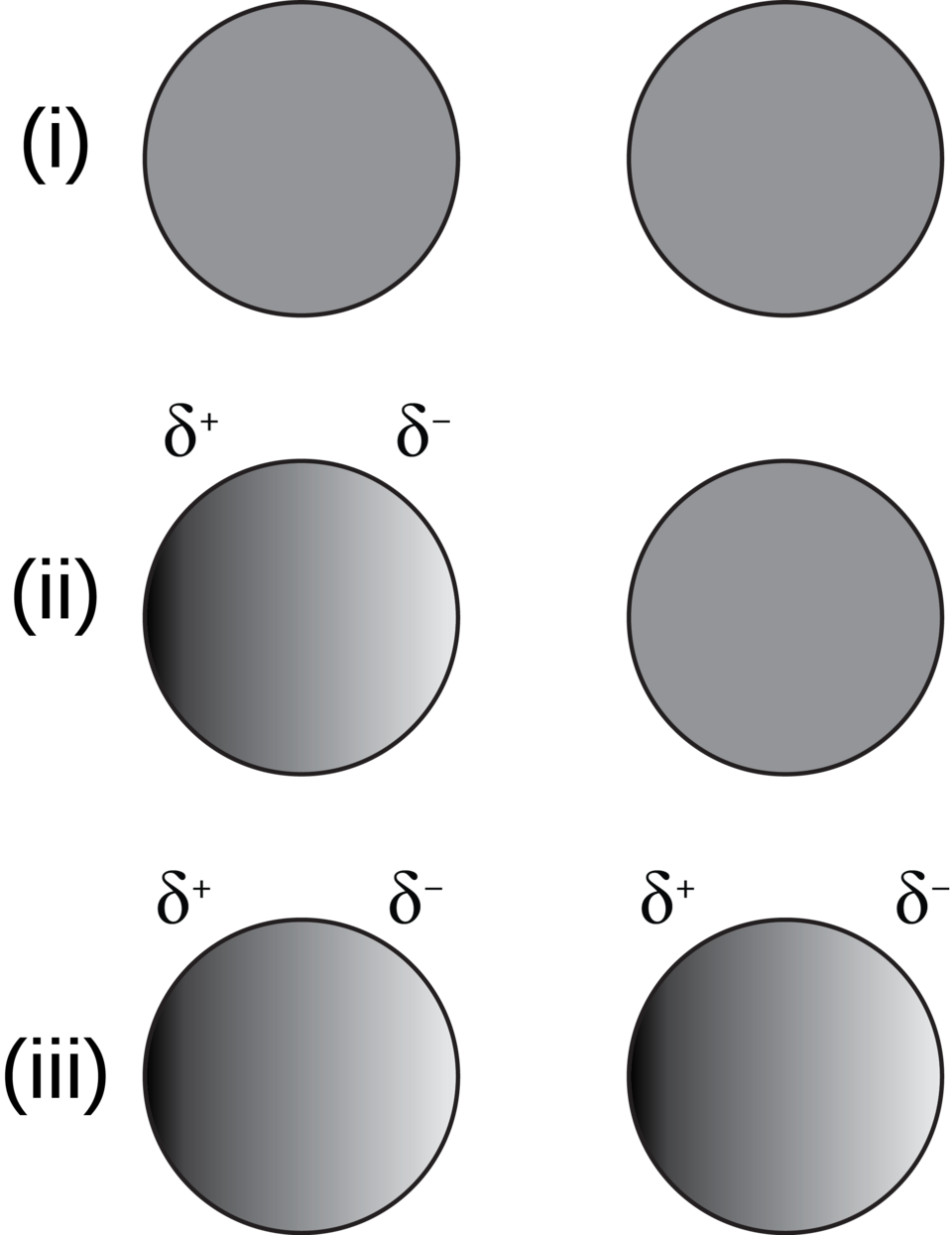
Instantaneous electron-density fluctuations create a temporary dipole in one particle, which then polarizes a neighboring particle to form an induced dipole. The resulting attraction between opposite partial charges is the physical basis of London (dispersion) forces. Source
The opposite partial charges on the two particles then attract each other.
This process happens continuously:
electron movement creates an instantaneous dipole
the instantaneous dipole causes an induced dipole in a nearby particle
the two dipoles attract
as electron positions keep changing, new dipoles form again
London forces act between all atoms and molecules. This is important. Even completely nonpolar molecules still have London forces because electron clouds can always become temporarily uneven.
What affects the strength of London forces?
The main factor is how easily the electron cloud can be distorted. This is often described as polarizability.
More electrons usually means a stronger London force because the electron cloud is larger and more easily distorted.
Larger particles generally have stronger London forces than smaller ones for the same reason.
Greater surface contact between molecules can increase the attractions because more of the electron cloud is close enough to neighboring molecules.
So, London forces are strongest when particles have large, easily distorted electron clouds and can get close to each other.
It is important not to describe London forces as bonds. They are intermolecular attractions, not covalent, ionic, or metallic bonding.
Permanent dipole–dipole forces
Some molecules have a permanent uneven distribution of electron density. This happens when atoms with different electronegativities form covalent bonds and the molecule has a shape that leaves one end more positive and another end more negative overall. Such molecules are polar molecules.
Permanent dipole–dipole forces: Intermolecular attractions between the δ+ end of one polar molecule and the δ− end of another polar molecule.
Because the dipole is permanent, the molecules attract one another through opposite partial charges.
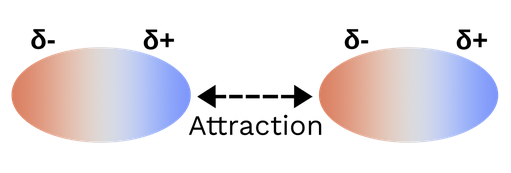
Two polar molecules are drawn with permanent dipoles labeled and , oriented so opposite ends face each other. The dashed arrow emphasizes that dipole–dipole forces are intermolecular attractions arising from the alignment of permanent partial charges. Source
In a liquid or solid, many molecules are oriented so that positive regions are close to negative regions of neighboring molecules.
These attractions are usually stronger than London forces between molecules of similar size, but this is not an absolute rule. A very large nonpolar molecule can have stronger London forces than a small polar molecule. The key point is that permanent dipole–dipole forces are an extra attraction present only when molecules are polar.
The strength of permanent dipole–dipole attraction depends on:
the size of the permanent dipole
how close the molecules can get
how well the molecules can align with each other
Because molecules are moving, especially in liquids and gases, the alignment is not perfect all the time. The attractions are therefore temporary in arrangement, even though the dipoles themselves are permanent.
Comparing the two types of force
You should be able to distinguish clearly between these two intermolecular forces.
London forces are present in all particles.
Permanent dipole–dipole forces only occur between polar molecules.
Polar molecules have both London forces and permanent dipole–dipole forces.
Nonpolar molecules have London forces only.
Stronger intermolecular forces mean more energy is needed to separate molecules.
A common source of confusion is to think that permanent dipole–dipole forces replace London forces. They do not. London forces are always present, because all electron clouds can be distorted.
Another common mistake is to confuse a polar bond with a polar molecule. A molecule may contain polar bonds but still be nonpolar overall if the bond dipoles cancel. In that case, there would be no permanent dipole–dipole attraction between its molecules, although London forces would still act.
What exam questions often test
Questions on this topic often require you to:
explain how an instantaneous dipole forms
explain how an induced dipole is produced in a neighboring molecule
state that London forces occur in all molecules and atoms
identify whether a molecule is polar and therefore able to form permanent dipole–dipole attractions
explain why stronger intermolecular forces lead to higher melting or boiling temperatures
Use precise wording. For London forces, mention instantaneous dipoles, induced dipoles, and electrostatic attraction.
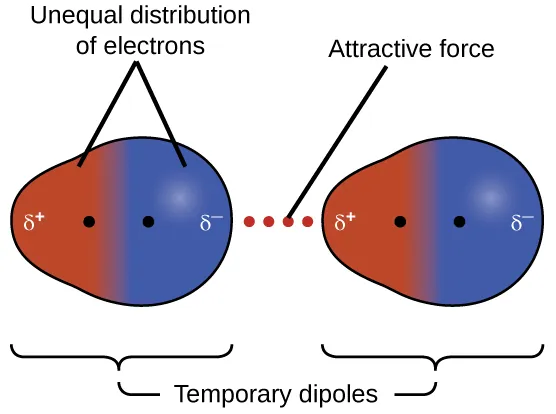
Two neighboring nonpolar molecules are shown developing temporary and regions as electrons become unevenly distributed. The diagram highlights that the attraction is electrostatic and depends on the presence of these transient (instantaneous/induced) dipoles. Source
For permanent dipole–dipole forces, mention polar molecules and attraction between opposite partial charges.
Practice Questions
Explain how an induced dipole is formed in an atom or molecule. (2 marks)
An instantaneous dipole in a neighboring particle distorts the electron cloud. (1)
This causes an uneven distribution of charge, producing a temporary dipole with slight positive and slight negative ends. (1)
Two substances, X and Y, have molecules with similar numbers of electrons. Molecules of X are nonpolar. Molecules of Y are polar.
Explain the intermolecular forces present in X and Y, and predict which substance is likely to have the higher boiling temperature. (5 marks)
X has London forces only. (1)
London forces arise from instantaneous dipoles inducing dipoles in neighboring molecules. (1)
Y has London forces and permanent dipole–dipole forces. (1)
Permanent dipole–dipole forces are attractions between the δ+ end of one molecule and the δ− end of another. (1)
Y is likely to have the higher boiling temperature because its intermolecular forces are stronger overall, so more energy is needed to overcome them. (1)
FAQ
All noble gas atoms are nonpolar, so the only intermolecular forces between them are London forces.
Down the group, the atoms contain more electrons and have larger electron clouds. These clouds are easier to distort, so the London forces become stronger. As a result, more energy is needed to separate the atoms, so boiling temperatures increase.
Both $Br_2$ and $I_2$ are nonpolar, so their intermolecular attractions are London forces.
$I_2$ molecules have more electrons and larger electron clouds than $Br_2$ molecules. This gives iodine stronger London forces, so its molecules are held together more strongly. At room temperature, that is enough for iodine to be solid, while bromine remains liquid.
A particle is polarizable if its electron cloud can be distorted easily.
This matters because London forces depend on temporary dipoles forming. If the electron cloud is easy to distort, an instantaneous dipole can form more easily and can induce a stronger dipole in a neighboring particle. Highly polarizable particles therefore usually experience stronger London forces.
In a gas, molecules are much farther apart and move very rapidly in random directions.
Because of this, the δ+ end of one molecule is less often close to the δ− end of another for long enough to create strong attractions. In liquids, molecules are closer together, so permanent dipole attractions act more often and more effectively.
The name dispersion forces refers to the way electron density becomes spread out unevenly for a moment.
That temporary dispersion of electrons creates an instantaneous dipole, which then induces a dipole in a nearby particle. So London forces and dispersion forces refer to the same type of intermolecular attraction; the two names are interchangeable.

