

CIE Syllabus focus:
'Explain how water dissolves some ionic compounds through ion hydration and dissolves simple alcohols through hydrogen bonding.'
Water is a highly effective solvent because its polarity lets it interact strongly with ions and with molecules that can hydrogen bond, especially small alcohol molecules.
Why water is such a good solvent
Water molecules are polar. The oxygen atom is slightly negative, while the hydrogen atoms are slightly positive. This uneven distribution of charge allows water to attract ions and also interact strongly with polar groups in covalent molecules. Because many water molecules can surround a particle at once, water can separate particles from each other and keep them dispersed through the liquid. This makes water a very effective solvent for many ionic compounds and for simple alcohols.
Dissolving ionic compounds
Ion hydration
When an ionic solid is added to water, the ions at the surface of the crystal attract nearby water molecules. Water molecules become arranged around these ions because opposite charges attract. If enough water molecules gather, they weaken the attraction between the ions in the lattice and pull ions away into the solution.
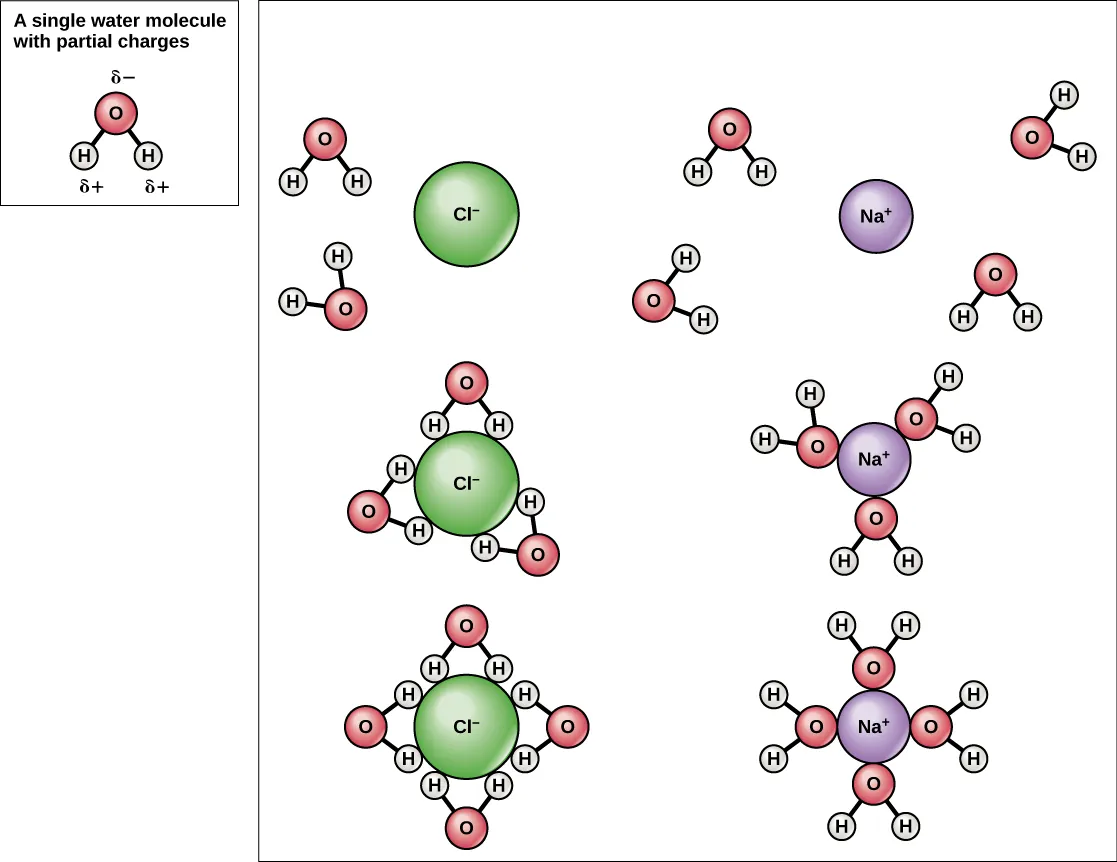
Schematic showing sodium chloride dissociating into Na ^- ions, each surrounded by an ordered “sphere of hydration.” The orientations of water molecules around each ion illustrate how polarity stabilizes free ions and keeps them dispersed in solution. Source
The dissolved ions then move independently through the water rather than staying fixed in the giant ionic lattice.
Hydration: The process in which water molecules surround and attract dissolved ions.
For a cation, the oxygen end of the water molecule points toward the positive ion.
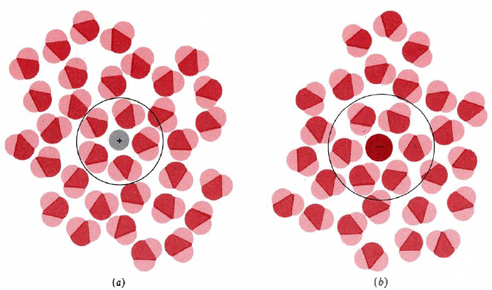
Diagram of hydration (solvation) shells around ions, showing how the O end of water molecules orients toward a cation while the H $ end orients toward an anion. The image emphasizes ion–dipole attraction as the key interaction that stabilizes separated ions in aqueous solution. Source
For an anion, the hydrogen ends point toward the negative ion. This orientation matters because it gives the strongest possible electrostatic attraction between the ion and the polar water molecules. Each dissolved ion becomes surrounded by several water molecules, forming a hydration shell. These surrounding water molecules help prevent the ions from immediately rejoining the solid.
Why only some ionic compounds dissolve
The word some is important. Water does not dissolve every ionic compound. Dissolving occurs only if the attractions between water molecules and the ions are strong enough to compete with the attractions holding the ions together in the lattice. If the lattice attractions are too strong, the ions are not separated effectively, so the substance is only slightly soluble or insoluble.
A clear particle-level explanation of ionic dissolution usually includes these points:
water molecules are attracted to ions at the crystal surface
the ions become surrounded by water molecules
the ions separate from the lattice
the hydrated ions spread through the solution
Dissolving simple alcohols
Hydrogen bonding with water
Simple alcohols, such as methanol and ethanol, contain an -OH group. This group is polar, and the oxygen atom has lone pairs. As a result, alcohol molecules can form hydrogen bonds with water molecules. Alcohols therefore dissolve in water because of strong intermolecular forces, not because they form ions.
Hydrogen bonding: A strong intermolecular attraction between a hydrogen atom bonded to N, O, or F and a lone pair on N, O, or F in another molecule.
When an alcohol is mixed with water, hydrogen bonds form between the alcohol’s oxygen atom and hydrogen atoms in water, and also between the alcohol’s hydrogen in the -OH group and water’s oxygen atom.
These attractions allow alcohol molecules to become incorporated into the structure of liquid water. The alcohol molecules remain whole; their covalent bonds are not broken during dissolution.
Why the hydroxyl group matters
The hydrocarbon part of an alcohol is not strongly attracted to water. The key part is the hydroxyl group, because it allows hydrogen bonding. In simple alcohols, the effect of the -OH group is strong enough for the molecules to mix well with water. Water molecules surround the alcohol molecules and form a network of hydrogen bonds throughout the liquid.
This is different from ionic dissolution. An alcohol does not separate into charged particles in water. Instead, the alcohol molecules stay intact and are held in the solution by hydrogen bonding with the surrounding water molecules. This is why explanations must refer to molecules for alcohols, but to ions for ionic compounds.
Comparing the two processes
At first glance, both processes can look similar because a substance disappears into water. However, the particle changes are different. For an ionic compound, the crystal breaks up into hydrated positive and negative ions. For a simple alcohol, separate alcohol molecules mix with water, but no ions are produced. In both cases, water’s polarity is crucial: it stabilizes ions by hydration and stabilizes alcohol molecules by hydrogen bonding.
Common errors to avoid
A dissolved ionic compound is not present as intact molecules. It is present as free-moving ions surrounded by water molecules. By contrast, a dissolved alcohol is still present as complete molecules.
It is also inaccurate to say that water “breaks” the covalent bonds in an alcohol during dissolution. The covalent bonds inside the alcohol molecule remain unchanged; only intermolecular attractions with water are involved.
In exam answers, naming the interaction matters. For ionic compounds, use ion hydration and describe how water is arranged around cations and anions. For simple alcohols, use hydrogen bonding between the alcohol and water molecules.
Practice Questions
Sodium chloride dissolves in water.
Describe how water molecules are arranged around the Na+ ions and the Cl- ions. (2 marks)
oxygen end of water points toward Na+ / the cation (1)
hydrogen ends of water point toward Cl- / the anion (1)
Explain how water dissolves both an ionic compound such as magnesium chloride and a simple alcohol such as ethanol. In your answer, compare the interactions involved. (5 marks)
Award 1 mark for each valid point, up to 5 marks:
water is polar / has a negative region and positive regions
water molecules are attracted to ions at the surface of the ionic lattice
ions become surrounded by water molecules / hydrated
the hydrated ions separate from the lattice and move through the solution
ethanol / a simple alcohol remains as molecules and does not form ions
hydrogen bonds form between water molecules and the -OH group of the alcohol
FAQ
The -OH group of an alcohol is attracted to water, but the hydrocarbon chain is much less attracted to water.
As the chain gets longer, the nonpolar part becomes more important than the polar -OH group. This makes the molecule overall less compatible with water, so solubility decreases.
Soluble usually means one substance dissolves in another to a significant extent.
Miscible means the two liquids mix completely in all proportions to form one layer.
Small alcohols such as ethanol are often described as miscible with water because they can mix completely, not just dissolve a little.
Not always. The number of closely associated water molecules can vary with:
the charge on the ion
the size of the ion
the concentration of the solution
Some ions often have a fairly regular inner hydration shell, but the overall number of nearby water molecules is not completely fixed.
Water can only dissolve an ionic solid if the attraction between water molecules and the ions is strong enough to overcome the attraction within the lattice.
If the ions are held very strongly together, water may hydrate the surface but still fail to pull many ions fully into solution. That is why some salts dissolve readily while others hardly dissolve at all.
More -OH groups usually increase solubility because each -OH group can take part in hydrogen bonding with water.
This means molecules such as ethane-1,2-diol can interact very strongly with water. Multiple hydrogen-bonding sites often make the molecule much more water-soluble than an alcohol with only one -OH group and a similar carbon chain length.
