

CIE Syllabus focus:
'Use intermolecular forces, including hydrogen bonding and London forces, to explain the trend in boiling temperatures from hydrogen fluoride to hydrogen iodide.'
The boiling temperatures of the hydrogen halides show a clear overall pattern, but hydrogen fluoride is unusual. Understanding this trend depends on comparing the intermolecular forces between their molecules.
The hydrogen halides as simple molecular substances
The hydrogen halides are HF, HCl, HBr, and HI. They are all simple covalent molecules, so their boiling temperatures are determined by the attractions between molecules, not by breaking the covalent bond inside each molecule.
When a hydrogen halide boils:
the H–X covalent bond stays intact
the molecules move apart from one another
the intermolecular forces are overcome
This is why the explanation must focus on the forces between molecules rather than on bond enthalpy within the molecule itself.
A very common mistake is to say that HF has a high boiling temperature because the H–F bond is strong. The H–F bond is strong, but boiling does not involve breaking that bond. The important question is: how strongly are the molecules attracted to each other?
Why hydrogen fluoride is unusual
Hydrogen fluoride has a much higher boiling temperature than the other hydrogen halides. This is unusual because HF has the smallest molecules in the group, so if only weak intermolecular forces were present, it would be expected to have the lowest boiling temperature.
The reason for its unexpectedly high boiling temperature is hydrogen bonding.
Hydrogen bonding: The strong intermolecular attraction between a hydrogen atom bonded to a very electronegative atom and a lone pair on a neighboring molecule.
In HF, fluorine is very electronegative. This makes the H–F bond very polar, so the hydrogen atom carries a significant partial positive charge and the fluorine atom carries a significant partial negative charge. As a result, one HF molecule can attract another strongly through hydrogen bonds.
Each HF molecule can take part in strong attractions with nearby HF molecules, creating much stronger intermolecular forces than would otherwise be expected for such a small molecule. More energy is therefore needed to separate the molecules, so the boiling temperature is high.
This is why HF does not follow the same simple pattern as HCl, HBr, and HI.
The trend from HCl to HI
Once hydrogen fluoride is set aside, the remaining hydrogen halides show a much more regular trend. The boiling temperatures increase from HCl to HBr to HI.
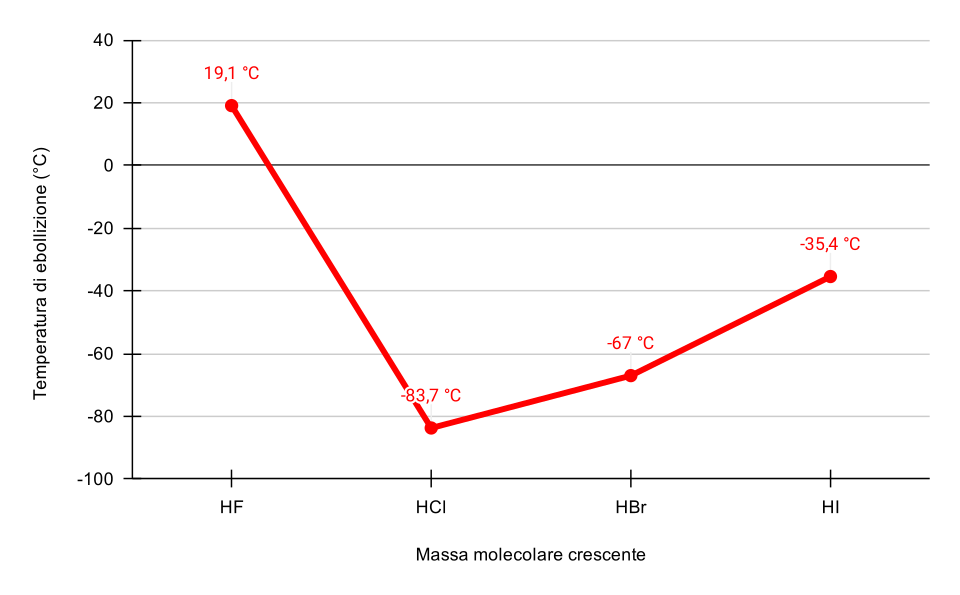
This graph compares the boiling points of HF, HCl, HBr, and HI and makes the overall pattern immediately visible: a steady rise from HCl to HI, with HF anomalously high. It is a useful visual cue that the main change down the group is increasing dispersion (London) forces, while HF is separated by the extra contribution from hydrogen bonding. Source
These molecules do not show significant hydrogen bonding. Chlorine, bromine, and iodine are not electronegative enough for the type of strong hydrogen bonding seen in HF. Their intermolecular attractions are mainly London forces.
London forces: Intermolecular attractions caused by temporary dipoles that induce dipoles in neighboring molecules.
From HCl to HBr to HI, the molecules become larger and contain more electrons. This matters because:
larger electron clouds are more easily distorted
this makes temporary dipoles form more easily
stronger temporary dipoles induce stronger dipoles in nearby molecules
the London forces become stronger
As the strength of London forces increases, more energy is needed to separate the molecules during boiling. Therefore, the boiling temperatures rise from HCl to HBr to HI.
The increase is not caused by stronger covalent bonds. In fact, the H–I bond is weaker than the H–Cl bond. The trend is explained by the increasing strength of the intermolecular forces between the molecules.
Explaining the full trend from HF to HI
The full pattern can be described in two parts:
HF has an unusually high boiling temperature because of hydrogen bonding
from HCl to HI, boiling temperatures increase because London forces get stronger
So, moving from hydrogen fluoride to hydrogen iodide:
there is a large drop from HF to HCl because hydrogen bonding is no longer present
there is then a steady rise from HCl to HI because London forces increase
A useful overall order is:
HCl < HBr < HI < HF
This pattern shows that hydrogen bonding has a much greater effect on boiling temperature than the London forces present in the very small HF molecule. However, among HCl, HBr, and HI, the increase in molecular size and number of electrons becomes the controlling factor.
Another important point is that bond polarity alone does not explain the trend. HCl is more polar than HI, but HI has the higher boiling temperature. This is because the stronger London forces in HI outweigh the effect of greater polarity in HCl.
Key points for explanations
When explaining this trend in an exam answer, make sure your explanation includes the following ideas:
the hydrogen halides are simple molecular substances
boiling involves overcoming intermolecular forces
HF has hydrogen bonding
hydrogen bonding in HF is strong
HCl, HBr, and HI mainly have London forces
London forces increase from HCl to HI because the molecules have more electrons and larger, more polarizable electron clouds
stronger intermolecular forces mean more energy is needed for boiling
therefore the boiling temperatures increase from HCl to HBr to HI, while HF is anomalously high
Practice Questions
State which hydrogen halide has the highest boiling temperature and give the reason for this. (2 marks)
HF identified (1)
hydrogen bonding between HF molecules / strong intermolecular forces due to hydrogen bonding (1)
Explain the trend in boiling temperatures from hydrogen fluoride to hydrogen iodide. (5 marks)
HF has an anomalously high / much higher boiling temperature than the others (1)
because HF molecules form hydrogen bonds (1)
HCl, HBr, and HI do not form hydrogen bonds / their main intermolecular forces are London forces (1)
London forces increase from HCl to HI because the molecules have more electrons / larger electron clouds / greater polarizability (1)
therefore more energy is needed to separate the molecules, so boiling temperature increases from HCl to HBr to HI (1)
FAQ
Hydrogen bonding requires hydrogen to be bonded to a very electronegative, small atom. At A-Level, this is usually limited to N, O, and F.
Chlorine is less electronegative than fluorine and has a larger atom with lower charge density. The H–Cl bond is not polarized enough to produce the unusually strong intermolecular attraction classified as hydrogen bonding.
HF molecules tend to associate because of hydrogen bonding.
In liquid HF, molecules are not behaving as completely isolated particles. They can form short chains or more extended arrangements linked by hydrogen bonds. This association helps explain why HF behaves differently from the heavier hydrogen halides and why its boiling temperature is much higher than its small size would suggest.
Small differences can happen because of:
different levels of rounding
different stated pressures
differences in sample purity
updated or more precise experimental measurements
The overall pattern does not change. Even if exact values vary slightly, the accepted trend remains the same: HF is much higher than expected, and among the others, boiling temperature increases from HCl to HI.
liquid boils when its vapor pressure equals the external pressure.
If the external pressure changes, the temperature needed for boiling also changes. That is why boiling temperatures are usually quoted at a standard pressure. If you compare data from different sources, make sure the boiling temperatures were measured under the same conditions.
Boiling temperature tells you about the energy needed to separate molecules from one another, not the energy needed to break bonds inside a molecule.
So a higher boiling temperature for HI means the intermolecular forces between HI molecules are stronger than those between HBr or HCl molecules. It does not mean the H–I covalent bond is the strongest. In fact, the H–I bond is relatively weak compared with H–F.

