

CIE Syllabus focus:
'Explain why water poorly dissolves compounds that cannot hydrogen bond, including polar halogenoalkanes, and select non-aqueous solvents with similar intermolecular forces to the solute.'
Solubility depends on the balance between attractions broken and attractions formed. In this topic, the key idea is that water only dissolves substances that can interact with it strongly enough.
Solubility and intermolecular forces
For a substance to dissolve, particles of the solute must separate and become surrounded by particles of the solvent. This is only favorable when the new attractions formed between solute and solvent are similar in strength to the attractions already present in each pure substance.
Water is an unusual solvent because liquid water contains a large number of hydrogen bonds between water molecules.
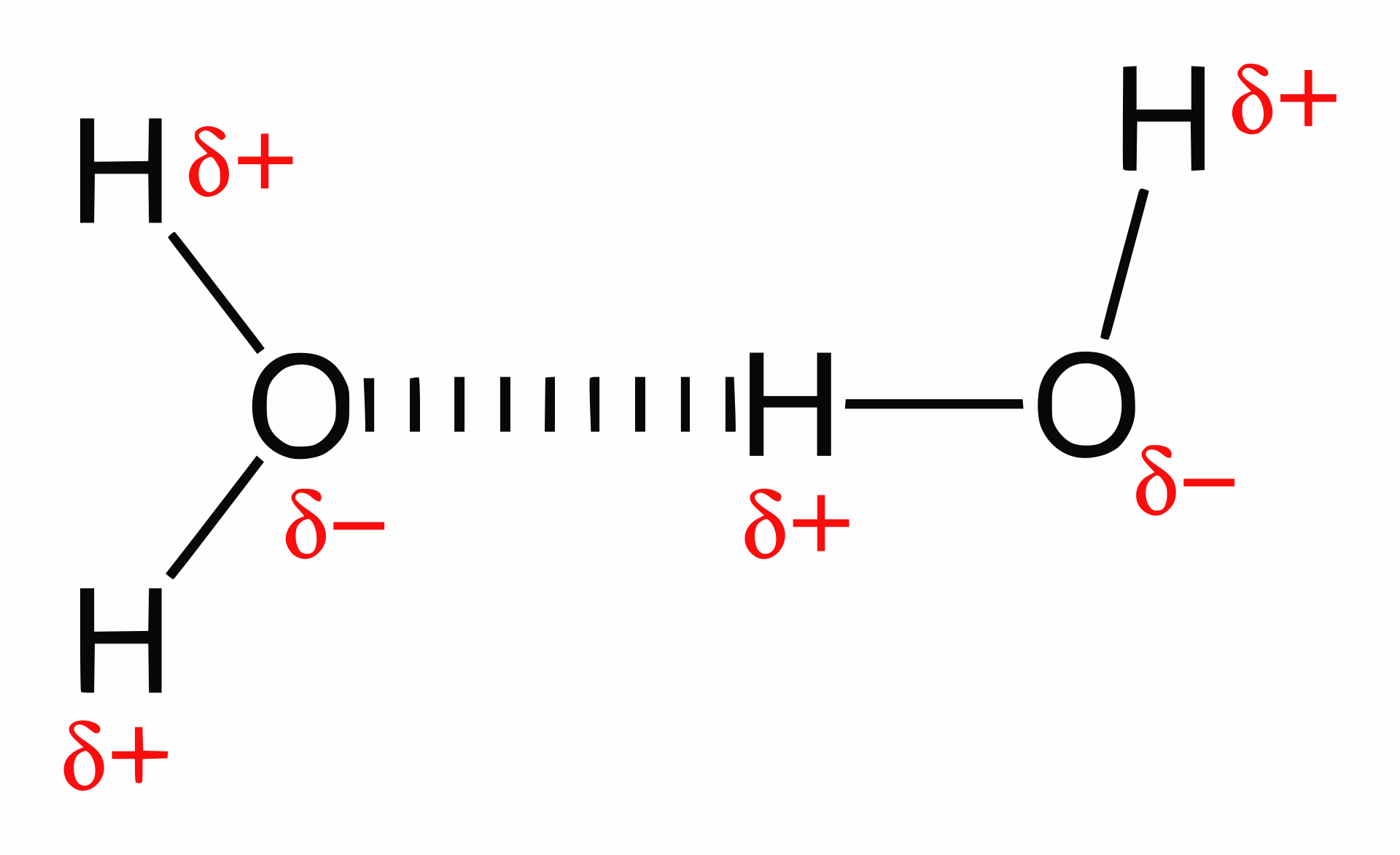
A 2D schematic of liquid water showing individual water molecules linked by hydrogen bonds (typically drawn as dotted lines). It reinforces the idea that water’s unusually strong solvent–solvent attractions come from a hydrogen-bonded network, which must be disrupted when a solute dissolves. Source
These attractions are relatively strong compared with permanent dipole-dipole forces and London forces. As a result, dissolving a substance in water means disrupting some water-water hydrogen bonds, so the new attractions to the solute must be good enough to replace them.
Why water is highly selective
A substance usually dissolves well in water if it can form strong attractions with water molecules. For many molecular substances, the most important case is the ability to form hydrogen bonds with water.
If a substance cannot hydrogen bond with water, then the attractions between that substance and water are weaker. In that situation:
water-water hydrogen bonds are broken
only weaker solute-water attractions are formed
the overall change is not favorable enough for extensive dissolving
This is why polarity alone is not enough to guarantee good solubility in water. A molecule can be polar but still dissolve poorly if it cannot form hydrogen bonds with water.
Why polar molecules can still be poorly soluble
Some students assume that any polar molecule will dissolve well in water. This is not always true. Water is polar, but its behavior is dominated by hydrogen bonding, not just by simple polarity.
A polar molecule that cannot hydrogen bond with water can still attract water molecules by permanent dipole-dipole forces. However, these attractions are usually too weak to compensate for the hydrogen bonds that must be broken in liquid water. The result is low solubility or immiscibility.
Polar halogenoalkanes
Halogenoalkanes are a key example. The carbon-halogen bond is polar because the halogen atom is more electronegative than carbon. This means halogenoalkane molecules often have a permanent dipole.
Even so, halogenoalkanes are only slightly soluble, or insoluble, in water. The important reason is that they cannot form hydrogen bonds with water. When a halogenoalkane is mixed with water:
some water-water hydrogen bonds would need to be disrupted
the new attractions between water and the halogenoalkane are mainly dipole-dipole and London forces
these new attractions are weaker than the hydrogen bonds in water
Because the new interactions are not strong enough, water does not dissolve the halogenoalkane well. This explains why many halogenoalkanes form a separate organic layer when mixed with water.
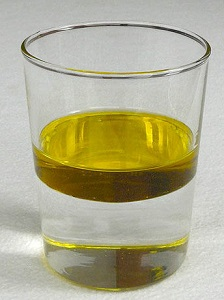
Photograph of two immiscible liquids forming distinct layers, illustrating what happens when solute–solvent attractions are too weak to offset breaking water–water hydrogen bonds. This is the same macroscopic observation described for many halogenoalkanes in water: poor mixing leads to phase separation into an aqueous layer and an organic layer. Source
This idea is very important in exam answers: do not say only that a halogenoalkane is “polar.” You must link the poor solubility to the absence of hydrogen bonding with water and the fact that water prefers its own strong hydrogen-bonded network.
Choosing a non-aqueous solvent
When water is not suitable, a non-aqueous solvent may be chosen instead.
Non-aqueous solvent: A solvent other than water.
The main rule is often described as like dissolves like. This does not mean the substances must be identical. It means the intermolecular forces in the solvent should be similar in type and strength to those in the solute.
Matching the solvent to the solute
If a solute is mainly affected by London forces, it will usually dissolve better in a solvent where London forces are also important. If a solute has permanent dipoles but does not hydrogen bond, it is often more soluble in an organic solvent that can provide similar dipole-dipole and London interactions, rather than in water.
For polar halogenoalkanes, an organic solvent is often more suitable than water because the solvent molecules can interact with the halogenoalkane without needing to compete against a very strong hydrogen-bonded structure. The match in intermolecular forces is better, so dissolving is more favorable.
A good solvent choice is therefore based on the attractions present in the solute, not just on whether the solute contains polar bonds.
Practical selection ideas
When selecting a solvent, ask these questions:
Does the solute hydrogen bond with water?
If not, are its attractions mainly London forces, or a mixture of London forces and permanent dipole-dipole forces?
Would an organic solvent provide a better match for those attractions than water?
This leads to some useful guidance:
substances that cannot hydrogen bond with water are often poorly soluble in water
molecular substances with mostly London forces are usually more soluble in non-polar or weakly polar organic solvents
polar molecular substances that still cannot hydrogen bond may also dissolve better in non-aqueous organic solvents than in water
the best solvent is the one that forms the most suitable solute-solvent intermolecular forces
In exam questions, the strongest answers explain why water is poor and then explain why the alternative solvent is better. The comparison must be about intermolecular forces. Statements such as “it is organic so it dissolves” are too vague. You should refer to hydrogen bonding, dipole-dipole forces, and London forces where appropriate.
When the solute and solvent have similar intermolecular forces, the molecules mix more easily and a homogeneous solution is more likely to form. When the forces are very different, especially when water’s hydrogen bonding has no good replacement, solubility is low and separate layers are often seen.
Practice Questions
Bromoethane is a polar molecule, but it is only slightly soluble in water. Explain why. [2]
Bromoethane cannot form hydrogen bonds with water. [1]
Water-water hydrogen bonds are stronger than the attractions formed between water and bromoethane, so little dissolves. [1]
A student wants to dissolve chlorobutane and is considering water or a non-aqueous organic solvent.
(a) State which type of solvent is more suitable. [1]
(b) Explain why water is not a good solvent for chlorobutane. [2]
(c) Explain how the intermolecular forces in the better solvent make it more suitable. [2]
(a)
A non-aqueous organic solvent. [1]
(b)
Chlorobutane cannot form hydrogen bonds with water. [1]
Water-water hydrogen bonds are stronger than chlorobutane-water attractions, which are mainly dipole-dipole and London forces. [1]
(c)
The better solvent has intermolecular forces similar to those in chlorobutane. [1]
It can form suitable London forces, and possibly dipole-dipole interactions, with chlorobutane so dissolving is more favorable. [1]
FAQ
This depends on density, not on how well they dissolve.
If the halogenoalkane is less dense than water, it forms the top layer. If it is more dense than water, it forms the bottom layer. Many brominated or iodinated organic liquids are denser than water, while some chlorinated ones are not.
Shaking breaks one liquid into tiny droplets that spread through the other liquid. This gives a cloudy temporary mixture called an emulsion.
If no emulsifier is present, the droplets gradually merge again and the liquids separate into two layers. So temporary mixing after shaking does not mean true solubility has occurred.
As the carbon chain gets longer, water solubility usually decreases.
The larger hydrocarbon part is mostly non-polar and interacts poorly with water. Even though the carbon-halogen bond is polar, that single polar region becomes less important as the non-polar part of the molecule gets bigger.
It is useful, but it is an oversimplification.
Real solubility depends on several factors:
the exact strength of the intermolecular forces
molecular size and shape
temperature
whether very strong attractions in the pure solvent must be broken
So two substances may both be called “polar,” yet still mix poorly if one relies heavily on hydrogen bonding and the other does not.
A simple method is to add a few drops of water to the funnel.
Watch which layer increases in volume. That layer is the aqueous layer, so the other one is the organic layer. You can also compare densities if you know the solvent being used, but the drop test is often the safest quick check.
