

CIE Syllabus focus:
'Know that metallic bonding is the strong electrostatic attraction between positive metal ions and delocalised electrons.'
Metallic bonding explains how metal atoms are held together in a metal.
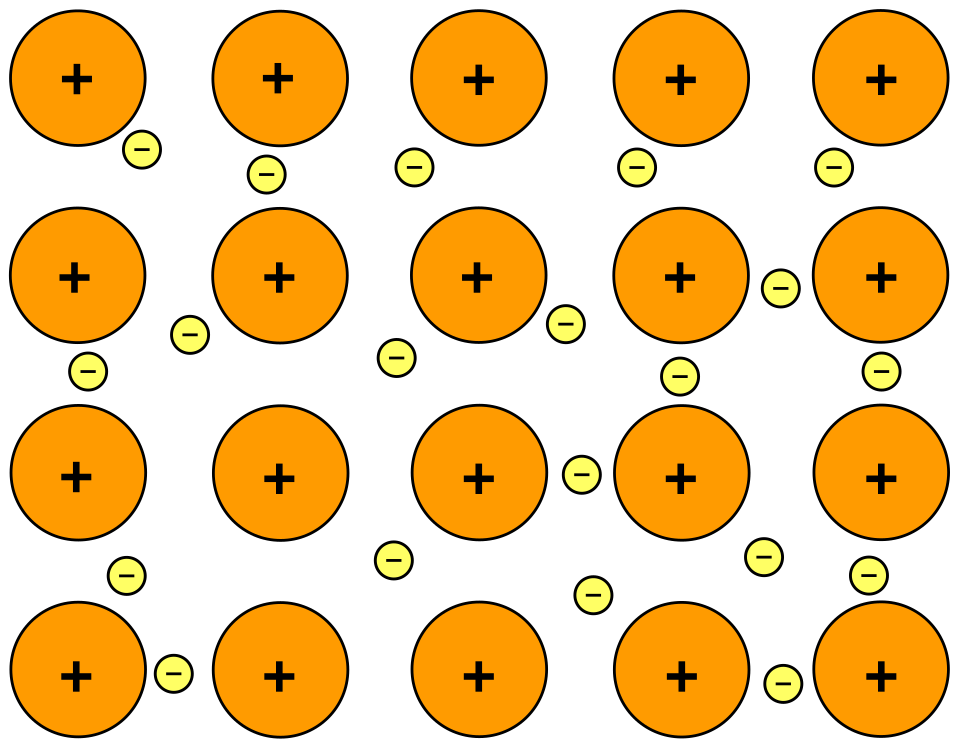
Schematic diagram of metallic bonding showing regularly arranged positive metal ions surrounded by delocalised electrons. The diagram emphasizes that the bonding is the overall electrostatic attraction between the ion lattice and the mobile electron ‘sea’, rather than a localized bond between a pair of atoms. Source
The key ideas are the formation of positive metal ions, mobile electrons, and the strong electrostatic attraction between them.
Metallic bonding
A metal is not made of separate molecules. Instead, many metal atoms are held together in one continuous structure by metallic bonding. In this model, the outer electrons of metal atoms are no longer attached to just one atom. They become free to move throughout the metal, while the rest of each atom becomes a positive ion.
Metallic bonding: The strong electrostatic attraction between positive metal ions and delocalized electrons.
This definition contains every key idea that exam answers need. The attraction is strong because it acts throughout the metal, not just between one pair of particles. It is electrostatic because it is an attraction between opposite charges. The particles involved are positive metal ions and delocalized electrons.
How metallic bonding forms
From metal atoms to positive ions
Metal atoms have outer-shell electrons that are relatively easy to remove. When a metal forms its bonded structure, these outer electrons become detached from individual atoms. The atoms that have lost these electrons are left as positive metal ions.
These positive ions are sometimes called metal ion cores because they include the nucleus and the inner electrons. They are positive because the atom now has more protons than electrons associated with it.
It is important to describe the particles correctly. In a metal, the positive ions do not exist on their own as separate particles moving randomly through empty space. They are part of an ordered arrangement, surrounded by electrons that move throughout the structure.
Delocalized electrons
The released outer electrons do not belong to one specific ion. Instead, they are spread across the whole metal.
Delocalized electrons: Electrons that are free to move throughout the entire metal structure rather than being associated with one atom or one bond.
Because these electrons are mobile, each positive ion is attracted to many electrons around it, and each electron is attracted to many positive ions.
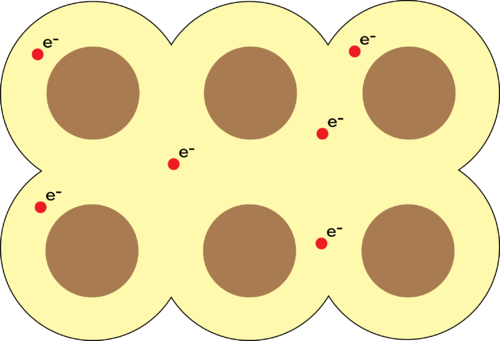
Electron-sea model diagram: metal cations form a fixed lattice (large spheres), while delocalised electrons (labeled e−) move throughout the structure. This illustrates why metallic bonding is collective—each ion attracts many electrons and each electron is attracted to many ions across the whole metal. Source
This is very different from a bond that is limited to just two atoms. In metallic bonding, the attraction is collective and extends across the whole metal.
A common description is that the electrons form a “sea” around the positive ions. This image can be helpful, but in exam answers you should always use the more precise phrase delocalized electrons.
Why the attraction is strong
Electrostatic attraction
Electrostatic attraction means attraction between opposite charges. In a metal, the positive metal ions and negative electrons attract each other strongly.
This attraction is strong for two main reasons:
the charges are opposite, so they attract
there are very many attractions acting throughout the structure at the same time
The bonding does not depend on one electron linking one pair of ions. Instead, the attraction is spread over the whole metal. That is why metallic bonding is described as a strong bonding force.
The strength of metallic bonding can vary from one metal to another. In general, stronger metallic bonding is associated with:
a greater positive charge on the metal ions
more delocalized electrons per ion
smaller ions, which allow the attraction to act over a shorter distance
These factors all increase the electrostatic attraction between the positive ions and the delocalized electrons.
A bonding model for the whole metal
Metallic bonding should be thought of as a model for the entire metal, not for a single pair of particles. There are no individual molecules in a metal. There are also no shared pairs of electrons located between just two atoms.
Instead:
metal atoms contribute outer electrons to a mobile electron system
the remaining parts of the atoms become positive ions
the whole structure is held together by attraction between the ions and the delocalized electrons
This explains why the bonding in metals is often described as non-directional. The attraction acts in all directions around each positive ion because the electrons are not fixed in one place. When writing about metallic bonding, it is usually best to focus on the exact particles involved and the nature of the attraction between them.
How to describe metallic bonding in exams
Key wording to use
Strong answers usually include these ideas:
positive metal ions
delocalized electrons
strong electrostatic attraction
attraction acting throughout the metal
You may also refer to the outer-shell electrons becoming delocalized.
Common mistakes to avoid
Do not say that:
metal atoms are held together by shared pairs of electrons
the electrons are fixed between two atoms
metals consist of separate molecules
the bonding is just between neutral atoms
These statements do not describe metallic bonding accurately. The important point is that the electrons are mobile and delocalized, and the bonding is the electrostatic attraction between these electrons and the positive metal ions.
If a question asks for the bonding in a named metal such as sodium, magnesium, or aluminum, the same basic model applies. Only the details of how many electrons become delocalized may change. The core idea always stays the same: a metal is held together by the strong electrostatic attraction between positive metal ions and delocalized electrons.
Practice Questions
State what is meant by metallic bonding. (2 marks)
strong electrostatic attraction (1)
between positive metal ions and delocalized electrons (1)
A student says, “A metal is held together by shared pairs of electrons between neighboring atoms.” Explain why this statement is incorrect and describe metallic bonding in sodium. (5 marks)
sodium atoms lose their outer electron / outer electron becomes delocalized (1)
positive sodium ions are formed / sodium ion cores remain (1)
electrons are delocalized and move throughout the metal (1)
attraction is electrostatic (1)
attraction is between positive ions and delocalized electrons, not shared pairs between two atoms / acts throughout the metal (1)
FAQ
In a solid metal, the positive ions are in fixed positions, but the delocalized electrons are still mobile.
When a potential difference is applied, these electrons can drift through the metal and carry charge.
This is why electrical conduction in metals does not require the metal to be melted first.
Metallic bonding does not only exist in solids. It can also exist in liquid metals.
In liquid mercury, the particles are no longer held in fixed positions, but there are still positive metal ions and delocalized electrons attracting one another.
So the bonding model remains metallic, even though the structure is less ordered than in a solid metal.
Transition metals often form ions with higher positive charge and contribute more delocalized electrons.
This can increase the electrostatic attraction between the positive ions and the electron system.
Group 1 metals usually provide only one delocalized electron per atom and form $+1$ ions, so their metallic bonding is often weaker.
That is one reason many transition metals are harder and have higher melting temperatures.
An alloy contains more than one element, usually including a metal.
Metallic bonding is still present, because there are still positive ions and delocalized electrons. However, the ions are not all the same size.
Different-sized ions can distort the arrangement and make it harder for layers to move past each other.
This often makes alloys harder than pure metals.
“Sea of electrons” is a useful picture, but it is a simplified description.
It helps students remember that the electrons are mobile and not tied to one bond or one atom.
However, real metals are described more accurately using ideas from advanced atomic and solid-state models, where electron behavior is treated in a more detailed way.
For A-Level Chemistry, “delocalized electrons” is the best precise term to use in answers.

