IB Syllabus focus: 'Organized civil society, including NGOs, social movements, resistance movements, interest groups and pressure groups, should be analysed as political actors.'
Civil society actors are central to global politics because they organize people, ideas, and resources outside formal government institutions. They can amplify demands, challenge power, and shape policies across local, national, and global arenas.
Civil society as a political actor
Civil society includes the organized associations and networks through which people pursue shared interests or values.
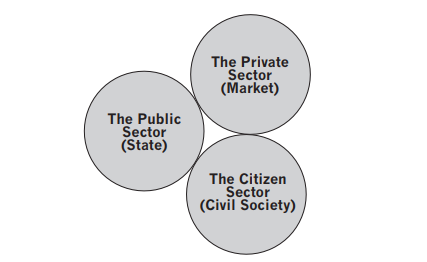
A three-sphere diagram showing the public sector (state), private sector (market), and citizen sector (civil society) as distinct but coexisting parts of society. This is a useful baseline model for distinguishing civil society actors from governments and profit-seeking firms when analyzing who holds what kinds of power and resources. Source
It matters in global politics because many political struggles are not led by governments alone; they are also driven by citizens, communities, unions, faith groups, campaign organizations, and activist networks.
Civil society: The sphere of voluntary collective action outside the state in which people organize around shared interests, values, or identities.
These actors are political because they try to influence decisions, public debate, law, behavior, and resource allocation. They may defend human rights, oppose corruption, pressure companies, campaign on climate policy, resist occupation, or promote the interests of workers, farmers, consumers, or minorities. Their power usually comes less from formal authority and more from organization, legitimacy, expertise, numbers, and visibility.
Main forms of organized civil society
NGOs
Non-governmental organizations are usually more formal and structured than loose activist networks. They may operate locally, nationally, or transnationally, and they often combine research, advocacy, service delivery, monitoring, fundraising, and public campaigning.
NGO: A non-state, non-profit organization that works to provide services, advocate for change, monitor behavior, or represent causes and communities.
NGOs can influence global politics by publishing reports, documenting abuses, training activists, lobbying officials, and shaping media narratives. Some focus on humanitarian relief, while others seek policy change. Their credibility often depends on evidence, professional staff, and sustained engagement, but critics may question whom they represent, how transparent they are, or who finances them.
Social movements and resistance movements
Social movements are broader collective efforts that bring people together around a cause, identity, or grievance. They are often less centralized than NGOs and rely heavily on participation, symbols, and public action.
Social movement: A collective and sustained effort by people seeking social or political change through organized action outside formal state institutions.
Social movements use marches, strikes, boycotts, petitions, online campaigning, and civil disobedience to pressure decision-makers or change social norms. Resistance movements are a specific form of organized opposition, usually directed against occupation, authoritarian rule, or severe injustice. They may gain legitimacy from representing excluded groups, but their methods, goals, and internal leadership can be highly contested.
Interest groups and pressure groups
Interest groups represent specific interests, such as business sectors, labor unions, professional bodies, farmers, or environmental constituencies. Pressure groups seek to influence public policy without trying to form a government themselves. In practice, the terms often overlap.
These actors usually focus on targeted influence rather than mass mobilization. They may lobby legislators, submit policy proposals, finance campaigns, mobilize members, or use litigation and public relations to secure favorable outcomes. Their effectiveness often depends on access, resources, and insider knowledge.
How civil society actors exercise influence
Organized civil society can shape politics through several mechanisms:
Agenda setting: drawing attention to neglected issues and forcing elites to respond.
Representation: speaking for groups whose voices are weak, ignored, or dispersed.
Information and expertise: supplying research, testimony, monitoring data, or specialist knowledge.
Mobilization: turning individual concerns into collective action through membership, protest, or campaigns.
Accountability: exposing abuses, corruption, or policy failures and demanding scrutiny.
Norm promotion: changing what is seen as acceptable or legitimate, for example on gender equality or land rights.
Direct pressure: using lobbying, boycotts, consumer campaigns, or strategic disruption to influence decisions.
Transnational networks can connect local grievances to global audiences, increasing pressure on governments and corporations.
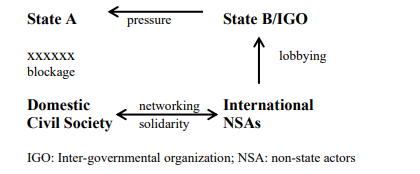
A schematic of the “boomerang model” of transnational advocacy: when State A blocks domestic civil society, domestic activists network with international non-state actors, who then lobby a more powerful state or an IGO to pressure State A. The diagram clarifies the strategic pathway by which civil society can convert information, legitimacy, and international attention into policy leverage. Source
Digital media can magnify this influence by lowering communication costs, spreading messages quickly, and helping decentralized groups coordinate, although visibility online does not always produce policy change.
Strengths and limitations
These actors matter because they can be flexible, innovative, and close to affected communities. They may respond faster than formal institutions, build solidarity across borders, and keep issues visible when governments prefer silence. Local credibility can be especially important where official information is distrusted. Grassroots actors may also challenge dominant narratives by centering lived experience rather than official claims.
However, organized civil society is not automatically democratic or inclusive. Some NGOs depend heavily on donors and may follow funding priorities rather than community needs. Some movements are fragmented, short-lived, or vulnerable to repression. Well-resourced interest groups may enjoy far greater access than marginalized groups, creating unequal influence even within civil society itself.
Legitimacy, accountability, and analysis
When analyzing civil society actors, ask not only whether they are active, but also whether they are legitimate and accountable. Legitimacy may come from membership, transparency, expertise, moral authority, effectiveness, or deep roots in a community. Accountability refers to the ways an organization answers to members, supporters, donors, or affected populations.
A strong analysis should consider:
Who the actor claims to represent
What goals it pursues
Which methods it uses
What resources it can mobilize
How far its influence reaches
Whether it empowers affected people or speaks over them
This matters because civil society actors can expand participation and challenge power, but they can also reproduce inequalities, exclude rivals, or simplify complex issues for campaigning purposes.
Practice Questions
Identify two types of organized civil society that can act as political actors.
1 mark for each correct type identified, up to 2 marks.
Acceptable answers include: NGOs, social movements, resistance movements, interest groups, pressure groups.
Explain three ways organized civil society can influence political outcomes.
1 mark for each correctly identified way of influence, up to 3 marks.
1 additional mark for each clear explanation of how that method shapes political outcomes, up to 3 marks.
Valid ways include:
agenda setting
lobbying or direct pressure
public mobilization
monitoring and accountability
norm promotion
representing marginalized groups
media campaigning
FAQ
Astroturfing is the creation of a fake grassroots campaign that appears citizen-led but is actually organized or funded by powerful interests, such as corporations or political operatives.
It matters because it can distort public debate, hide real power relationships, and make policymakers think a position has broad social support when it does not.
Leaderless or decentralized structures can make movements harder to suppress and easier for many people to join. They may also fit movements that value participation and horizontal decision-making.
However, this can create problems:
unclear strategy
internal disagreements
difficulty negotiating with authorities
weak long-term coordination
NGOs often gain access through accreditation, consultative status, partnerships, expert reputation, or invitations to attend side events and hearings.
Access usually depends on factors such as:
technical knowledge
funding and professional staff
established networks
ability to produce reliable data
reputation for constructive engagement
Professionalization happens when a movement develops paid staff, offices, formal leadership, and stable funding. This can improve continuity, research quality, and access to decision-makers.
It can also create tension if activists feel the organization becomes too cautious, donor-driven, or detached from grassroots energy.
Yes, but credibility depends on how the relationship is managed. Partnerships can provide funding, expertise, or implementation capacity.
To avoid losing trust, civil society actors usually need:
transparency about funding
clear ethical boundaries
independence in criticism
measurable public-interest goals
safeguards against conflicts of interest