IB Syllabus focus: 'Private companies, the media and other individual or collective actors can exercise influence in global political issues.'
In global politics, influence does not belong only to states. Businesses, media organizations, and powerful individuals can shape agendas, decisions, and public attitudes across borders, sometimes faster than governments can respond.
Private actors as political actors
Private actors matter because they control resources that governments often need or cannot fully regulate. They may not make laws directly, but they can affect what policies are considered, how issues are understood, and which voices are amplified.
Private actors: Non-state individuals or organizations that can shape political outcomes through money, information, ownership, expertise, or public influence.
In this subtopic, private actors include:
Multinational companies
Media organizations
Technology platforms
Wealthy individuals and philanthropists
Credit rating agencies, consultancies, and industry networks
Other individual or collective actors with significant reach
Their political importance comes from the fact that many global issues—such as climate change, migration, trade, public health, and digital surveillance—are shaped not only by public law but also by private decisions.
Sources of influence
Economic power
Companies can influence politics because they control investment, employment, production, supply chains, and data. Governments may adjust policy to attract or retain business activity, especially when firms can move capital across borders.
Economic influence can appear through:
Lobbying for favorable regulation or lower taxes
Threats to relocate production
Decisions about where to invest, hire, or withdraw services
Control over critical goods such as energy, medicines, food, or communications infrastructure
This gives some firms structural power: decision-makers may anticipate business preferences even without direct pressure.
Informational power
The media and other private actors also influence politics by shaping what people know and what they pay attention to.
Agenda-setting: The ability to influence which issues receive public and political attention, even without deciding the final policy outcome.
When a media outlet, platform, or influential individual repeatedly highlights one issue, that issue can become politically urgent. Information power also includes the ability to frame an issue—for example, presenting migration as a security problem, a humanitarian problem, or an economic opportunity. Different frames encourage different policy responses.
How companies shape global political issues
Private companies influence global politics in both direct and indirect ways.
Direct methods include:
Meeting policymakers and regulators
Funding campaigns or advocacy where legally permitted
Joining policy consultations
Using legal action to challenge regulations
Negotiating with governments over contracts, taxation, or market access
Indirect methods include:
Setting industry standards that others follow
Controlling platforms or infrastructure used by millions of people
Shaping consumer behavior through advertising
Publishing research, data, or impact reports to support preferred policies
Companies can sometimes help address global problems. For example, firms may invest in renewable energy, improve labor standards in supply chains, or support vaccine development. However, they may also obstruct change when regulation threatens profits. This tension means students should avoid assuming that private companies are either purely beneficial or purely harmful.
A key analytical issue is accountability.

This image (from an OHCHR educational booklet on business and human rights) depicts a formal decision-making setting where government authorities and business representatives shape outcomes that affect communities. It supports the idea that private actors can exert substantial influence on public decisions, raising accountability questions when affected people are not equally represented in the process. Source
Private firms can have major public impact, but they are usually accountable first to owners, shareholders, or executives rather than to citizens as a whole. Their influence may therefore be powerful without being fully democratic or transparent.
The media as a political actor
Media organizations do more than report events. They select stories, choose sources, set priorities, and interpret political developments. This makes the media a major actor in global politics.
Media influence includes:
Gatekeeping: deciding what enters public discussion
Framing: shaping how events are understood
Investigative journalism: exposing abuses of power
Mobilization: encouraging public pressure, protest, or consumer action
The media can strengthen accountability by revealing corruption, human rights abuses, or environmental damage. At the same time, media systems can reproduce bias, sensationalism, or misinformation. Ownership concentration may allow a small number of private actors to shape large parts of public debate. In digital spaces, platform companies add another layer of influence through algorithms, moderation decisions, and rules about visibility.
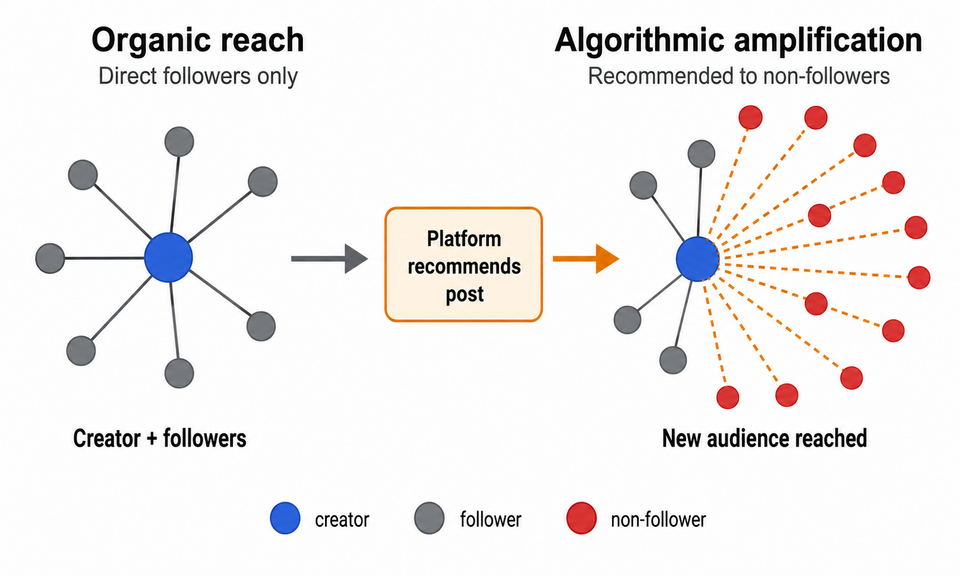
This diagram contrasts “organic reach” (a creator reaching only their direct followers) with “algorithmic amplification” (a platform recommending content outward to non-followers). It illustrates how platform design—especially ranking and recommendation—can transform individual posts into system-wide agenda-setting power by rapidly expanding visibility beyond a user’s existing network. Source
Because audiences are fragmented, influence is not automatic. Media power depends on credibility, audience reach, ownership structure, political context, and media freedom.
Other individual or collective actors
The syllabus also includes other non-state actors beyond companies and media institutions. These may include:
Billionaires and philanthropists
Celebrities and public intellectuals
Private foundations
Consultancy firms
Credit rating agencies
These actors can influence politics by funding projects, endorsing causes, shaping elite opinion, or affecting how risky a country appears to investors. Their influence may be especially strong when they combine money, visibility, and access to decision-makers.
How to analyze their role in an issue
When evaluating private actors in any global political issue, ask:
What type of power do they hold: economic, informational, reputational, or technological?
Are they influencing policy, public opinion, or both?
Who benefits from their involvement, and who may be excluded?
How transparent are their actions?
What formal or informal checks exist on their power?
Private actors matter because they can fill governance gaps, accelerate change, or pressure governments to act. But they can also distort priorities, protect narrow interests, or reduce democratic control over important decisions.
Practice Questions
(3 marks)
Identify three ways a private company can influence a global political issue.
1 mark for each valid method identified, up to 3 marks.
Valid responses may include:
lobbying policymakers
funding advocacy or campaigns
threatening to relocate investment or jobs
setting industry standards
controlling key infrastructure, platforms, or supply chains
using legal action to challenge regulation
(6 marks)
Explain how media organizations can shape government responses to a global political issue.
1 mark for explaining agenda-setting or how media make an issue politically visible.
1 mark for explaining framing or how media presentation affects interpretation of the issue.
1 mark for showing how media influence public opinion.
1 mark for linking public opinion to pressure on policymakers or institutions.
1 mark for discussing a further media role such as investigative journalism, mobilization, or exposure of abuses.
1 mark for noting that media influence varies depending on factors such as credibility, audience reach, ownership, or political context.
FAQ
Lobbying is usually a legal attempt to influence policy through meetings, submissions, research, or public campaigns.
Corruption involves improper or illegal exchanges, such as bribery, hidden favors, or abuse of office.
The difference often depends on:
transparency
legality
whether access is open or unfairly bought
whether public officials are acting in the public interest
A system can have legal lobbying but still face criticism if wealth gives some actors far more access than others.
Who owns a media company can shape editorial priorities, staffing, and long-term incentives.
Different ownership models create different pressures:
family ownership may reflect strong personal political preferences
publicly traded firms may prioritize profit and audience metrics
billionaire ownership may bring political influence beyond commercial goals
nonprofit models may protect some public-interest journalism but depend on donors
Ownership does not automatically determine content, but it can shape what kinds of reporting are encouraged or avoided.
Advertising power comes from paying to place messages in front of an audience. It lets companies, political actors, or wealthy individuals promote preferred ideas directly.
Editorial power comes from deciding what counts as news, which experts are quoted, and how events are interpreted.
Advertising is usually visible as persuasion.
Editorial influence can be less obvious because it works through selection and presentation, not just overt messaging.
In practice, the two can interact if commercial pressures affect newsroom decisions.
Shareholders may worry that political activity creates risk rather than advantage.
Common concerns include:
consumer boycotts
damage to brand reputation
regulatory backlash
conflict with environmental, social, and governance commitments
political spending that does not clearly benefit the firm
Some investors prefer companies to stay focused on profitability, while others want firms to take positions on public issues.
This means corporate political action is often shaped by internal business politics, not just outside pressure.
Media platforms operate across many jurisdictions at once, but laws remain mostly national.
This creates problems such as:
different standards on hate speech, privacy, and defamation
disputes over which country’s courts have authority
difficulty enforcing penalties against firms headquartered elsewhere
rapid content circulation that outpaces legal procedures
Platforms may also adjust their rules differently by market, which creates uneven protections.
As a result, regulation often becomes fragmented, with companies navigating multiple legal systems while still operating on a global scale.