IB Syllabus focus: 'Rules, norms and institutions regulate interactions between political actors and can shape or limit responses to political issues.'
Political interactions are guided not only by power and interests, but also by shared expectations, procedures, and boundaries. Understanding rules and norms helps explain why some actions are accepted, contested, delayed, or blocked.
What rules and norms are
In global politics, actors rarely operate in a completely free environment. Their choices are structured by rules, which set out what is allowed or required, and norms, which define what is considered appropriate or legitimate.
Rule: An explicit standard, law, or procedure that guides or restricts political behavior.
Rules are often written down, formally adopted, and linked to procedures or sanctions.
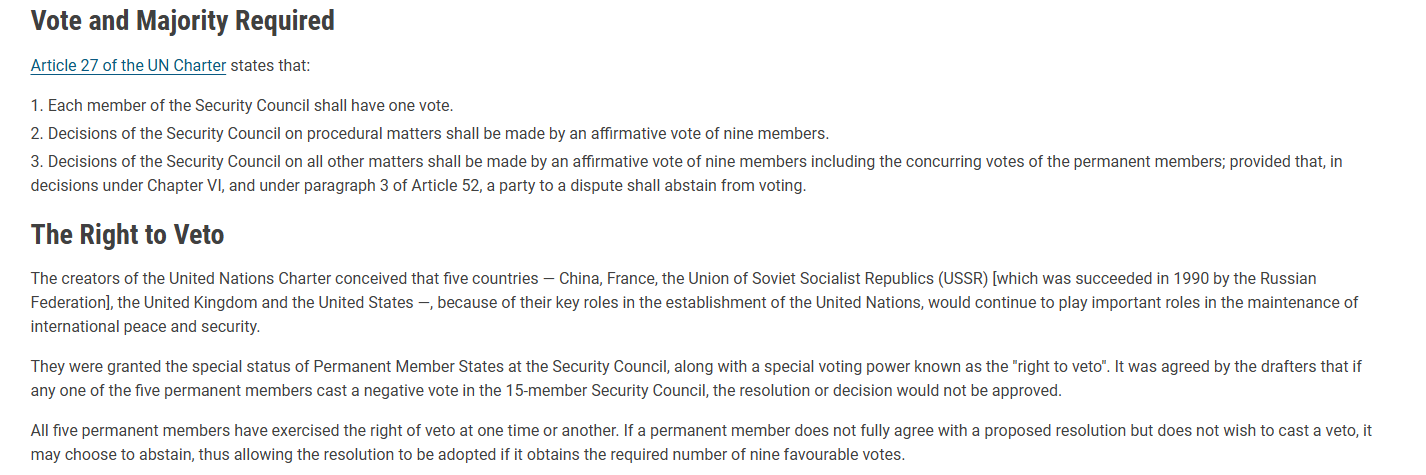
This UN reference page summarizes the Security Council’s voting rules, distinguishing procedural decisions (nine affirmative votes) from substantive decisions (nine affirmative votes including concurrence of the permanent members). It explains the veto as a built-in institutional mechanism that can prevent adoption of a draft resolution even when a majority supports it. As an example of a formal rule, it shows how procedures translate into concrete constraints on political outcomes. Source
Norm: A shared expectation about appropriate behavior that influences how political actors believe they should act.
Norms may be informal, but they still matter politically because they shape reputation, legitimacy, and pressure from others. A state may be able to ignore a norm, but doing so can create criticism, mistrust, or diplomatic costs.
Although rules and norms are different, they frequently reinforce one another. A legal rule can reflect an established norm, and a norm can later be written into law or organizational procedure.
Where rules and norms come from
Formal sources
Some rules come from clearly recognized legal or political processes, including:
constitutions
treaties and conventions
charters of international organizations
domestic legislation
court rulings
formal procedural rules for voting, membership, or negotiation
These sources matter because they specify authority, procedures, and limits. For example, decision-making rules in an international body can determine whether action requires a majority vote, consensus, or approval from particular members.

This bar chart shows how many UN Security Council draft resolutions have been vetoed by each of the five permanent members over time (1946–2024). It illustrates how an institutional rule—the veto—can significantly constrain collective action even when many states favor a response. The figure helps connect procedural design to real-world limits on international decision-making. Source
Informal sources
Other expectations emerge through repeated practice rather than a single legal document. These include:
custom
diplomatic protocol
precedent
professional standards
shared moral expectations
Informal norms can become extremely influential over time.
If actors repeatedly behave in a certain way and treat that behavior as appropriate, it may become a strong expectation even without strict enforcement.
Institutions matter because they carry rules and norms into daily political practice. Meetings, negotiations, elections, and legal processes all embed expectations about who can speak, how decisions are made, and what counts as acceptable conduct.
How rules and norms regulate political interaction
Setting boundaries for action
Rules and norms define the range of politically acceptable responses. They can:
permit certain actions
prohibit certain actions
require consultation, reporting, or authorization
prioritize some values over others
This means political actors do not simply ask, “What do we want?” They also ask, “What are we allowed to do?” and “What can we justify publicly?”
A clear example is the importance of sovereignty and non-intervention. These principles do not eliminate conflict, but they create boundaries around when and how external actors can interfere in domestic affairs.
Creating predictability
Rules and norms reduce uncertainty. When actors share expectations about procedure and conduct, cooperation becomes easier because participants can anticipate how others are likely to behave.
This is especially important in areas such as:
treaty negotiations
elections
dispute resolution
diplomacy
responses to humanitarian crises
Predictability does not remove disagreement, but it makes political interaction more manageable. Even rivals often prefer a structured process to complete uncertainty.
Shaping legitimacy
Political action is judged not only by outcomes but also by whether it appears legitimate. Rules and norms influence legitimacy by defining what is seen as fair, lawful, responsible, or appropriate.
An action that follows accepted rules may gain support even if it is controversial. By contrast, an action that appears to violate a widely accepted norm may lose support even if it is effective in the short term.
Because of this, political actors often justify decisions in rule-based or norm-based language. They may appeal to international law, constitutional procedure, human rights standards, or democratic practice in order to defend their choices.
How rules and norms shape or limit responses to political issues
Rules and norms do not determine outcomes automatically, but they channel responses into some options and away from others.
They shape responses by:
identifying legitimate goals
defining proper procedures
encouraging cooperation
giving actors a common language for negotiation and criticism
They limit responses by:
banning or restricting certain tools
raising legal or reputational costs
slowing decisions through procedural requirements
making some strategies politically unacceptable
For example, rules on due process can limit emergency government action. Human rights norms can pressure leaders to justify detention, surveillance, or use of force. Organizational rules can delay action if approval must come through a formal vote. In each case, the response to an issue is filtered through an existing framework rather than chosen in isolation.
These constraints are not always negative. Limits can protect rights, prevent abuse, and reduce arbitrary decision-making. However, they can also frustrate actors who want faster or more flexible responses.
Compliance, contestation, and change
Political actors do not always follow rules and norms, but even noncompliance shows their importance. Violations often trigger justification, denial, or attempts to reinterpret the rule, which suggests that the standard still matters.
Actors may comply because of:
fear of penalties
concern for reputation
desire for reciprocity
belief that the rule or norm is appropriate
pressure from domestic or international audiences
Rules and norms are also contested. Different actors may disagree about what a rule means, whether a norm applies in a specific case, or which principle should take priority when standards conflict.
Over time, rules and norms can change. New circumstances, repeated challenges, public pressure, or shifting values may alter what is treated as acceptable. Some norms become stronger and more widely institutionalized; others weaken when actors stop defending them consistently.
How to analyze them in IB Global Politics
When examining a political issue, focus on the regulatory role of rules and norms rather than simply naming them. Useful questions include:
What specific rule or norm is relevant?
Is it formal, informal, or both?
How does it affect what actors can realistically do?
Does it increase or reduce an actor’s legitimacy?
Who benefits from the existing framework, and who is constrained by it?
Is the rule or norm broadly accepted, or actively contested?
This approach keeps attention on the syllabus focus: rules, norms, and institutions as forces that organize interaction and shape the range of political responses.
Practice Questions
(2 marks): Distinguish between a rule and a norm in global politics.
1 mark for identifying a rule as an explicit law, standard, or procedure guiding behavior.
1 mark for identifying a norm as a shared expectation of appropriate behavior, often informal.
(6 marks): Explain two ways rules and norms can shape or limit responses to political issues.
Award up to 3 marks for each way explained, to a maximum of 6 marks.
For each way:
1 mark for identifying a relevant way rules or norms shape or limit responses.
1 mark for explaining how that mechanism operates in political interaction.
1 mark for developing the explanation with a relevant implication or political example.
Relevant answers may include limits on acceptable action, procedural requirements, effects on legitimacy, reputational pressure, or improved coordination.
FAQ
Soft law includes declarations, guidelines, codes of conduct, and political commitments that are not fully enforceable like treaties.
It matters because it can still shape expectations, influence policy choices, guide international organizations, and provide standards for criticism. Soft law often acts as a testing ground for stronger future rules and can gradually harden into more formal obligations.
Customary norms usually develop through two elements:
consistent state practice
a belief that the practice is expected or required
Evidence can include official statements, military manuals, diplomatic behavior, court decisions, and voting patterns in international forums.
The process is often slow and disputed. States may agree that a practice exists but disagree about whether it has become a real norm or how far it applies.
A reservation is a formal statement made when joining a treaty that limits or interprets part of the obligation.
A derogation is a temporary suspension of certain obligations when a treaty itself allows this under specific conditions, often during emergencies.
A violation is a breach without a valid legal basis. These distinctions matter because they affect whether an actor is lawfully adjusting its commitments or simply breaking them.
Diplomatic protocols cover issues such as titles, seating order, flag placement, visit schedules, and forms of address.
They matter because symbolism affects status, recognition, and respect. A protocol dispute can signal exclusion, downgrade a relationship, or create tension even when no major legal rule has been broken. In high-stakes diplomacy, symbolic slights can shape trust and negotiation outcomes.
The answer depends on the political and legal system. Some states allow international law to have direct domestic effect, while others require domestic legislation first.
Even if a government follows domestic law, it may still face international criticism or legal responsibility if that domestic law conflicts with an international commitment. Common responses include:
amending the law
reinterpreting the rule
filing legal challenges
negotiating exceptions
withdrawing from the agreement