

IB Syllabus focus: 'Proprioceptors, baroreceptors and chemoreceptors are specialized cells that respond to stimuli and initiate nervous system responses. Their internal cellular function is not assessed.'
The body depends on rapid sensory feedback to detect movement, pressure, and chemical change, allowing appropriate nervous responses that support posture, circulation, and breathing during rest and exercise.
Detecting change and starting a response
Before the body can adjust to a changing situation, it must first detect that something has changed. Sensory receptors are the first stage in this process. They respond to a specific stimulus, send information to the central nervous system, and help trigger an appropriate response. In IB SEHS, the key focus is the type of stimulus each receptor detects and the general body response that follows, rather than the detailed cellular events inside the receptor itself.
Sensory receptor: A specialized cell or structure that detects a stimulus and helps initiate a nervous system response.
Sensory receptors work continuously. They provide feedback during both normal daily activity and exercise, helping the body adapt quickly to internal and external demands. In this subsubtopic, the main receptors are proprioceptors, baroreceptors, and chemoreceptors.
Proprioceptors
Proprioceptors provide information about body position and movement.
Proprioceptor: A receptor that detects body position, joint movement, muscle stretch, or muscle tension.
Proprioceptors are located in structures such as muscles, tendons, and joints.
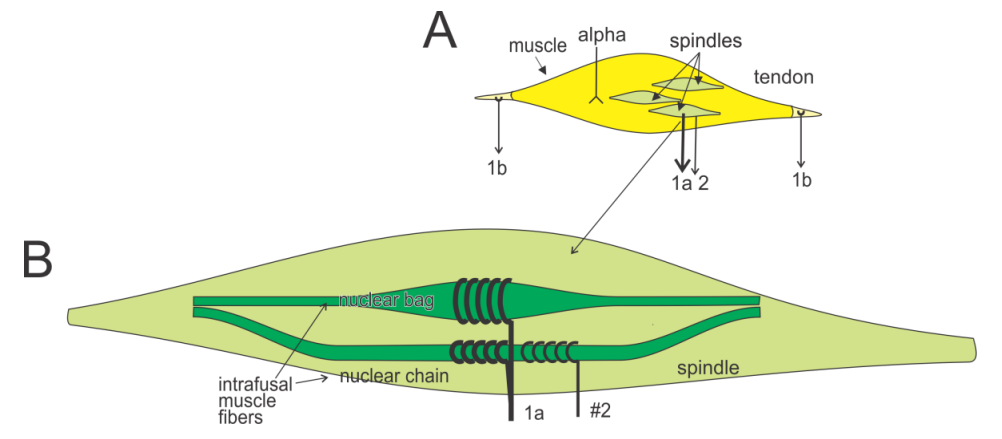
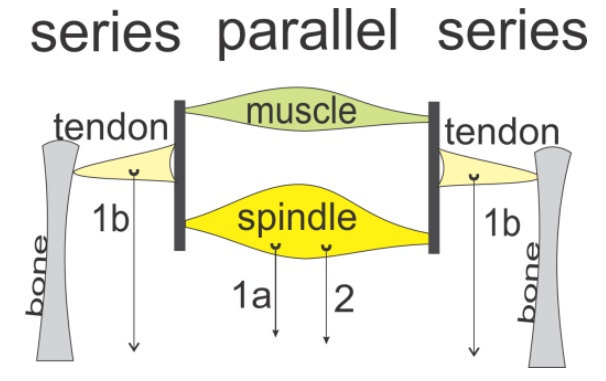
Schematic diagrams of muscle spindles and Golgi tendon organs, emphasizing their different placements relative to skeletal muscle fibers (spindles in parallel; Golgi tendon organs in series within the tendon). This positioning helps explain why spindles primarily signal muscle length/stretch and rate of stretch, while Golgi tendon organs primarily signal muscle tension/force. Source
They allow the nervous system to monitor where body parts are, how fast they are moving, and whether muscles are lengthening or generating tension. This information is essential for coordination, balance, and postural control.
Proprioceptors are especially important in sport and exercise because many movements must be controlled without constantly looking at the body. For example, an athlete landing from a jump or changing direction rapidly depends on proprioceptive input to make quick muscular adjustments. If movement is not well controlled, technique may deteriorate and injury risk may increase.
A major point for IB SEHS is that proprioceptors help initiate responses that adjust muscle activity. When a joint angle changes suddenly or a muscle is stretched unexpectedly, the nervous system can respond by changing muscle contraction patterns. This helps maintain stability and efficient movement. You do not need to know the receptor’s internal cellular mechanism, only what it detects and the type of response it helps produce.
Baroreceptors
Baroreceptors monitor changes in blood pressure.
Baroreceptor: A receptor that detects changes in pressure by sensing stretch in blood vessel walls.
Baroreceptors are found mainly in major arteries, especially around the carotid arteries and aorta.
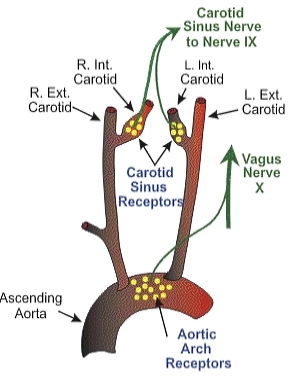
Diagram of the arterial baroreceptor pathway showing baroreceptors located in the carotid sinus and aortic arch and their afferent signaling routes via the glossopharyngeal nerve (CN IX) and vagus nerve (CN X). It summarizes how pressure-related stretch information is rapidly relayed to the brainstem to adjust cardiovascular output and stabilize blood pressure. Source
When blood pressure rises, artery walls stretch more, and baroreceptors detect this increased stretch. When blood pressure falls, stretch is reduced, and receptor input changes accordingly.
Their role is to help the nervous system maintain a relatively stable blood pressure. If pressure becomes too high, nervous responses can reduce it toward normal. If pressure drops, nervous responses can increase it. This is important because tissues, especially the brain, need a reliable blood supply.
Baroreceptors are highly relevant during movement and exercise transitions. For example, when a person stands up quickly, blood pressure may briefly drop. Baroreceptor input helps trigger a rapid compensatory response so that blood flow to the brain is maintained. During physical activity, these receptors continue to provide information that supports cardiovascular regulation. For this course, emphasis should stay on the stimulus detected and the general response, not the detailed receptor physiology.
Chemoreceptors
Chemoreceptors detect chemical changes in the blood and body fluids.
Chemoreceptor: A receptor that responds to changes in chemical conditions such as carbon dioxide, hydrogen ion concentration, or oxygen.
Chemoreceptors are important because exercise changes the chemical environment inside the body. As working muscles produce more carbon dioxide, and as acidity rises, chemoreceptors detect these changes and send information to the nervous system. In some situations, low oxygen concentration can also stimulate chemoreceptors.
The main body response linked to chemoreceptor activity is an adjustment in breathing.
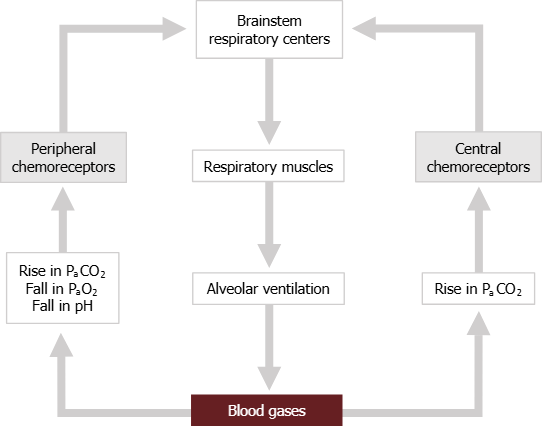
Block-diagram of the chemoreflex circuit linking changes in blood gases to ventilatory control. It contrasts central chemoreceptors (primarily driven by CO2-related signals) with peripheral chemoreceptors (responsive to CO2, O2, and pH), and shows how their input to brainstem respiratory centers increases alveolar ventilation to restore homeostasis. Source
When carbon dioxide and hydrogen ion concentration rise, ventilation increases so that more carbon dioxide can be removed and gas exchange can remain effective. This helps support normal function during exercise and contributes to maintaining internal balance.
Chemoreceptors therefore play a major role in linking metabolic demand to respiratory response. They help explain why breathing becomes deeper and faster as exercise intensity increases. As with the other receptors in this topic, students are not required to learn the receptor’s internal cellular action. The focus is on the stimulus detected and the resulting nervous system response.
Comparing the receptor types
Although all three receptor types help initiate nervous responses, they each monitor a different kind of change:
Proprioceptors detect mechanical changes related to position, movement, stretch, and tension.
Baroreceptors detect pressure-related stretch in arterial walls.
Chemoreceptors detect chemical changes such as altered carbon dioxide, hydrogen ion concentration, or oxygen.
A useful way to think about all three is as a sequence:
Stimulus changes
Receptor detects the change
Information is sent to the nervous system
A body response is initiated
The response may involve a change in muscle activity, blood vessel behavior, heart function, or breathing pattern, depending on the receptor involved. For exam purposes, you should be able to identify each receptor, state the main stimulus it detects, and describe the broad type of response that follows. You do not need to explain the internal cellular function of these receptors.
Practice Questions
State the main stimulus detected by: a) baroreceptors b) chemoreceptors
1 mark for stating that baroreceptors detect changes in blood pressure or stretch in arterial walls
1 mark for stating that chemoreceptors detect changes in chemical conditions, such as carbon dioxide, hydrogen ion concentration/pH, or oxygen
Explain how proprioceptors, baroreceptors, and chemoreceptors initiate body responses during physical activity.
1 mark for explaining that proprioceptors detect body position, movement, muscle stretch, or tension
1 mark for linking proprioceptor input to coordination, balance, posture, or rapid muscle adjustment
1 mark for explaining that baroreceptors detect changes in blood pressure/stretch in arteries
1 mark for linking baroreceptor input to nervous responses that help stabilize blood pressure or maintain blood flow
1 mark for explaining that chemoreceptors detect changes in carbon dioxide, hydrogen ion concentration/pH, or oxygen and trigger changes in ventilation
Award up to 5 marks total
FAQ
An ankle sprain can damage ligaments and the sensory receptors inside them. Swelling and pain may also interfere with normal sensory feedback.
As a result, the brain receives less accurate information about joint position, which can reduce balance and increase the chance of another injury. This is one reason rehabilitation often includes balance and stability exercises.
Vision gives external information about where the body is in space, but proprioception gives internal information about limb position and movement even when you are not looking.
Proprioceptive feedback is also very fast and supports automatic corrections. In rapid sports movements, vision alone is usually too slow to manage every adjustment.
Both detect chemical change, but they monitor different locations and are especially sensitive to slightly different signals.
Central chemoreceptors mainly respond to carbon dioxide-related changes in the fluid around the brain.
Peripheral chemoreceptors are located in major arteries and respond to arterial oxygen as well as carbon dioxide and hydrogen ion concentration.
This helps the body regulate breathing with very fine control.
When exercise stops abruptly, blood can pool in the lower limbs because the muscle pump becomes less active. This can reduce venous return and briefly lower blood pressure.
Baroreceptors detect the drop and try to correct it, but the adjustment is not always immediate. A cool-down helps by keeping blood moving and reducing the sudden cardiovascular shift.
Yes, especially for movement-related control. Balance training, agility work, and skill practice can improve how effectively the body uses proprioceptive information.
Aerobic training may also support better cardiovascular reflex control in some people, although age, fatigue, and injury still affect receptor performance. Improvements often come from better nervous system coordination as much as from the receptors themselves.
