

IB Syllabus focus: 'The endocrine system, made up of glands and hormones, regulates biological processes. Hormones are mediator molecules released in one body region that regulate cells in other regions.'
Hormonal communication allows one part of the body to influence another. Understanding glands, hormones, and target cells explains how the endocrine system coordinates many essential processes for health and performance.
The endocrine system
The endocrine system is a bodywide communication system that helps regulate activity in different tissues and organs. Its main components are glands that produce chemical messengers and release them so they can act elsewhere in the body.
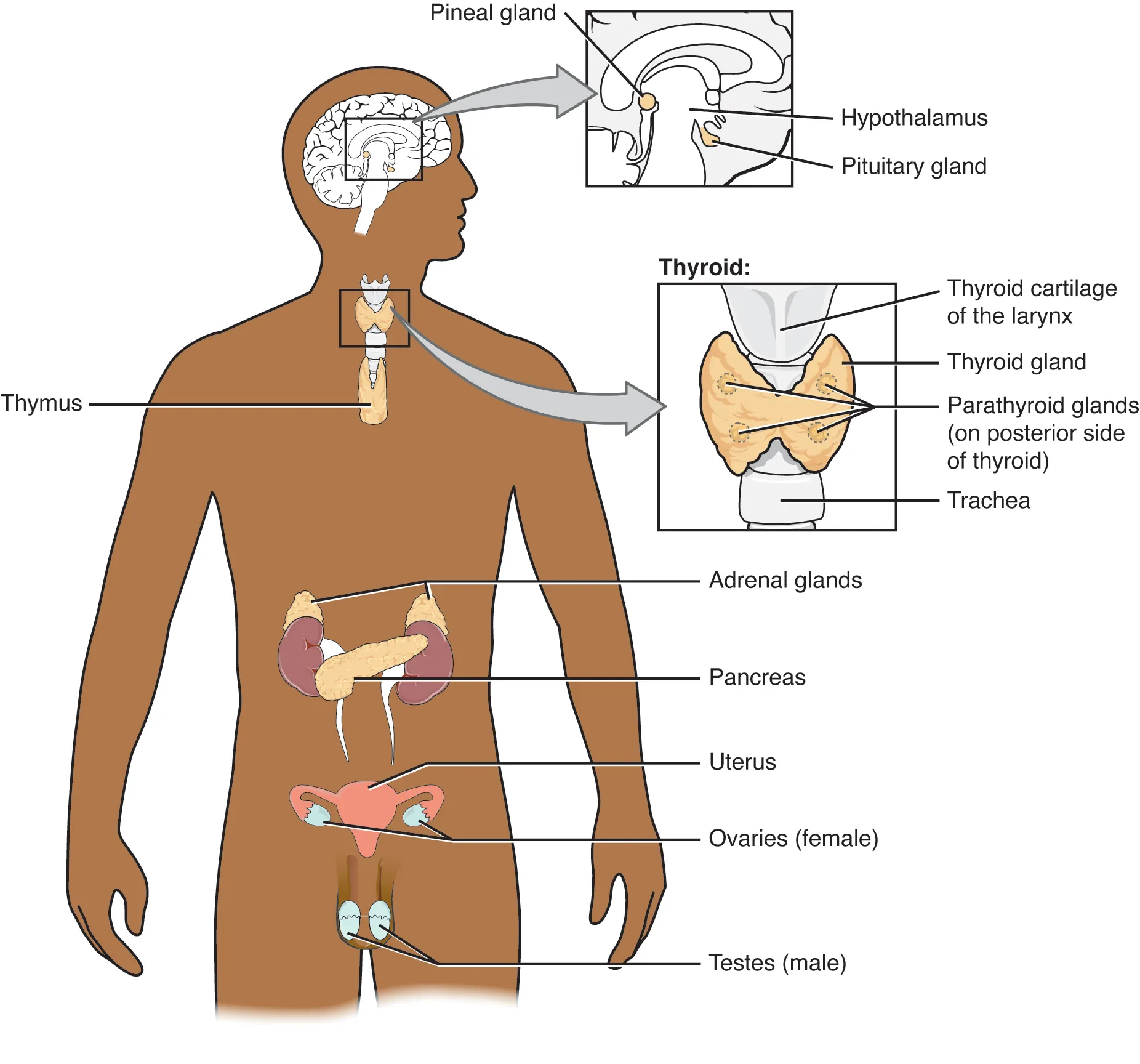
Major endocrine glands are distributed throughout the body (e.g., pituitary, thyroid, adrenals, pancreas, and gonads). This diagram emphasizes that endocrine regulation is “bodywide” because hormones released from many different anatomical sites enter circulation and act at distant targets. Source
Endocrine system: A system of glands that secretes hormones to regulate cells, tissues, and organs throughout the body.
Unlike a signal that stays local, endocrine communication is designed for long-distance regulation. A gland releases a hormone in one region, and that hormone reaches cells in another region, allowing the body to coordinate functions across many structures at once. This makes the endocrine system important for maintaining organized, controlled body function.
Endocrine glands
Glands are specialized structures that make and release secretions. In the endocrine system, glands release hormones directly into the internal environment so they can be transported to distant parts of the body.
Endocrine glands do not all perform the same role. Different glands produce different hormones, and each hormone is linked to particular biological processes.
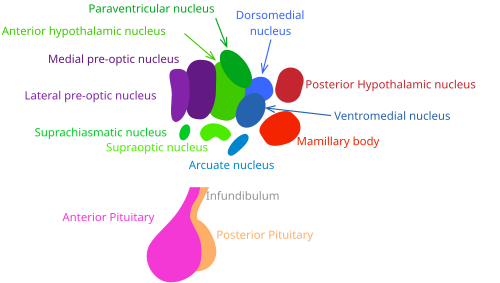
The hypothalamus and pituitary illustrate how endocrine signals can be organized hierarchically, with one region releasing hormones that influence other tissues. A labeled structural diagram helps connect the idea of “different glands” to real anatomy and supports later learning about hormone control pathways. Source
The amount released can change according to the body’s needs, so endocrine regulation is dynamic rather than fixed. This allows the body to adjust processes such as growth, metabolism, maturation, and internal balance over time.
Hormones as mediator molecules
A hormone acts as a chemical messenger within the body.
Hormone: A mediator molecule released in one body region that regulates cells in other regions.
The word mediator is important. A hormone does not simply exist in the blood; it carries information from the gland that released it to the cells that need to respond. In this way, hormones help link separate parts of the body into a coordinated whole.
Hormones are effective because they can be released in small amounts and still produce meaningful changes in body function. Their role is regulatory rather than structural. In other words, hormones do not usually build tissues directly; instead, they influence how cells behave. A hormone may increase or decrease activity in a tissue, change the rate of a process, or alter what substances a cell takes up, stores, or releases.
Target cells and receptors
A hormone does not affect every cell it reaches; it acts only on a target cell.
Target cell: A cell that has the specific receptor needed to detect and respond to a particular hormone.
This specificity is essential. Many hormones circulate widely, but only cells with the correct receptors can respond. A receptor is a protein that recognizes a particular hormone. When the hormone binds to its receptor, the target cell changes its activity.
This explains why one hormone can travel throughout the body without causing the same effect everywhere. Cells without the correct receptor are not directly regulated by that hormone. Cells with the receptor may respond strongly. As a result, endocrine regulation is both widespread and selective: hormones can be distributed broadly, but their effects remain focused on the right tissues.
How endocrine regulation occurs
Endocrine regulation follows a clear communication pathway:
A gland detects that a change in body function is needed.
The gland secretes a hormone.
The hormone enters the bloodstream or internal circulation.
It is transported from the release site to other body regions.
It reaches cells throughout the body, but only target cells with the correct receptors respond.
The responding cells change their activity, helping regulate a biological process.
This sequence shows why hormones are described as molecules released in one place and acting in another. The key feature is communication across distance. The endocrine system therefore provides a way to coordinate organs and tissues that are physically separated but functionally connected.
Biological processes regulated by hormones
The endocrine system regulates a wide range of biological processes. These include processes related to growth and development, where hormones help control the pace and pattern of change over time. They also include metabolism, where hormones influence how the body uses, stores, and mobilizes energy.
Hormones also help regulate maturation and reproductive function, ensuring that body processes occur at appropriate times and in the correct sequence. In addition, endocrine control contributes to maintaining stable internal conditions by adjusting cell activity when demands change.
Another key point is that endocrine regulation supports coordination between body systems. A hormone released by one gland can influence cells in several tissues, allowing a single signal to produce an organized response. This is useful when the body must adjust multiple processes together rather than one process in isolation.
Because hormones regulate rather than directly perform a function, their effects depend on the responsiveness of the target cells. If the signal is released but the target cells do not respond appropriately, regulation is disrupted. Effective endocrine control therefore depends on three linked components: a functioning gland, release of the correct hormone, and responsive target cells with the proper receptors.
Practice Questions
Define a hormone. [1]
A hormone is a mediator molecule or chemical messenger released in one body region that regulates cells in other regions. (1)
Explain how the endocrine system regulates biological processes through glands, hormones, and target cells. [5]
States that the endocrine system is made up of glands and hormones. (1)
Explains that glands secrete hormones. (1)
Explains that hormones are released in one body region. (1)
Explains that hormones are transported to or act on cells in other regions. (1)
Explains that only target cells with the correct receptors respond, leading to regulation of a biological process. (1)
FAQ
Different tissues may have different receptor types or different amounts of the same receptor.
Once the hormone binds, each cell may activate a different internal signaling pathway. This means one hormone can cause different responses depending on the target tissue.
An endocrine gland releases hormones into the internal environment so they can act on distant target cells.
An exocrine gland releases its products through ducts to a surface or cavity. For example:
endocrine secretion is for signaling
exocrine secretion is usually for transport, digestion, lubrication, or protection
Hormones are powerful because target cells have specific receptors that can detect low concentrations.
After binding, the signal is often amplified inside the cell. A small hormonal signal can therefore trigger a much larger cellular response.
No. Some hormones dissolve easily in plasma and travel freely.
Others do not dissolve as easily and are carried by transport proteins. This can affect:
how long they stay in circulation
how quickly they reach target tissues
how long their effects last
The hormone may still be released normally, but the cell response becomes reduced.
This can happen if:
receptor numbers decrease
receptors change shape
signaling inside the cell becomes less effective
When sensitivity falls, endocrine regulation becomes less efficient even if hormone levels are unchanged.
