

IB Syllabus focus: 'The cardiovascular system transports nutrients, hormones, gases, heat and waste. Heart rate, stroke volume, cardiac output, blood pressure and blood redistribution vary with age, sex differences, body size, fitness, activity type and intensity.'
This topic focuses on how the cardiovascular system supports exercise by moving materials around the body and how key circulatory variables respond to different physical demands.
Cardiovascular transport during exercise
The cardiovascular system includes the heart, blood, and blood vessels. Its main role is transport. During exercise, this transport function becomes more important because working muscles need a rapid and continuous supply of materials and an efficient removal of by-products.
Key transport roles include:
delivering oxygen and nutrients such as glucose to active tissues
carrying hormones in the blood to target cells
removing carbon dioxide and other waste products
moving heat from active muscles to other parts of the body
These roles help maintain performance during exercise. If transport cannot match demand, fatigue develops more quickly and exercise intensity must drop.
Heart rate, stroke volume, and cardiac output
Heart rate changes quickly with exercise and is one of the easiest cardiovascular measures to observe.
Heart rate: The number of times the heart beats each minute.
As exercise intensity increases, heart rate usually increases in a near-linear way. This helps the body pump more blood to active muscles. Resting heart rate is often lower in fit individuals because each beat can pump more blood. Maximum heart rate generally decreases with age. At the same absolute workload, females and smaller individuals may show a slightly higher heart rate because their stroke volume is often lower.
Stroke volume is the amount of blood pumped from the heart in one beat, usually referring to the left ventricle.
Stroke volume: The amount of blood ejected by the left ventricle in one heartbeat.
Stroke volume usually rises from rest to moderate exercise. This happens because more blood returns to the heart and the heart contracts more forcefully. In many people, stroke volume then reaches a plateau at higher intensities, although highly trained endurance athletes may continue to increase it. Larger body size and better aerobic fitness are usually associated with a greater stroke volume, while older age may reduce maximal stroke volume.
Cardiac output is the total volume of blood pumped by the heart each minute.
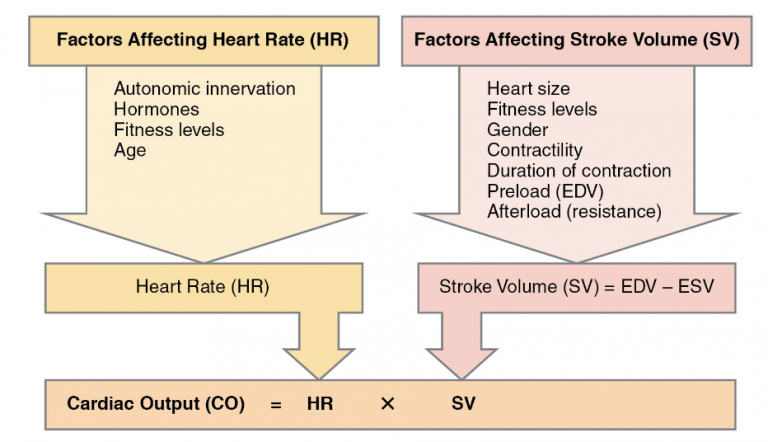
This flow chart organizes cardiac output as the combined result of heart rate and stroke volume, and maps common physiological influences onto each component. It helps you integrate the syllabus theme that cardiovascular variables vary with factors such as fitness, age, and hormonal/autonomic control. Read it as a “cause → component (HR or SV) → effect on CO” diagram. Source
It is a major determinant of how much oxygen and fuel can reach working muscles.
= cardiac output, usually
= heart rate,
= stroke volume, usually
As exercise intensity rises, cardiac output rises sharply because heart rate increases and stroke volume usually increases as well.
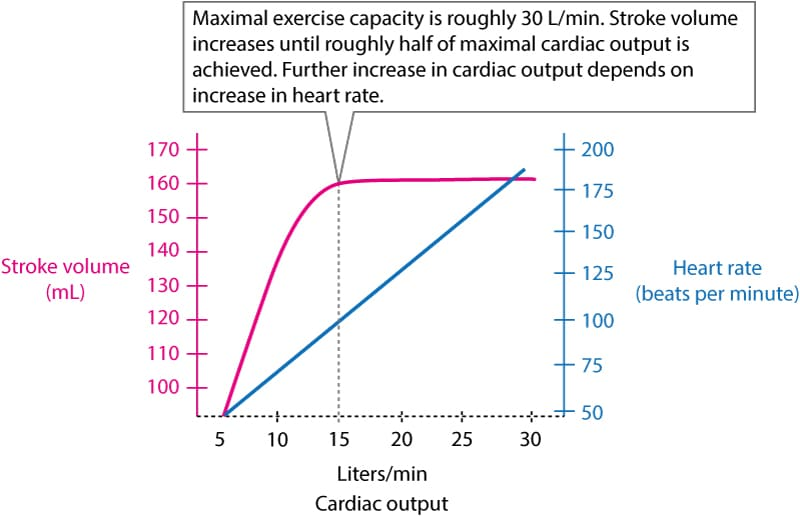
This figure summarizes the typical exercise-intensity response patterns of heart rate, stroke volume, and cardiac output. It highlights that HR tends to rise progressively, SV rises from rest and often plateaus at higher intensities, and therefore cardiac output increases markedly across the work range. Use it to visually connect the equation to real physiological responses during graded exercise. Source
A trained endurance athlete can achieve a much higher maximal cardiac output than an untrained person, mainly because of a larger stroke volume rather than a higher maximal heart rate.
Blood pressure responses
Blood pressure is the force of blood against artery walls. Systolic pressure is measured during ventricular contraction, and diastolic pressure is measured during ventricular relaxation.
During dynamic aerobic exercise, systolic blood pressure rises with intensity because more blood is being pumped each minute. Diastolic blood pressure usually changes very little, or may fall slightly, because blood vessels in active muscles dilate and reduce resistance.
During static exercise or heavy resistance exercise, blood pressure can rise much more. This is because forceful muscle contractions compress blood vessels and increase resistance to blood flow. Blood pressure responses are also affected by age, body size, and fitness. Older or less fit individuals often have a higher resting blood pressure and may show a greater rise during exercise.
Blood redistribution
The body does not send blood equally to all tissues during exercise. Instead, blood redistribution directs more flow to places with the greatest immediate need.
At rest, a large share of blood flow goes to organs such as the:
digestive system
liver
kidneys
During exercise:
working muscles receive much more blood to support energy production
skin may receive more blood to help transport heat away from the body
digestive organs and kidneys receive less blood
brain blood flow is maintained because it is essential for normal function
This redistribution becomes more pronounced as exercise intensity increases. It is a key reason why the cardiovascular system can match blood supply to changing demands.
Factors that affect cardiovascular variables
Age
Maximum heart rate generally decreases with age.
Maximal cardiac output may fall if both heart rate and stroke volume are lower.
Blood vessels may become less elastic, contributing to higher blood pressure.
Sex differences
Males often have a greater stroke volume and higher maximal cardiac output, partly because of larger heart size and blood volume.
Females may show a slightly higher heart rate at the same absolute workload.
These are general trends and can be modified by training.
Body size
Larger individuals usually have a greater absolute stroke volume and cardiac output.
Smaller individuals may need a higher heart rate to produce the same absolute cardiac output.
Fitness
Endurance training usually lowers resting heart rate.
It increases stroke volume and can increase maximal cardiac output.
Fit individuals often perform the same submaximal exercise with a lower heart rate and a smaller blood pressure response.
Activity type and intensity
As intensity increases, heart rate, cardiac output, and systolic blood pressure increase.
Activities using large muscle groups, such as running or cycling, create a large demand for blood flow.
Resistance exercise may produce especially high blood pressure because of vessel compression during contractions.
Practice Questions
State two functions of the cardiovascular system during exercise. [2]
1 mark for each correct function, up to 2 marks.
Accept any two of:
transports nutrients
transports hormones
transports gases such as oxygen or carbon dioxide
transports heat
removes waste products
Explain how heart rate, stroke volume, cardiac output, blood pressure, and blood redistribution change from rest to vigorous dynamic exercise, and outline one effect of endurance training on these responses. [6]
Heart rate increases as exercise intensity increases. [1]
Stroke volume increases from rest to moderate exercise and may then plateau in many individuals. [1]
Cardiac output increases because . [1]
Systolic blood pressure increases during vigorous dynamic exercise. [1]
Diastolic blood pressure usually changes little or may decrease slightly during dynamic exercise. [1]
Blood is redistributed toward working muscles and skin, with less flow to digestive organs and kidneys. [1]
Award full 6 marks for any six valid points, including one clear effect of endurance training such as lower resting or submaximal heart rate, greater stroke volume, or higher maximal cardiac output.
FAQ
Because cardiac output depends on both heart rate and stroke volume, one athlete can pump the same total volume of blood with fewer beats if each beat ejects more blood.
This is common in endurance athletes. A larger, more efficient stroke volume lets them maintain the same $Q$ at a lower heart rate during submaximal exercise.
As exercise intensity rises, the heart has less time to fill between beats. At some point, filling time becomes too short for stroke volume to keep rising much further.
Training status matters. Highly trained endurance athletes often delay this plateau because they have stronger ventricular filling and contraction, so stroke volume can keep increasing longer.
Body position changes venous return. In a supine position, blood returns to the heart more easily because gravity has less effect.
This usually means stroke volume is higher and heart rate can be lower at the same workload compared with upright exercise. In standing exercise, the body often relies more on an increased heart rate to maintain cardiac output.
Pulse pressure is the difference between systolic and diastolic blood pressure: $PP = SP - DP$.
During dynamic exercise, systolic pressure rises while diastolic pressure often stays similar or falls slightly, so pulse pressure usually widens. This can give extra information about how strongly blood is being ejected and how the arteries are responding.
Upper-body exercise usually involves a smaller muscle mass and can create more vascular resistance. That makes it harder to deliver blood efficiently.
As a result, the body often responds with a higher heart rate and a greater blood pressure increase. This is why arm exercise can feel harder than leg exercise even when the external workload appears similar.
