

IB Syllabus focus: 'Minute ventilation, tidal volume and respiration rate vary with age, sex differences, body size, fitness, activity type and intensity. The respiratory system diagram is provided in the SEHS data booklet.'
During exercise, breathing changes rapidly to match the body’s rising demand for oxygen and carbon dioxide removal. Understanding these respiratory responses helps explain differences in performance between people, workloads, and activity types.
Key respiratory measures
Exercise increases the need for air to move in and out of the lungs. Three linked measures are used to describe this response: minute ventilation, tidal volume, and respiration rate. These measures are related, but they do not always change in the same way during activity.
Minute ventilation is the total amount of air moved each minute.
Minute ventilation: The total volume of air inhaled or exhaled per minute.
At rest, minute ventilation is relatively low because metabolic demand is low. As exercise begins, minute ventilation rises so that more air is available to support the needs of the body.
Tidal volume describes how much air is taken in or breathed out with each breath.
Tidal volume: The volume of air moved in or out of the lungs in one breath.
In the early stages of exercise, a large part of the rise in ventilation comes from breathing more deeply, so tidal volume usually increases quickly.
Respiration rate refers to how often breathing occurs.
Respiration rate: The number of breaths taken per minute.
As exercise becomes harder, respiration rate rises further and becomes increasingly important because tidal volume cannot keep increasing indefinitely.
The relationship between the three measures is shown below.
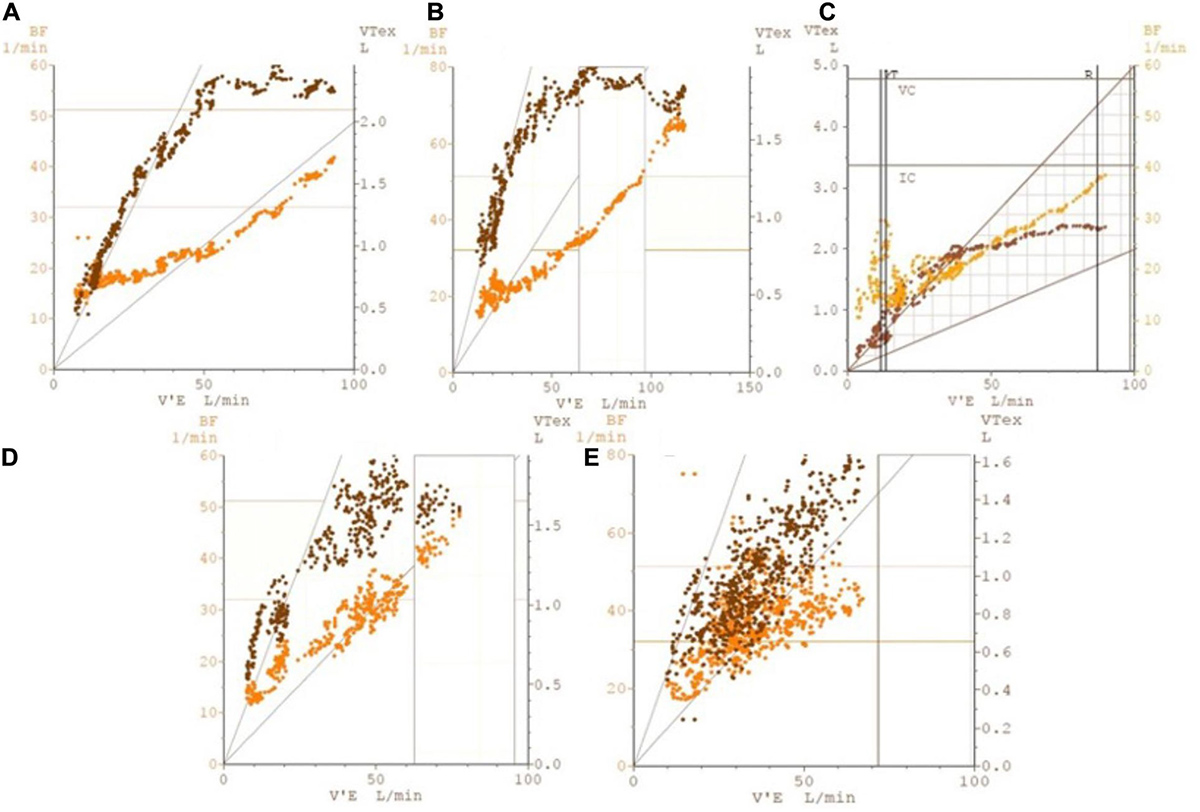
Illustrative plots of breathing frequency and tidal volume versus minute ventilation across an incremental exercise test. It highlights that minute ventilation can increase through different combinations of deeper breaths (higher tidal volume) and faster breaths (higher breathing frequency), which supports interpretation of different breathing patterns across workloads. Source
= Minute ventilation, in
= Tidal volume, in liters per breath
= Respiration rate, in breaths per minute
Because minute ventilation depends on both tidal volume and respiration rate, a change in either one changes total ventilation. From rest to moderate exercise, tidal volume usually makes a major contribution. At higher intensities, respiration rate often shows the larger additional increase.
Patterns of change during activity
At the start of exercise, ventilation increases quickly. This rapid rise helps the body adjust to the new workload. If exercise continues at a steady submaximal intensity, ventilation usually reaches a stable level that matches the demand of that workload.
If intensity keeps rising, minute ventilation continues to increase. This increase is not perfectly linear at very high workloads, because harder exercise creates a much greater need for air movement. Near maximal effort, both tidal volume and respiration rate are elevated, but respiration rate often rises most sharply late in exercise.

Two-panel plot showing how tidal volume increases with rising exercise demand before reaching a plateau, while respiratory frequency continues to rise more steeply at higher intensities. The figure reinforces why further increases in minute ventilation at high workloads rely more on breathing faster once depth of breathing is near its practical limit. Source
The breathing response also depends on the nature of the activity. Continuous endurance exercise usually causes a progressive and sustained increase in ventilation. Intermittent exercise, such as many team sports, causes repeated rises and partial recoveries. Very short maximal efforts may end before ventilation settles into a steady pattern.
Factors affecting respiratory responses
Age
Age influences respiratory responses because lung size and breathing efficiency change across the lifespan. Children usually have smaller lungs and lower tidal volumes, so they often rely more on a higher respiration rate during activity. Adults can usually achieve larger tidal volumes at the same relative intensity. In older adults, respiratory function may decline, which can reduce the ability to increase ventilation effectively during intense exercise.
Sex differences
Sex differences are general trends rather than rules for every individual. On average, males tend to have larger lungs and airways than females of similar age and training status. This often allows a larger tidal volume and greater absolute minute ventilation during exercise. Females may show a slightly higher respiration rate at the same absolute workload, partly because lung volumes are often smaller. However, there is considerable overlap between individuals.
Body size
Body size affects absolute respiratory values. Larger individuals usually have larger lungs and can move more air per breath, so tidal volume and absolute minute ventilation are often higher. Smaller individuals may meet the same task demands with relatively faster breathing. This means raw ventilation values should be interpreted carefully when comparing performers of different sizes.
Fitness
Fitness changes how efficiently a person breathes during exercise. At the same submaximal workload, a trained performer often shows a lower respiration rate and a larger tidal volume than an untrained person. This creates a more economical breathing pattern, with fewer but deeper breaths. During maximal exercise, trained athletes can usually reach a higher minute ventilation because they can sustain a greater workload and continue increasing ventilation at higher intensities.
Activity type and intensity
Activity type strongly affects breathing responses. Endurance activities such as distance running or cycling produce sustained increases in minute ventilation because aerobic demand remains high for long periods. Resistance training often causes shorter bursts of increased ventilation, with breathing varying between effort and recovery. Lower-intensity or skill-based activities usually produce smaller changes.
Intensity is one of the strongest immediate influences on respiratory response. As intensity increases:
Minute ventilation increases.
Tidal volume rises noticeably from rest to moderate exercise.
Respiration rate becomes increasingly important at high intensities.
This pattern occurs because deeper breathing is effective early in exercise, but tidal volume approaches a practical limit. After that point, further increases in minute ventilation depend more on breathing faster.
Using the SEHS data booklet
The SEHS data booklet includes a respiratory system diagram.
For this subsubtopic, students should use the diagram to recognize the respiratory structures involved in ventilation and relate those structures to the measured variables of minute ventilation, tidal volume, and respiration rate.
Practice Questions
State the equation for minute ventilation. [2]
or equivalent formula. (1)
Correct identification of as tidal volume and as respiration rate. (1)
Explain how respiratory responses change as exercise intensity increases, and discuss how fitness and body size can influence these responses. [5]
Minute ventilation increases as exercise intensity increases. (1)
Tidal volume increases from rest to moderate exercise. (1)
Respiration rate increases and becomes more important at high intensities. (1)
Trained performers often show lower respiration rate and higher tidal volume at the same submaximal workload, or can achieve higher maximal minute ventilation. (1)
Larger individuals often have higher absolute tidal volume or minute ventilation, while smaller individuals may rely more on higher breathing frequency. (1)
FAQ
Tidal volume cannot increase forever because the lungs, rib cage, and breathing muscles all have practical mechanical limits. As exercise intensity rises, breathing deeper becomes less efficient once those limits are approached.
At that stage, the easiest way to further raise minute ventilation is to increase breathing frequency. That is why respiration rate often rises sharply near maximal exercise.
Swimming limits when a breath can be taken because breathing must fit the stroke cycle and head position in the water. This can produce a lower respiration rate but a larger tidal volume per breath.
Runners usually have more freedom to breathe at any moment, so their breathing frequency can adjust more continuously to changing intensity.
Yes. Anxiety can raise breathing frequency before or during a test, even if the physical workload has not changed much. This may make early measurements seem higher than expected.
That is why familiarization, clear instructions, and a calm testing environment can improve the accuracy of respiratory data.
Minute ventilation shows how much air is moved per minute, but it does not show how that air movement is achieved. Two athletes may have the same minute ventilation with very different tidal volumes and respiration rates.
Looking at the pattern matters, because deeper, slower breathing may reflect a different response from shallow, rapid breathing at the same total ventilation.
Common problems include:
poor mask fit
air leaks
movement of the equipment
delayed recording during rapid intensity changes
disruption of natural breathing because the athlete is aware of being tested
Field data can still be useful, but they should always be interpreted with testing conditions in mind.
