

IB Syllabus focus: 'The energy continuum describes the relative contribution of each energy system according to activity type. The oxidative system dominates at rest and during extended submaximal activity.'
Energy for movement does not come from one system at a time. Instead, exercise intensity and duration shift the balance between systems, helping explain performance at rest, during steady exercise, and during sudden pace changes.
The energy continuum
The body must continuously resynthesize ATP, and it does this through three interacting energy systems: the phosphagen system, the glycolytic system, and the oxidative system. In practice, these systems always work together, but their relative contribution changes depending on the demands of the activity.
Energy continuum: the idea that all energy systems contribute to ATP production at all times, but their relative contribution changes according to exercise intensity, duration, and activity type.
This means energy supply is not an on/off process.
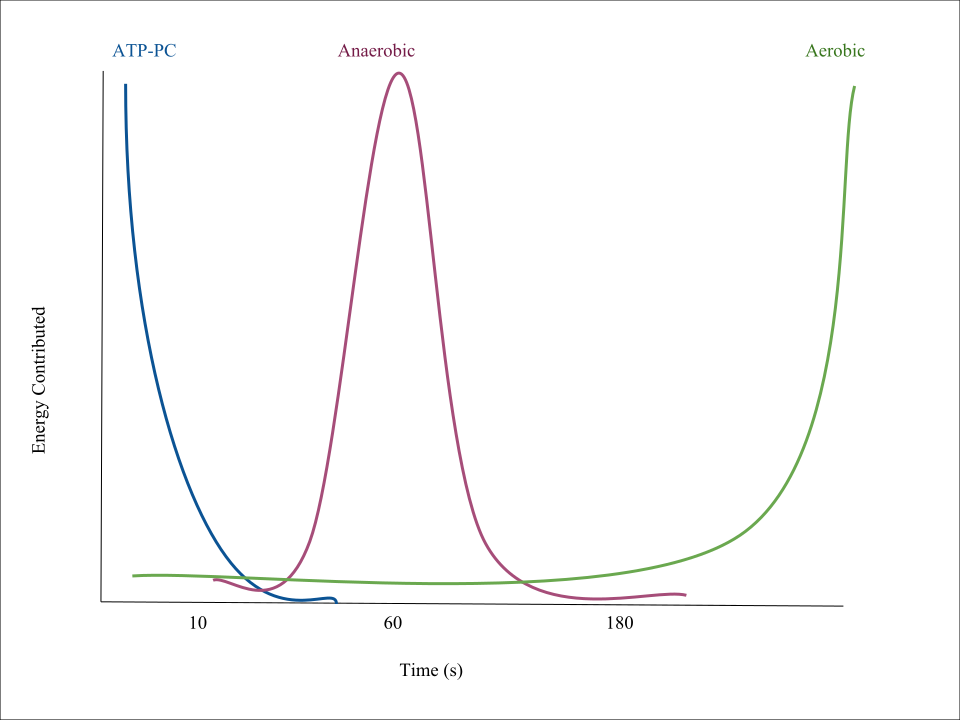
This graph illustrates the energy continuum by showing how ATP supply shifts from the phosphagen (ATP-PC) system to glycolytic pathways and then toward the oxidative system as exercise duration increases. It reinforces that all three systems contribute simultaneously, but with changing dominance depending on intensity and time. Use it to visualize why short, explosive efforts rely more on anaerobic pathways while longer efforts increasingly depend on aerobic metabolism. Source
One system does not suddenly stop while another starts. Instead, the dominant source of ATP shifts smoothly as exercise conditions change.
A useful way to think about the continuum is:
Low ATP demand: greater reliance on the oxidative system
Rapid or very high ATP demand: greater reliance on the phosphagen and glycolytic systems
Changing demands: a shifting blend of all three systems
Relative contribution, not complete separation
The key idea in this subtopic is relative contribution. Even at rest, the body is using ATP for essential functions such as breathing, circulation, and maintaining posture. During this time, the oxidative system dominates because ATP demand is low and oxygen supply is sufficient.
As soon as exercise begins, ATP demand rises.
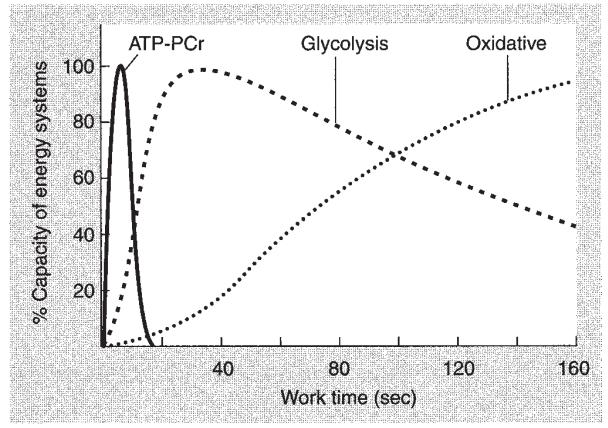
This figure summarizes how the three energy systems interact to resynthesize ATP across different exercise demands. It emphasizes that the phosphagen system supports very brief, high-intensity work; glycolysis contributes strongly during short-to-moderate durations at high intensity; and the oxidative system dominates during prolonged, lower-to-moderate intensity exercise. It’s a compact visual that pairs well with explanations of intensity changes (surges) causing shifts along the continuum. Source
The body cannot wait for one system to fully replace another, so multiple systems contribute immediately. Early in exercise, especially if the movement begins suddenly, the faster anaerobic pathways make a larger contribution. If the exercise then settles into a sustainable pace, the oxidative system increases its share of ATP production.
This is why the word continuum is important. It describes a sliding scale rather than separate categories. A performer may move along this scale many times within one session or one event.
Exercise intensity and activity type
Rest and very low-intensity activity
At rest, the body needs a relatively small amount of ATP. Because oxygen is readily available for these low demands, the oxidative system provides most of the ATP. The same general pattern is seen during very light activity such as walking slowly or easy movement between efforts.
The dominance of the oxidative system at rest does not mean the other systems are inactive. It means their contribution is much smaller.
Extended submaximal activity
Extended submaximal activity means exercise performed below maximal effort and sustained over a long period. Examples include steady jogging, continuous cycling at a moderate pace, or prolonged swimming.
During this type of activity:
ATP demand is elevated above rest, but still manageable
Oxygen delivery can meet most of the required energy demand
The oxidative system becomes the main supplier of ATP
This is why the specification emphasizes that the oxidative system dominates during extended submaximal activity. These conditions favor a system that can support ATP resynthesis over a long duration.
High-intensity exercise and sudden increases in pace
As exercise intensity increases, the required rate of ATP resynthesis rises. If the demand becomes very rapid, the relative contribution of the phosphagen and glycolytic systems increases.
This happens in activities such as:
sprint starts
explosive accelerations
repeated attacks in team games
a finishing kick near the end of a race
The important point is that a change in intensity causes a change in position on the energy continuum. A performer in a long event can still temporarily shift toward greater anaerobic contribution during a surge or sprint.
Why the oxidative system dominates at rest and during extended submaximal activity
The oxidative system is dominant in these situations because the overall ATP demand is either low or sustainably moderate. Under these conditions, the body has enough time and oxygen to supply most energy aerobically.
Its dominance in prolonged submaximal exercise is linked to three main features:
sustainability over long durations
suitability for steady ATP supply
effectiveness when exercise intensity remains below maximal
This does not mean submaximal exercise is easy. It means the intensity is low enough for the body to rely mainly on oxidative metabolism rather than depending heavily on faster anaerobic pathways.
Applying the continuum to sport
Different activities sit at different points on the continuum because they place different demands on the body.
A 100 m sprint involves a very high ATP demand in a short time, so anaerobic systems contribute more heavily.
A distance run at a steady pace depends mainly on the oxidative system because the effort is extended and submaximal.
In games sports such as soccer or basketball, the overall event lasts a long time, so oxidative contribution is important across the match, but repeated bursts cause temporary shifts toward greater anaerobic contribution.
In a middle-distance race, the contribution may change from the start, through the settled middle section, to the final sprint.
This makes the energy continuum especially useful for understanding real performance. Most sports are not powered by a single energy system. Instead, performers move along the continuum as the intensity and nature of the activity change.
Practice Questions
Define the energy continuum.
1 mark for stating that all energy systems contribute to ATP production at the same time.
1 mark for stating that their relative contribution changes according to exercise intensity and/or activity type.
Explain how the relative contribution of the energy systems changes from rest, to extended submaximal exercise, and then to a sudden sprint finish.
1 mark for stating that at rest the oxidative system is dominant.
1 mark for explaining that this is because ATP demand is low and oxygen supply is sufficient.
1 mark for stating that during extended submaximal exercise the oxidative system remains the main contributor.
1 mark for explaining that this is because the activity is sustainable and below maximal intensity.
1 mark for stating that during a sudden sprint finish the relative contribution of anaerobic systems increases.
1 mark for explaining that higher intensity requires ATP to be supplied more rapidly, so phosphagen and glycolytic contribution rises.
FAQ
Yes. The same external workload can produce different internal demands.
A fitter or more economical athlete may rely relatively more on the oxidative system at that speed, while a less trained athlete may require a greater anaerobic contribution because the effort represents a higher relative intensity for them.
A warm-up can help the oxidative system contribute earlier in the session.
This happens because:
heart rate and blood flow increase
muscle temperature rises
oxygen delivery and oxygen use become more efficient
As a result, the early reliance on anaerobic pathways may be reduced slightly compared with starting from complete rest.
Stop-start sports involve frequent changes in intensity rather than one steady demand.
Short accelerations, jumps, tackles, and brief recovery periods constantly shift the performer back and forth along the continuum. That means the dominant contribution can change many times within a few minutes, or even within a single play.
Because duration alone does not determine the continuum position.
Even in long events, athletes may:
start quickly
climb a hill
respond to an attack
sprint to the finish
Each of these moments raises ATP demand rapidly, increasing the relative contribution of anaerobic systems even though the overall event is mainly oxidative.
Pacing affects how often and how far an athlete shifts away from oxidative dominance.
Even pacing usually keeps the athlete closer to a steady oxidative contribution. Erratic pacing, with repeated surges, pushes the athlete more often toward anaerobic energy supply.
This can increase fatigue and make it harder to sustain performance later in the event.
