

IB Syllabus focus: 'The lactate inflection point is the maximum exercise intensity at which the body can metabolize lactate at the same rate as its production.'
This concept helps explain why endurance exercise can suddenly feel much harder as intensity rises. Understanding the lactate inflection point helps athletes judge sustainable pace, predict fatigue, and target training more precisely.
What the lactate inflection point means
The lactate inflection point is a key marker in exercise physiology.
Lactate inflection point: The maximum exercise intensity at which the body can metabolize lactate at the same rate as its production.
As exercise intensity increases, working muscles produce more lactate. At lower and moderate intensities, the body can remove and use this lactate efficiently. The inflection point is reached when lactate production and lactate clearance are still balanced, but any further increase in intensity causes lactate to accumulate rapidly.
Below this point, blood lactate remains relatively stable. Just above it, the curve becomes steeper because removal can no longer keep up with production. This is why the term inflection is used: it describes the point at which the blood lactate response changes noticeably.
The body produces lactate continuously, especially during exercise.
Lactate: A product of carbohydrate metabolism that can be transported in the blood and used as a fuel by other tissues.
Lactate is not simply a waste product. It can be transported in the blood and used as a fuel by other tissues, especially when oxygen delivery and oxidative capacity are adequate.
Physiological basis
The lactate inflection point does not represent a sudden switch from “aerobic” to “anaerobic” exercise. Instead, exercise intensity rises along a continuum. As intensity increases, the rate of glycolysis increases and more pyruvate is formed. Some of this pyruvate is converted to lactate. At the same time, lactate can be removed by oxidation in muscle fibers, the heart, and other tissues, or it can be converted into glucose in the liver.
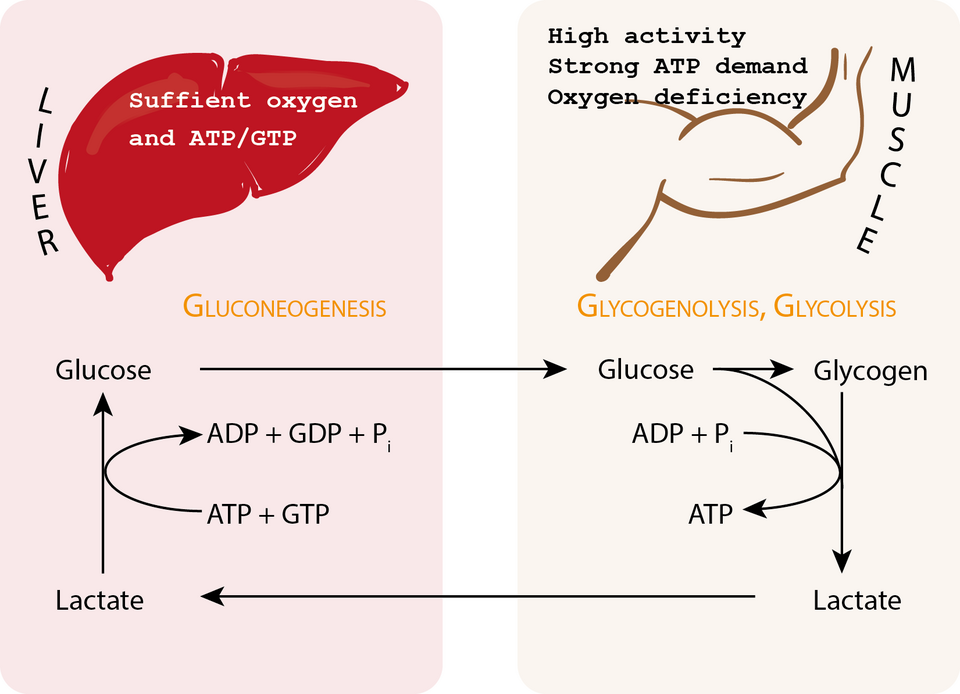
This diagram summarizes the Cori cycle, showing how lactate produced in working muscle can enter the bloodstream, travel to the liver, and be converted back into glucose. It illustrates a key reason lactate is not simply a waste product: it is a transportable fuel precursor that can be recycled to support ongoing exercise. Source
When production and removal are balanced, exercise remains sustainable for a longer period. When intensity rises beyond the point, lactate and associated hydrogen ions accumulate more quickly. This is linked with increasing acidity, a stronger sense of effort, and reduced ability to maintain the same pace.
Balance between production and removal
Production rises as exercise intensity increases and carbohydrate breakdown speeds up.
Removal depends on blood flow, oxidative capacity, and the transport of lactate to tissues that can use it.
The lactate inflection point reflects how well the body can produce energy and clear lactate at the same time.
What happens above the point
Once the athlete works above the lactate inflection point, blood lactate concentration increases progressively. This does not mean exercise must stop immediately, but the effort becomes far less sustainable. Fatigue develops more quickly, ventilation rises sharply, and pace usually has to be reduced if the activity is to continue.
How it is identified
The lactate inflection point is usually identified during an incremental exercise test. Exercise intensity is increased in stages on a treadmill, cycle ergometer, or similar device. Small blood samples are taken at each stage to measure blood lactate concentration.
These values are plotted against exercise intensity. At lower intensities, the curve is relatively flat.
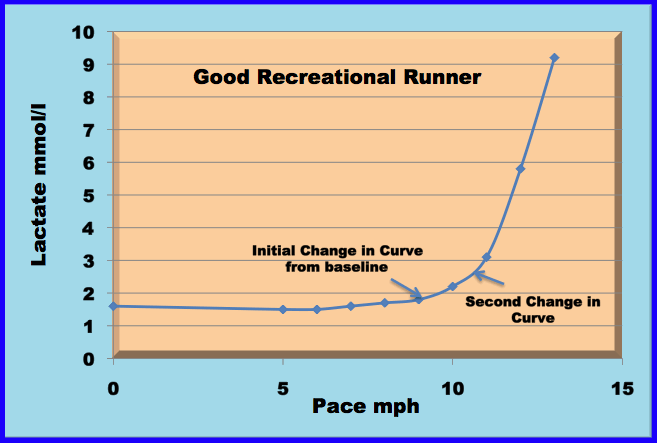
This schematic lactate curve plots blood lactate concentration against increasing exercise intensity and highlights the point where the curve begins to rise more steeply. It matches the “flat then upward bend” pattern used to identify an inflection/threshold during an incremental test. Source
At higher intensities, there is a clear upward bend. That change in slope indicates the point at which lactate is no longer being cleared at the same rate it is produced.
The exact workload identified can vary slightly with the testing protocol. Stage duration, the size of each increase in intensity, and the athlete’s familiarity with the exercise mode can all influence the result.
Interpreting the value
The lactate inflection point should be viewed as a practical performance marker, not an absolute line that is identical on every test. Small changes in test design or sampling timing can alter the exact value reported. In addition, athletes may reach the point at different speeds, power outputs, or heart rates depending on the exercise mode used.
This matters because the measured value should match the sport being analyzed. A treadmill result is most useful for running, while a cycle test is more useful for cycling. The underlying principle stays the same: better endurance performers can sustain a higher external workload before rapid lactate accumulation begins.
Importance for performance and training
For endurance athletes, the lactate inflection point is often more useful than a single maximal test value because it reflects the highest intensity that can be maintained without rapid lactate accumulation. Athletes with a higher lactate inflection point can perform at a faster speed or higher power output before fatigue increases sharply.
In events such as distance running, cycling, rowing, and swimming, performance is strongly linked to how close an athlete can work to this point.
A higher point allows more work to be done at race pace before the body is forced to slow down.
It can help distinguish athletes with similar general fitness but different endurance capacity.
Training can shift the lactate inflection point to a higher intensity. Useful adaptations include greater mitochondrial density, improved capillarization, better lactate transport, and increased oxidative enzyme activity. Coaches often use this point to set training zones, especially for sustained endurance work near the highest controllable intensity.
Regular testing can show whether an athlete is able to sustain a greater speed, power output, or workload before lactate begins to rise rapidly.
Practice Questions
Define the lactate inflection point.
1 mark for stating that it is the maximum exercise intensity.
1 mark for stating that lactate is metabolized or cleared at the same rate as it is produced.
Explain the significance of the lactate inflection point for endurance performance and training.
1 mark for stating that below the point, lactate production and removal are balanced.
1 mark for stating that above the point, lactate accumulates progressively.
1 mark for linking this accumulation to earlier fatigue or reduced sustainability of exercise.
1 mark for explaining that a higher lactate inflection point allows a higher speed or power output before rapid fatigue.
1 mark for connecting it to endurance performance in sustained events.
1 mark for stating that it can be used to set training intensities or monitor training adaptations.
FAQ
At normal body pH, most of the substance present is lactate, not lactic acid. In exercise science, people often say “lactic acid,” but that is technically less accurate.
This matters because blaming “lactic acid” for every symptom can be misleading. Lactate itself can be reused as fuel, while the associated rise in hydrogen ions is more closely linked to the drop in pH during hard exercise.
The body does not respond exactly the same way in every exercise mode. Running and cycling recruit muscles differently, place different demands on posture and coordination, and may use different total muscle mass.
A trained runner may therefore reach the lactate inflection point at a different heart rate, speed, or power output in each test. For best sport-specific use, the test should match the athlete’s event as closely as possible.
Yes, but the estimate is less direct. Coaches may use the ventilatory response, a talk test, heart-rate patterns, or the pace an athlete can sustain for a long hard effort.
These methods can be useful in the field when blood testing is impractical. However, they are indirect markers, so they should be used consistently rather than assumed to be identical to a laboratory-measured lactate inflection point.
Lactate responses are shaped by more than performance outcome alone. Muscle fiber distribution, movement economy, pacing style, training history, and testing familiarity can all influence how quickly blood lactate rises during an incremental test.
This means two athletes can perform similarly but arrive there through slightly different physiological profiles. One might rely on very efficient lactate clearance, while another may compensate with stronger finishing speed or better tactical pacing.
Yes. Acute factors can shift the measured result even when long-term fitness has not changed. Heavy training, low glycogen, poor sleep, dehydration, or mild illness may make the point appear at a lower workload on the day of testing.
A well-managed taper can have the opposite effect by reducing fatigue and improving freshness. That is why repeated testing works best when warm-up, nutrition, recovery, and test timing are standardized as much as possible.
