

IB Syllabus focus: 'Excess post-exercise oxygen consumption is required to return the body to homeostasis and depends on the oxygen deficit incurred during exercise. It is typically divided into fast and slow components.'
After exercise ends, oxygen use does not instantly return to resting level. Understanding why this happens helps explain recovery demands, exercise intensity, and the body’s return to normal function.
Understanding excess post-exercise oxygen consumption
Excess post-exercise oxygen consumption (EPOC) refers to the period after exercise when oxygen uptake remains above resting level.
Excess post-exercise oxygen consumption (EPOC): The extra oxygen consumed during recovery above resting levels to help restore the body to homeostasis.
EPOC shows that recovery is an active physiological process. Even though movement has stopped or intensity has dropped, the body still needs extra oxygen to reverse the disturbances caused by exercise and re-establish stable internal conditions.
When exercise begins or suddenly becomes harder, energy demand rises before oxygen delivery and aerobic metabolism can fully match it.
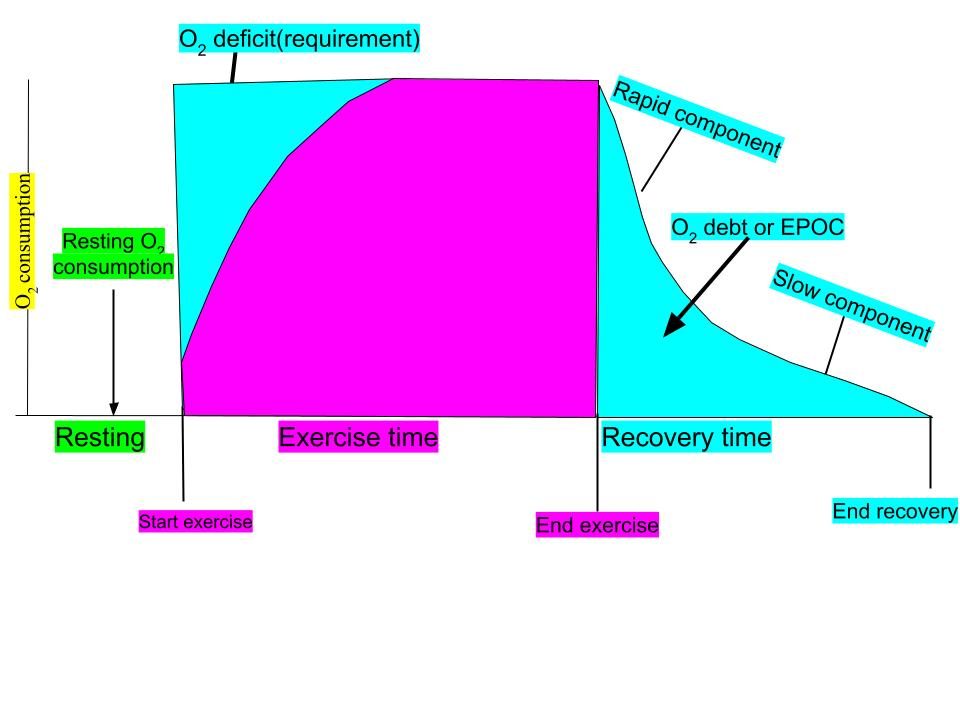
Graph showing oxygen uptake across rest → exercise → recovery, highlighting the initial oxygen deficit (when oxygen demand rises faster than uptake) and the subsequent EPOC/oxygen debt during recovery. The labeled areas make it easy to link the two definitions: a larger deficit during exercise generally implies a larger recovery oxygen requirement afterward. Source
Oxygen deficit: The gap between the oxygen required for a given exercise intensity and the oxygen actually taken up, especially at the start of exercise or after a sharp increase in intensity.
The larger the oxygen deficit during exercise, the larger the recovery demand afterward is likely to be. This is why EPOC is usually much greater after high-intensity activity than after light exercise.
Why oxygen consumption stays elevated after exercise
During recovery, oxygen is needed for multiple processes rather than for external work. The body is using oxygen to restore normal function, not to continue exercise performance.
Key reasons for elevated post-exercise oxygen consumption include:
Resynthesis of phosphocreatine (PCr) in muscle
Restoration of oxygen stores in blood and muscle
Support for continued elevated heart rate and ventilation immediately after exercise
Processing of lactate and other metabolic by-products
Reduction of body temperature toward resting level
Recovery from elevated stress hormones, such as adrenaline and noradrenaline
These recovery processes do not all happen at the same speed.
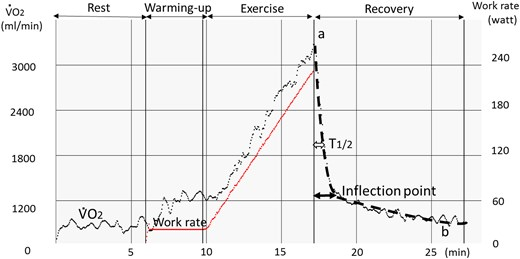
Recovery-phase curve fitted with a fast component (rapid early decline) and a slow component (more gradual later decline), separated by an inflection point. This figure visually supports the idea that EPOC is not a single process but a combination of recovery kinetics that occur on different time scales. Source
Some occur quickly in the first few minutes, while others continue for much longer, which is why EPOC is divided into fast and slow components.
Fast and slow components of EPOC
Fast component
The fast component happens immediately after exercise and usually declines rapidly. It is most important in the first few minutes of recovery.
This part of EPOC is mainly associated with relatively rapid restorative processes, including:
Replenishing ATP and phosphocreatine stores
Reloading oxygen stores in muscle and blood
The early reduction of heart rate and breathing rate
The fast component is especially important after short, intense exercise where phosphocreatine has been heavily used. Although oxygen uptake drops quickly in this phase, it still remains above resting level because recovery is still incomplete.
Slow component
The slow component lasts longer and may continue for an extended period after exercise, especially if the activity was hard, prolonged, or both.
This component is linked to slower recovery processes, such as:
Continued elevation of body temperature
Persistently high ventilation and circulation
Ongoing effects of catecholamines and other hormones
Lactate conversion and oxidation
General restoration of physiological balance
A rise in body temperature increases metabolic rate, so the body keeps using more oxygen than it would at rest. Likewise, if exercise was intense enough to create a large disturbance to homeostasis, the slow component becomes more noticeable and lasts longer.
Factors affecting the size of EPOC
The magnitude and duration of EPOC depend mainly on the oxygen deficit incurred during exercise. A larger disruption during exercise creates a greater recovery requirement afterward.
Important factors include:
Exercise intensity: higher intensity usually causes a larger EPOC
Exercise duration: longer sessions can increase the total recovery demand
Type of exercise: intermittent and very intense work often produces a larger EPOC than easy continuous work
Thermal strain: a greater rise in body temperature can prolong the slow component
Amount of muscle mass involved: whole-body exercise generally creates a larger recovery response
Intensity is often the most significant factor. Two activities of similar duration can produce very different EPOC responses if one creates a much larger oxygen deficit.
Why EPOC matters in sport and exercise
EPOC helps explain why recovery is not complete the moment exercise stops. An athlete may no longer be working, but their body is still under increased physiological demand.
In sport and training, this matters because:
Recovery time between efforts is affected by how much disturbance the previous effort caused
Harder exercise places a larger post-exercise recovery cost on the body
Coaches and athletes can better understand why intense sessions may feel demanding even after the work interval has ended
EPOC should be seen as a recovery phenomenon, not as a separate energy system. It reflects the oxygen needed to restore normal conditions after exercise. The key IB idea is that EPOC is required to return the body to homeostasis, and that its size depends on the oxygen deficit created during the exercise bout, with recovery occurring through fast and slow components.
Practice Questions
Define excess post-exercise oxygen consumption (EPOC). [2]
1 mark for stating that oxygen consumption remains elevated after exercise.
1 mark for stating that this extra oxygen is needed to help return the body to homeostasis / resting conditions.
Explain how the fast and slow components of EPOC help the body recover after high-intensity exercise. [6]
1 mark for stating that EPOC is elevated oxygen uptake after exercise.
1 mark for linking a larger EPOC to a larger oxygen deficit incurred during exercise.
1 mark for identifying the fast component as the immediate or short-lasting phase of recovery.
1 mark for explaining one fast-component process, such as phosphocreatine resynthesis or restoration of oxygen stores.
1 mark for identifying the slow component as the prolonged phase of recovery.
1 mark for explaining one slow-component process, such as elevated body temperature, continued hormonal effects, or lactate processing.
FAQ
EPOC is usually measured with indirect calorimetry, where a person breathes through a mask connected to gas analysis equipment.
Researchers track oxygen uptake during recovery and compare it with resting oxygen consumption. The area above resting level represents the extra oxygen used after exercise.
The measurement may continue for minutes or even hours, depending on how long recovery takes.
Yes, the fitness term “afterburn effect” usually refers to EPOC, but it is less precise.
“Afterburn” is popular language, while EPOC is the scientific term describing elevated post-exercise oxygen use.
The scientific term is better because it emphasizes:
recovery physiology
return to homeostasis
the role of oxygen deficit
fast and slow recovery components
A cool-down does not instantly remove EPOC, because the body still has to complete recovery processes.
However, a light cool-down may help make recovery feel more gradual by maintaining circulation and helping the transition from exercise to rest.
It may also support lactate clearance, but the total need for recovery oxygen still depends mainly on the disturbance created by the exercise itself.
Yes. Heavy resistance training, especially with short rests, large muscle groups, and high total workload, can create a substantial EPOC.
This is because it may cause:
a large oxygen deficit
high metabolic disturbance
elevated body temperature
sustained hormonal responses during recovery
That means EPOC is not limited to endurance exercise.
It can contribute to post-exercise energy expenditure, but it should be interpreted carefully.
Because oxygen consumption is linked to energy use, a larger EPOC generally means more energy is being used during recovery. However, the extra amount is often smaller than people assume from fitness advertising.
So, EPOC is real and measurable, but it is better understood as a recovery cost than as a dramatic source of calorie burn.
