
Particles in the atom and atomic radius
Structure of the atom
· Atoms are mostly empty space surrounding a very small, dense nucleus.
· The nucleus contains protons and neutrons.
· Electrons are found in shells in the empty space around the nucleus.
· The nucleus is tiny compared with the whole atom, but contains almost all the mass.
· The atom is neutral overall when number of protons = number of electrons.
Subatomic particles: charge and mass
· Proton: relative charge +1, relative mass 1.
· Neutron: relative charge 0, relative mass 1.
· Electron: relative charge –1, relative mass 1/1836.
· Protons and neutrons have much greater mass than electrons, so nearly all atomic mass is in the nucleus.
· Electrons determine the overall charge of ions when gained or lost.
Atomic number and mass number
· Atomic number / proton number (Z) = number of protons.
· Mass number / nucleon number (A) = number of protons + neutrons.
· Number of neutrons = mass number – atomic number.
· In a neutral atom: number of electrons = number of protons.
· In ions:
· Positive ion: electrons lost, so electrons = protons – charge.
· Negative ion: electrons gained, so electrons = protons + charge size.
Distribution of mass and charge
· Mass is concentrated in the nucleus because protons and neutrons are much heavier than electrons.
· Positive charge is concentrated in the nucleus due to protons.
· Negative charge is in the shells due to electrons.
· Neutrons add mass but no charge.
· Exam phrase: “Most of the atom is empty space; most of the mass is in the small, dense nucleus.”
Behaviour in an electric field
· A beam of protons is deflected towards the negative plate because protons are positively charged.
· A beam of electrons is deflected towards the positive plate because electrons are negatively charged.
· A beam of neutrons is not deflected because neutrons have no charge.
· At the same velocity, electrons are deflected much more than protons because electrons have a much smaller mass.
· Protons and electrons deflect in opposite directions because they have opposite charges.
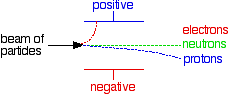
This diagram compares the paths of protons, electrons and neutrons through an electric field. It shows electrons being deflected more strongly than protons at the same speed because electrons have much lower mass. Source
Atomic radius
· Atomic radius = a measure of the size of an atom, linked to the distance from the nucleus to the outer electron shell.
· Atomic radius is affected by:
· Nuclear charge: more protons pull electrons closer.
· Number of shells: more shells increase radius.
· Shielding: inner shells reduce attraction between the nucleus and outer electrons.
· Across a period: atomic radius decreases.
· Down a group: atomic radius increases.
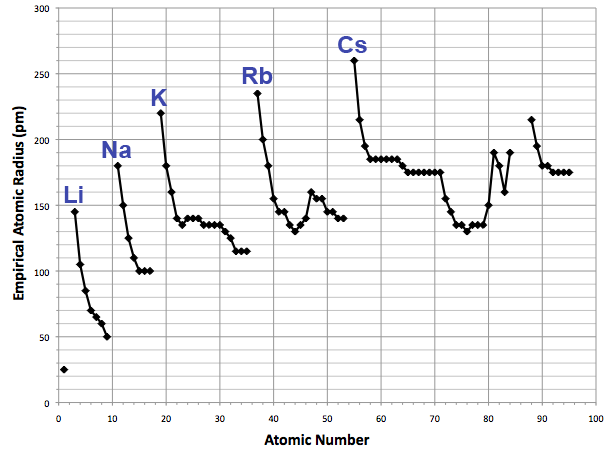
This graph shows how atomic radius changes across successive elements. Peaks occur near Group 1 elements, helping students see that atomic radius increases down a group and generally decreases across a period. Source
Explaining atomic radius trends
· Across a period, atomic radius decreases because:
· Nuclear charge increases as proton number increases.
· Electrons are added to the same shell.
· Shielding remains similar.
· Outer electrons are pulled more strongly towards the nucleus.
· Down a group, atomic radius increases because:
· A new electron shell is added.
· Shielding increases.
· Outer electrons are further from the nucleus.
· Increased shielding outweighs increased nuclear charge.
Ionic radius trends
· Ionic radius = size of an ion.
· Positive ions (cations) are smaller than their atoms because electrons are lost, reducing electron–electron repulsion and sometimes removing an outer shell.
· Negative ions (anions) are larger than their atoms because electrons are gained, increasing electron–electron repulsion.
· Down a group, ionic radius increases because ions have more electron shells.
· Across a period, compare ions carefully: cations and anions should not be treated as one simple continuous trend because different ion charges and electron arrangements affect size.
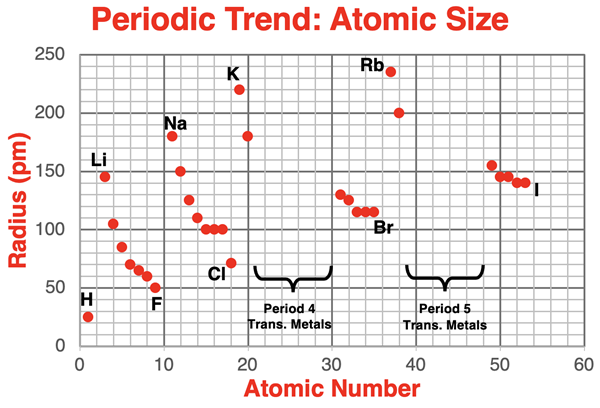
This diagram shows atomic size using circles, making the radius trend visually clear. The circles increase down groups and decrease from left to right across periods. Source
Common exam traps
· Do not say atoms are “mostly nucleus”: atoms are mostly empty space.
· Do not confuse mass number with atomic number.
· Do not forget that electrons have negligible mass compared with protons and neutrons.
· In electric fields, neutrons are not deflected because they are neutral.
· For atomic radius explanations, always mention nuclear charge, shells and shielding.
Checklist: can you do this?
· Define proton number, nucleon number, atomic radius and ionic radius.
· Calculate numbers of protons, neutrons and electrons in atoms and ions.
· Describe the mass and charge distribution within an atom.
· Predict the behaviour of protons, neutrons and electrons in an electric field.
· Explain trends in atomic radius and ionic radius across periods and down groups.