
First Ionisation Energy
· First ionisation energy, IE₁ = energy required to remove one electron from each atom in one mole of gaseous atoms to form one mole of gaseous 1+ ions.
· Must always refer to the gaseous state and one mole.
· General equation: X(g) → X⁺(g) + e⁻.
· Ionisation energy is always endothermic because energy is needed to overcome the attraction between the nucleus and the outer electron.
· Units are usually kJ mol⁻¹.
· Exam wording must include: gaseous atoms, gaseous ions, one mole, one electron removed.
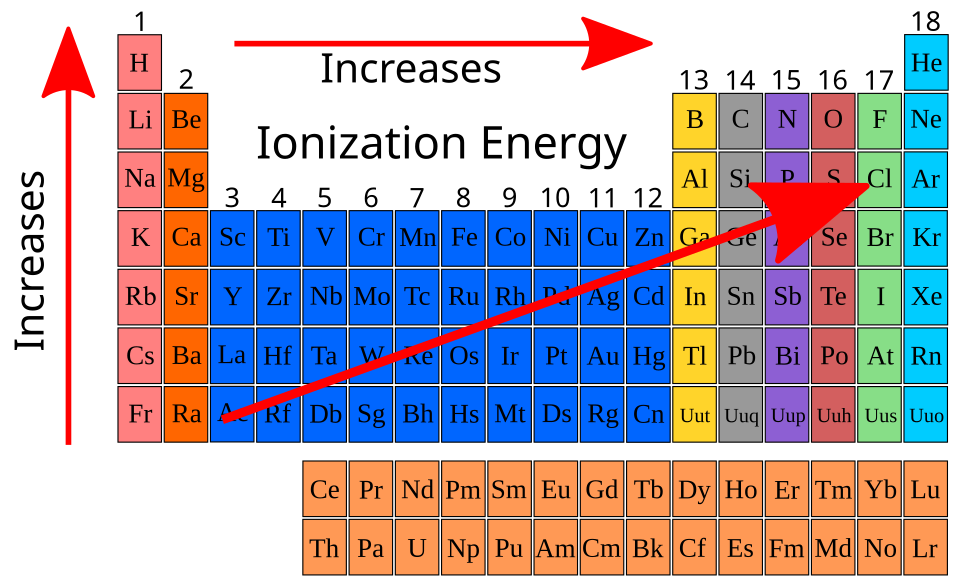
Ionisation energy generally increases across a period and decreases down a group. This diagram is useful for remembering the overall periodic trend before learning the explanations. Source
Equations for Successive Ionisation Energies
· Second ionisation energy removes an electron from a 1+ gaseous ion: X⁺(g) → X²⁺(g) + e⁻.
· Third ionisation energy removes an electron from a 2+ gaseous ion: X²⁺(g) → X³⁺(g) + e⁻.
· Each successive ionisation energy is larger than the previous one because the electron is removed from an ion with a greater positive charge.
· Always include state symbols in exam equations.
· The electron is always written as e⁻, not e.
· Common mistake: writing X(g) → X²⁺(g) + 2e⁻ for second ionisation energy; this is wrong because successive ionisations remove one electron at a time.
Factors Affecting Ionisation Energy
· Nuclear charge: more protons = stronger attraction for outer electrons = higher ionisation energy.
· Atomic/ionic radius: greater distance from nucleus = weaker attraction = lower ionisation energy.
· Shielding by inner shells: inner electrons repel outer electrons and reduce nuclear attraction = lower ionisation energy.
· Sub-shell shielding: electrons in inner sub-shells also shield outer electrons.
· Spin-pair repulsion: paired electrons in the same orbital repel each other, making one electron easier to remove = lower ionisation energy.
· Strong answers link trends to nuclear charge, radius, shielding, and spin-pair repulsion, not just “more shells”.
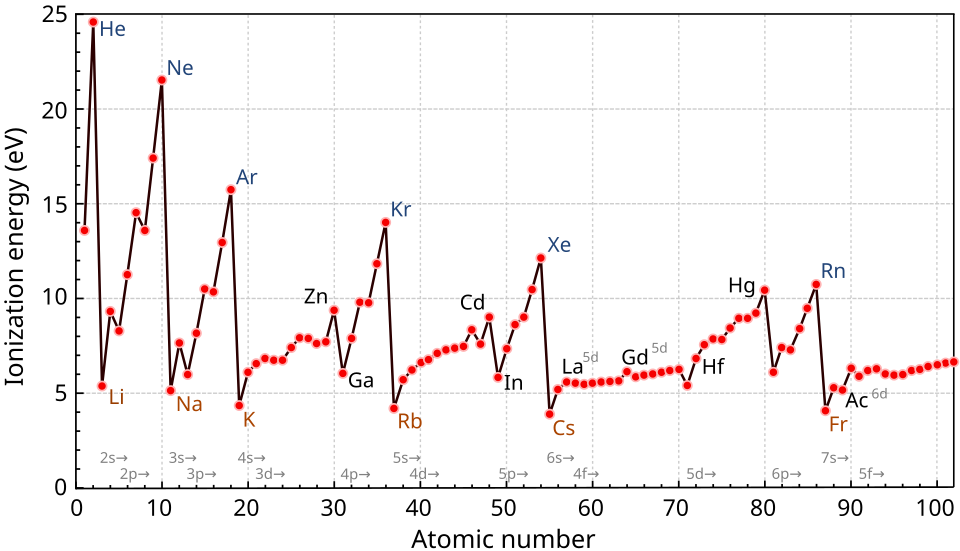
The graph shows how ionisation energy changes as electrons fill different shells and sub-shells. It helps explain why ionisation energy does not increase perfectly smoothly across the Periodic Table. Source
Trend Across a Period
· First ionisation energy generally increases across a period.
· Across a period, nuclear charge increases because proton number increases.
· Electrons are added to the same principal shell, so shielding is similar.
· Atomic radius generally decreases, so outer electrons are closer to the nucleus.
· Stronger nuclear attraction means more energy is required to remove the outer electron.
· Exam phrase: “increased nuclear charge with similar shielding causes stronger attraction between the nucleus and the outer electron.”
Exceptions Across a Period
· Ionisation energy can drop when the outer electron is removed from a higher-energy sub-shell.
· Example pattern: an electron in a p sub-shell is easier to remove than one in an s sub-shell of the same shell because the p electron is higher in energy and slightly more shielded.
· Ionisation energy can also drop when the removed electron is from a pair in an orbital.
· Spin-pair repulsion makes a paired electron easier to remove.
· In exam answers, explain exceptions using sub-shell energy or spin-pair repulsion, not by saying “the atom wants a full shell”.
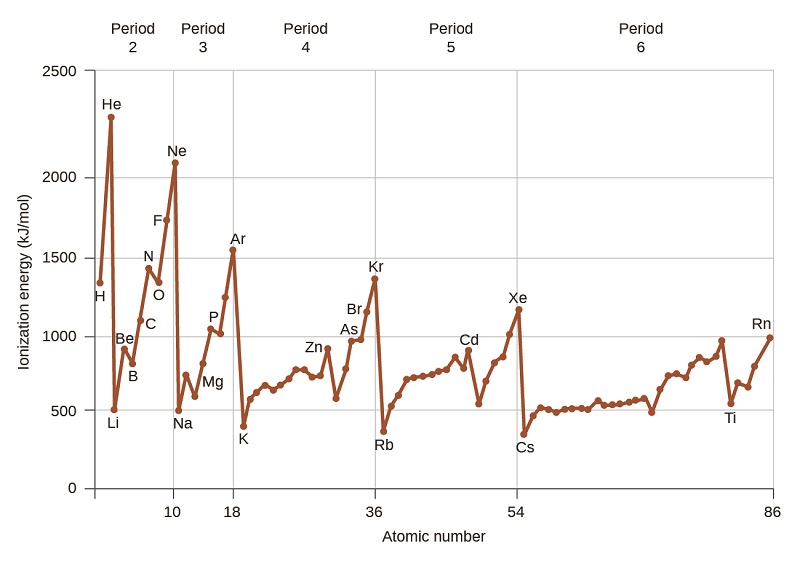
This graph shows the repeating pattern of first ionisation energies across periods. Peaks occur near noble gases, while low values occur near Group 1 elements. Source
Trend Down a Group
· First ionisation energy decreases down a group.
· Down a group, atoms have more electron shells.
· The outer electron is further from the nucleus, so atomic radius increases.
· There is also more shielding by inner shells.
· Although nuclear charge increases, the effect of increased radius and shielding is greater.
· Therefore, the attraction between the nucleus and outer electron becomes weaker, so less energy is needed to remove the electron.
Successive Ionisation Energies
· Successive ionisation energies always increase because electrons are removed from an increasingly positive ion.
· A large jump in successive ionisation energy shows that the next electron is being removed from an inner shell closer to the nucleus.
· The number of electrons removed before the large jump = number of outer-shell electrons.
· This can be used to deduce the group number of an element.
· Example logic: large jump after IE₂ means the atom had 2 outer electrons, so it is likely in Group 2.
· Successive ionisation energy data can be used to deduce electronic configuration and position in the Periodic Table.
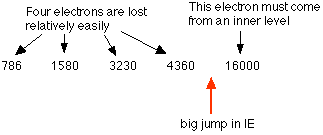
Successive ionisation energy graphs show where the big jump occurs. The jump identifies how many electrons were in the outer shell, helping deduce the element’s group. Source
Using Successive Ionisation Energy Data
· Identify the first very large jump in the data.
· Count how many electrons were removed before this jump.
· This number gives the number of outer-shell electrons.
· Use outer-shell electrons to deduce the element’s group.
· Link the jump to removal of an electron from an inner shell, where there is less shielding, a smaller radius, and stronger attraction to the nucleus.
· For hydrogen to krypton, combine this with electronic configuration knowledge to identify the likely period and group.
Exam Answer Phrases
· Across a period: “Ionisation energy increases because nuclear charge increases, while shielding remains similar, so the outer electron is more strongly attracted to the nucleus.”
· Down a group: “Ionisation energy decreases because atomic radius and shielding increase, so attraction between the nucleus and outer electron decreases.”
· Successive IE increase: “Each electron is removed from an ion with a greater positive charge, so attraction to the remaining electrons is stronger.”
· Large jump: “The next electron is being removed from an inner shell, closer to the nucleus and with less shielding.”
· Spin-pair exception: “The electron is easier to remove because of repulsion between paired electrons in the same orbital.”
· Sub-shell exception: “The electron is removed from a higher-energy sub-shell, so less energy is required.”
Checklist: can you do this?
· Define first ionisation energy using correct terms: one mole, gaseous atoms, gaseous ions, one electron.
· Write equations for first, second and subsequent ionisation energies with correct charges and state symbols.
· Explain trends across a period and down a group using nuclear charge, radius and shielding.
· Explain exceptions using sub-shell energy and spin-pair repulsion.
· Use successive ionisation energy data to deduce electronic configuration, group and Periodic Table position.