
Isotopes
· Isotopes = atoms of the same element with the same number of protons but different numbers of neutrons.
· Same proton number / atomic number = same element.
· Different neutron number = different mass number / nucleon number.
· Example: carbon-12 and carbon-14 are both carbon because they both have 6 protons, but they have different numbers of neutrons.
· Exam phrase: isotopes differ in neutron number, not proton number.
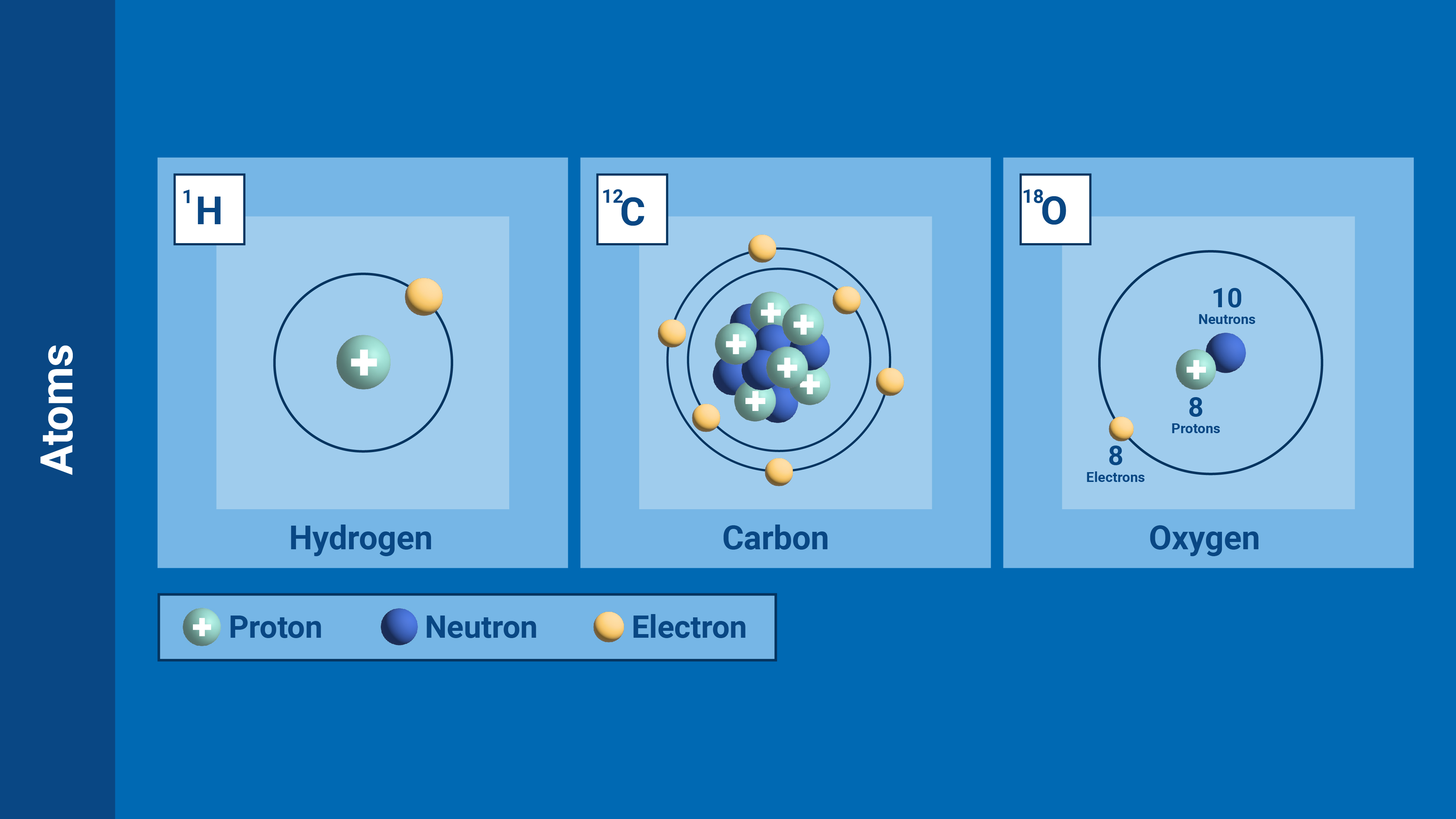
Hydrogen isotopes have the same number of protons but different numbers of neutrons. This changes their mass but not their identity as hydrogen atoms. Source
Isotope notation
· Isotopes can be written using the notation ˣᵧA.
· A = chemical symbol of the element.
· x = mass number / nucleon number = total number of protons + neutrons.
· y = atomic number / proton number = number of protons.
· Number of neutrons = mass number − proton number.
· Example: ¹⁴₆C means carbon with 6 protons and 8 neutrons.
Chemical properties of isotopes
· Isotopes of the same element have the same chemical properties.
· This is because they have the same number of protons and, in neutral atoms, the same number and arrangement of electrons.
· Chemical reactions depend mainly on electron arrangement, not neutron number.
· Therefore, isotopes of the same element usually react in the same way.
Physical properties of isotopes
· Isotopes of the same element have different physical properties.
· For CIE 1.2, this is limited to differences in mass and density.
· Different neutron numbers give different mass numbers, so isotopes have different masses.
· A heavier isotope can have a different density because density depends on mass.
· Exam contrast: same chemical properties but different physical properties.
Common exam mistakes
· Do not say isotopes have different protons; that would make them different elements.
· Do not confuse mass number with atomic number.
· Do not explain chemical similarity using “same neutrons”; the correct reason is same electron arrangement.
· Do not say isotopes have completely different properties; they have the same chemical properties but different mass and density.
· Always use the terms proton number, nucleon number, mass number and neutron number accurately.
Checklist: can you do this?
· Define isotope using same protons and different neutrons.
· Interpret ˣᵧA notation by identifying mass number and proton number.
· Calculate neutron number from mass number − proton number.
· Explain why isotopes have the same chemical properties using same electron arrangement.
· Explain why isotopes have different physical properties in terms of mass and density.