
Scope for CIE exams
· All atoms/ions are assumed to be in the ground state.
· Only elements from hydrogen to krypton are assessed.
· You must be able to write electronic configurations using full notation, shorthand notation and electrons-in-boxes notation.
· You must know the shapes of s orbitals and p orbitals only.
· You must understand how energy and inter-electron repulsion affect electronic configurations.
Shells, sub-shells and orbitals
· A shell is a main energy level around the nucleus.
· Each shell has a principal quantum number, n:
· n = 1 is the first shell
· n = 2 is the second shell
· n = 3 is the third shell
· A sub-shell is a region within a shell: s, p or d.
· An orbital is a region of space that can hold a maximum of 2 electrons.
· Electrons in the same orbital must be paired with opposite spins.
· Ground state = the lowest-energy electronic configuration of an atom or ion.
Number of orbitals and electrons in sub-shells
· s sub-shell = 1 orbital = holds 2 electrons maximum.
· p sub-shell = 3 orbitals = holds 6 electrons maximum.
· d sub-shell = 5 orbitals = holds 10 electrons maximum.
· Each orbital holds 2 electrons, so:
· s = 2
· p = 6
· d = 10
· A full sub-shell is written using superscript notation, e.g. 2p⁶ means 6 electrons in the 2p sub-shell.
Order of increasing energy
· Electrons fill the lowest available energy level first.
· Required CIE order up to krypton:
· 1s → 2s → 2p → 3s → 3p → 4s → 3d → 4p
· The 4s sub-shell fills before 3d because 4s is lower in energy before the 3d sub-shell is occupied.
· In transition metal ions, electrons are usually removed from 4s before 3d.
· Exam tip: do not simply fill shells as 2, 8, 18 without considering sub-shell order.
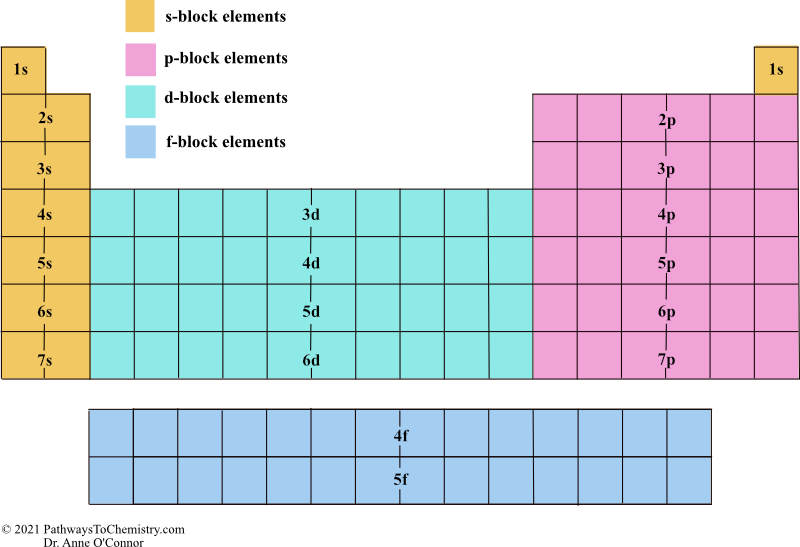
This diagram links the periodic table blocks to the order in which sub-shells fill. It is especially useful for remembering why 4s fills before 3d. Use it to practise writing configurations from atomic number. Source
Writing electronic configurations
· Use the total number of electrons:
· atoms: electrons = proton number
· positive ions: subtract electrons
· negative ions: add electrons
· Full configuration example for Fe, Z = 26:
· 1s² 2s² 2p⁶ 3s² 3p⁶ 3d⁶ 4s²
· Shorthand configuration example for Fe:
· [Ar] 3d⁶ 4s²
· Shell arrangement for Fe:
· 2, 8, 14, 2
· For ions, remove electrons from the outermost shell first.
· For transition metal ions, remove from 4s before 3d:
· Fe²⁺ = [Ar] 3d⁶
· Fe³⁺ = [Ar] 3d⁵
Electrons-in-boxes notation
· Each box represents one orbital.
· Each arrow represents one electron.
· Two electrons in the same orbital are shown as opposite arrows: ↑↓.
· In equal-energy orbitals, electrons occupy separate orbitals first before pairing.
· This minimises inter-electron repulsion.
· Example: 2p³ should be shown as:
· 2p: [↑] [↑] [↑]
· Example: 2p⁴ should be shown as:
· 2p: [↑↓] [↑] [↑]
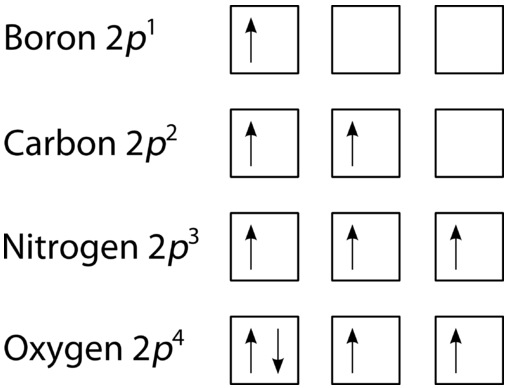
These diagrams show how electrons are placed into orbitals using box notation. They demonstrate that electrons occupy separate orbitals before pairing. This supports exam explanations involving inter-electron repulsion. Source
Energy and inter-electron repulsion
· Electrons occupy arrangements with the lowest possible energy.
· Lower-energy sub-shells fill before higher-energy sub-shells.
· Electrons repel each other because they are all negatively charged.
· Electrons spread out into separate equal-energy orbitals before pairing to reduce inter-electron repulsion.
· Pairing two electrons in the same orbital increases repulsion, so pairing happens only when necessary.
· Stable configurations often involve full or half-full sub-shells, especially in d-block atoms.
Shapes of orbitals
· An s orbital is spherical.
· A p orbital is dumbbell-shaped.
· The three p orbitals are arranged at right angles:
· pₓ
· pᵧ
· p𝓏
· Each p orbital holds 2 electrons, so a p sub-shell holds 6 electrons in total.
· You must be able to describe and sketch the shapes of s and p orbitals.
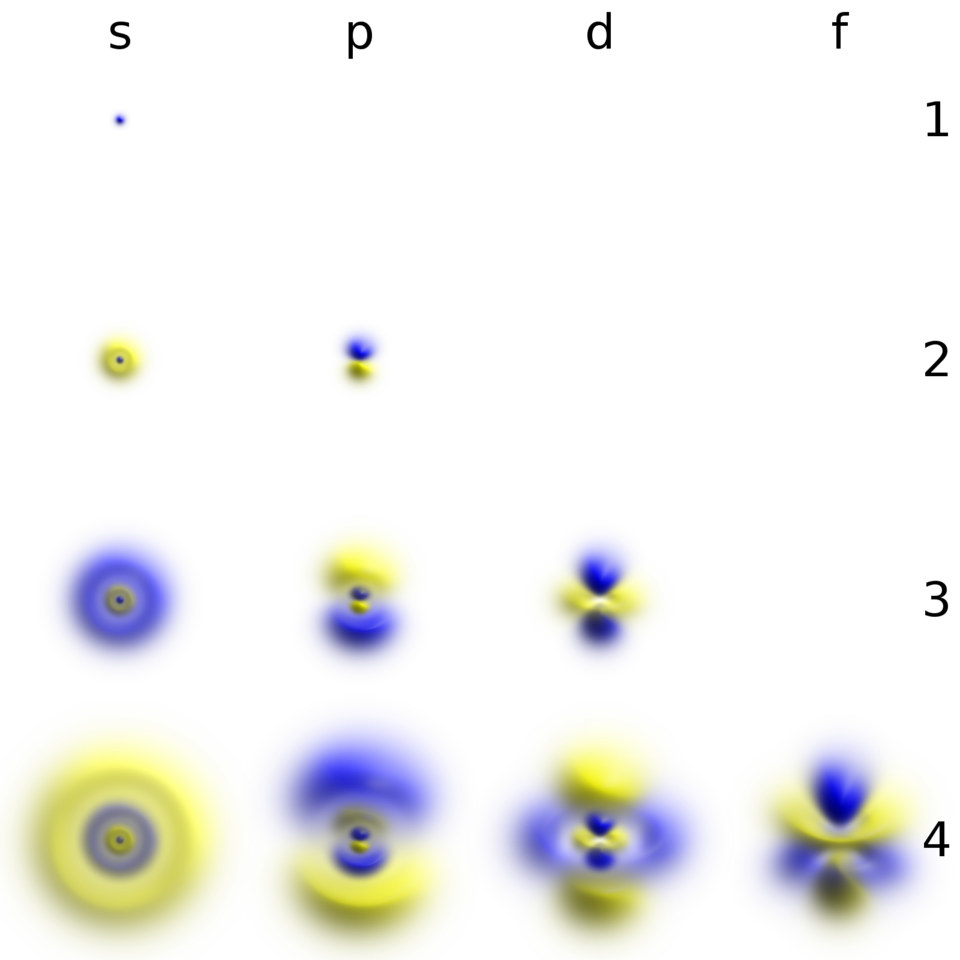
This image shows the 3D shapes of atomic orbitals. The s orbital appears spherical, while the p orbital has a dumbbell shape. These are the key orbital shapes required for this topic. Source
Free radicals
· A free radical is a species with one or more unpaired electrons.
· Unpaired electrons make free radicals highly reactive.
· In box notation, a free radical can be recognised by an orbital containing a single electron.
· Example idea: Cl· has one unpaired electron.
· Free radicals become important later in organic mechanisms, especially free-radical substitution.
Common exam mistakes
· Forgetting that each orbital holds a maximum of 2 electrons.
· Writing 3d before 4s when filling neutral atoms.
· Removing 3d electrons before 4s electrons when forming transition metal ions.
· Pairing electrons in p orbitals too early in electrons-in-boxes notation.
· Describing an orbital as a fixed path instead of a region of space.
· Confusing shells, sub-shells and orbitals.
· Forgetting that p has 3 orbitals and d has 5 orbitals.
Checklist: can you do this?
· Define shell, sub-shell, orbital, principal quantum number and ground state.
· State the number of orbitals and maximum electrons in s, p and d sub-shells.
· Write full and shorthand electronic configurations for atoms and ions from H to Kr.
· Draw electrons-in-boxes notation correctly, including unpaired electrons before pairing.
· Describe and sketch the shapes of s orbitals and p orbitals, and identify a free radical.