
Context: why government was difficult after 1793
· Louis XVI was executed in January 1793, leaving the new republic facing war, internal rebellion and political division.
· France was at war with the First Coalition, increasing pressure for stronger central control.
· The National Convention was divided between radical Montagnards/Jacobins, more moderate Girondins, and the wider Plain.
· The sans-culottes pushed for radical action, especially on food prices, punishment of enemies and direct democracy.
· Key judgement: government became more effective at survival and mobilisation, but less successful at protecting liberty, legality and stable representative rule.
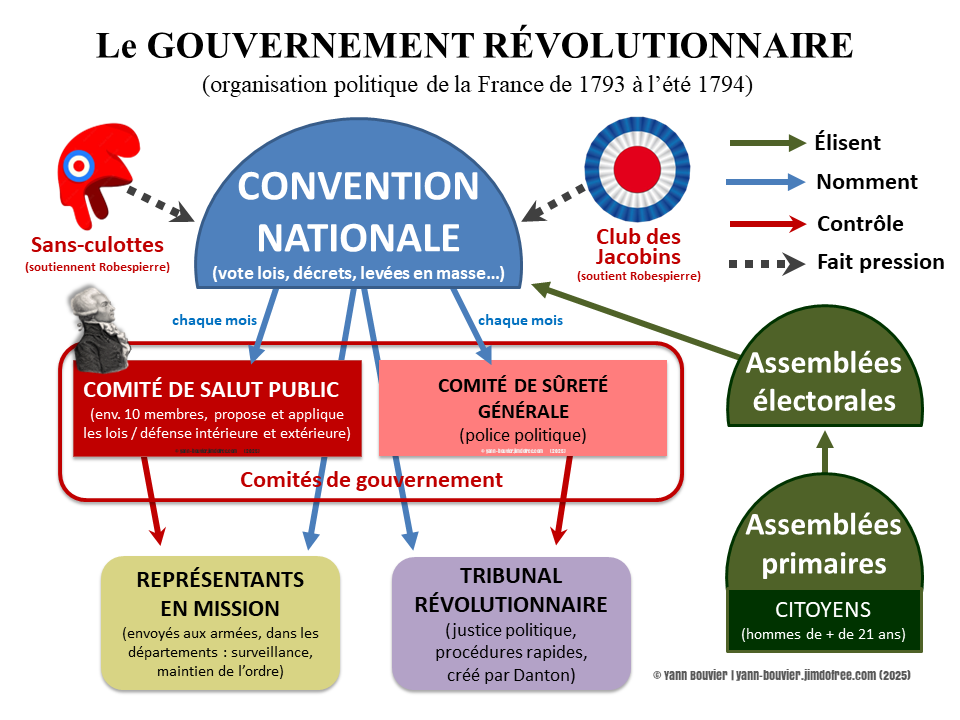
This diagram shows how revolutionary government was organised in 1793–94. It is useful for understanding how power shifted from elected assemblies towards committees, especially the Committee of Public Safety. Source
Instability, 1793–95
· Political instability: conflict inside the Convention led to purges, factional struggle and fear of counter-revolution.
· Sans-culotte pressure: Parisian radicals demanded price controls, action against hoarders and punishment of “enemies of the revolution”.
· War crisis: foreign invasion and civil war, especially the Vendée revolt, encouraged emergency government.
· Economic crisis: inflation, food shortages and falling value of assignats weakened public confidence.
· Federalist revolts: some areas resisted Parisian/Jacobin dominance after the fall of the Girondins.
· Judgement: France was not governed peacefully, but emergency measures helped prevent the republic’s collapse.
The Committee of Public Safety
· The Committee of Public Safety was created in April 1793 and became the key executive body of revolutionary government. It was charged with defending the republic against foreign and domestic enemies.
· It controlled war policy, supervised ministers and helped centralise decision-making.
· Robespierre became one of its most important members, though power was exercised through committees, not by him alone.
· The government introduced levée en masse to mobilise manpower for war.
· The Law of the General Maximum tried to control prices and supplies.
· Strength: it gave France decisive, centralised leadership during crisis.
· Weakness: it relied heavily on coercion, denunciation and emergency justice.
Robespierre and the Reign of Terror
· The Reign of Terror was used to defend the Revolution by identifying and punishing suspected enemies.
· The Revolutionary Tribunal and Law of Suspects made it easier to arrest and execute alleged counter-revolutionaries.
· The Terror helped crush opposition but created a climate of fear and political insecurity.
· The Law of 22 Prairial, 1794 reduced protections for accused people and intensified executions.
· Robespierre’s fall in Thermidor, July 1794, showed that the Terror had turned against even leading revolutionaries.
· Judgement: the Terror made government effective in repression and survival, but poor in justice, rights and long-term legitimacy.
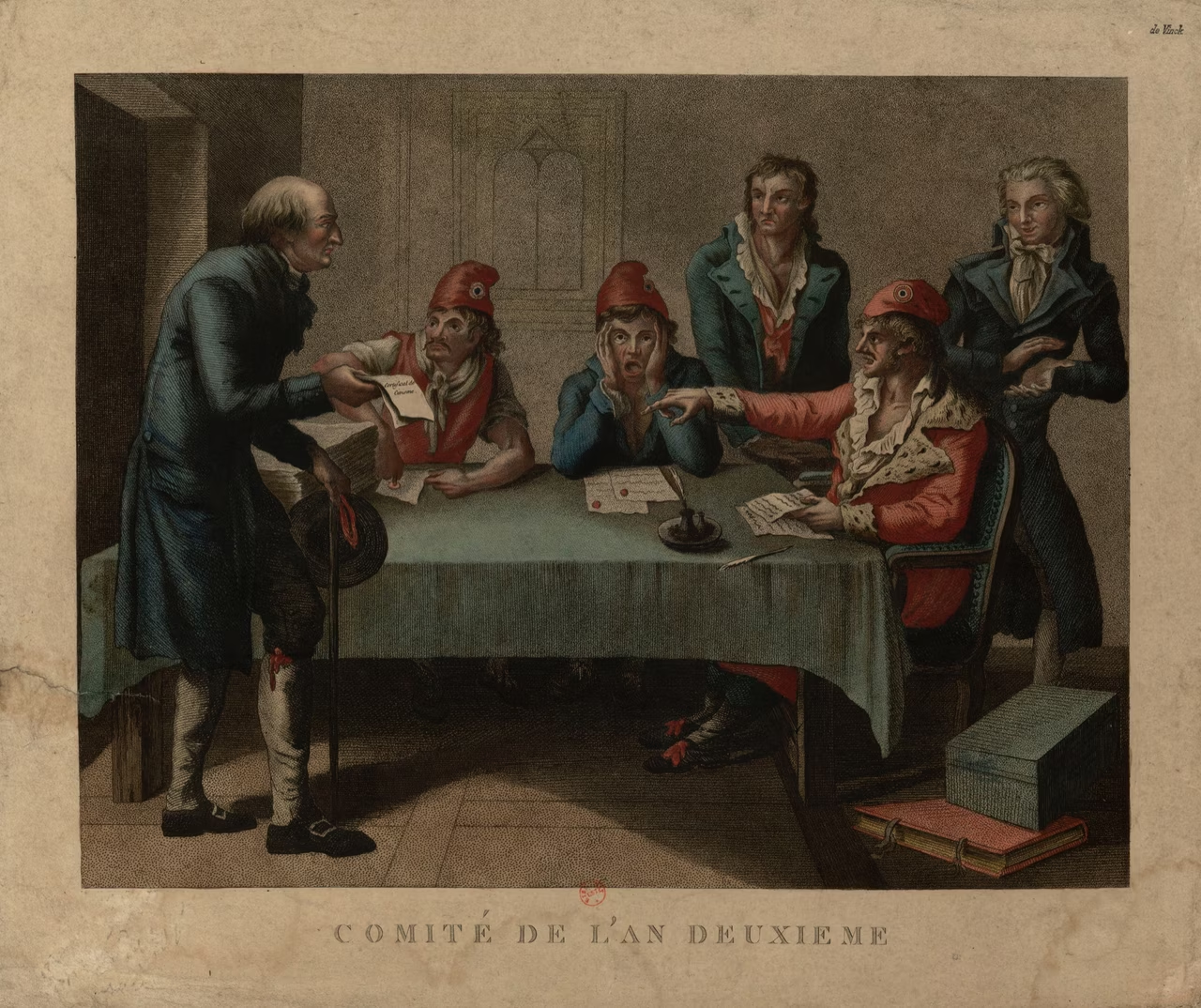
This engraving shows a revolutionary committee during the Terror. It helps students visualise how surveillance, suspicion and local revolutionary authority operated under emergency government. Source
Economic government under the Terror
· The government faced inflation, shortages and anger over bread prices.
· Assignats continued to lose value, causing rising prices and instability.
· The General Maximum fixed prices and wages to calm the sans-culottes and control inflation.
· Requisitioning helped supply armies but angered peasants and traders.
· Short-term success: helped feed armies and towns.
· Long-term weakness: controls were difficult to enforce and damaged economic confidence.
The White Terror and Parisian Risings, 1794–95
· After Robespierre’s fall, the Thermidorian Reaction reduced Jacobin power.
· The White Terror involved attacks on former Jacobins and radicals.
· The ending of price controls worsened inflation and food shortages.
· Parisian risings in Germinal and Prairial, 1795 showed continuing urban anger.
· The army was used to suppress unrest, showing government dependence on force.
· Judgement: post-Terror government reduced radical dictatorship but failed to create real stability.
The Constitution of Year III, 1795
· The Constitution of Year III created the Directory and aimed to prevent both monarchy and Jacobin dictatorship. It came into effect in 1795 and lasted until Napoleon’s coup in 1799.
· Executive power was held by five Directors.
· The legislature was divided into the Council of Five Hundred and Council of Ancients.
· Voting was restricted by property qualifications, limiting democracy.
· Strength: separation of powers was designed to prevent dictatorship.
· Weakness: the system was complicated, elitist and vulnerable to deadlock.
This diagram explains the political structure of the Directory. It is useful for understanding why the regime was designed to prevent dictatorship but also why it limited democracy through property-based voting. Source
Aims of the Directory
· The Directory aimed to create a moderate republic.
· It wanted to avoid a return to monarchy and prevent another radical Jacobin government.
· It aimed to restore order, protect property, stabilise finances and continue military success.
· It relied on middle-class support, property owners and the army.
· Judgement: its aims were realistic after the Terror, but it lacked enough popular support to govern securely.
Problems facing the Directory
· Financial problems: inflation, debt and weak taxation continued.
· Political opposition: faced threats from royalists on the right and Jacobins/radicals on the left.
· Dependence on the army: military force was used to suppress coups and uprisings.
· Corruption: Directors were associated with bribery, self-interest and weak leadership.
· Economic hardship: ordinary people suffered from high prices and shortages.
· Weak legitimacy: elections were sometimes manipulated or overturned to keep the regime in power.
· Judgement: the Directory survived for four years, but often by undermining its own constitutional principles.
Successes of the Directory
· Survival: it kept the republic going from 1795 to 1799.
· Military success: French armies won victories abroad, especially through generals such as Napoleon Bonaparte.
· Avoided extremes: it prevented both a full royalist restoration and a return to Jacobin Terror.
· Some financial reform: attempts were made to stabilise currency and taxation, though results were limited.
· Protected property owners: it reassured many middle-class citizens after radical social and economic policies.
· Judgement: the Directory governed best when judged by survival and military defence, not by democracy or social justice.
Failures of the Directory
· Political failure: it could not build stable popular support.
· Financial failure: economic problems remained severe and damaged confidence.
· Military dependence: reliance on generals weakened civilian government.
· Corruption and elitism: many saw the Directory as self-serving and disconnected from ordinary people.
· Coup culture: repeated use of force made the constitution seem meaningless.
· End in 1799: Napoleon’s Coup of 18 Brumaire overthrew the Directory and replaced it with the Consulate. The Directory governed France from 1795 until Napoleon’s coup in November 1799.
· Judgement: its collapse showed that France was still not governed securely by constitutional republicanism.
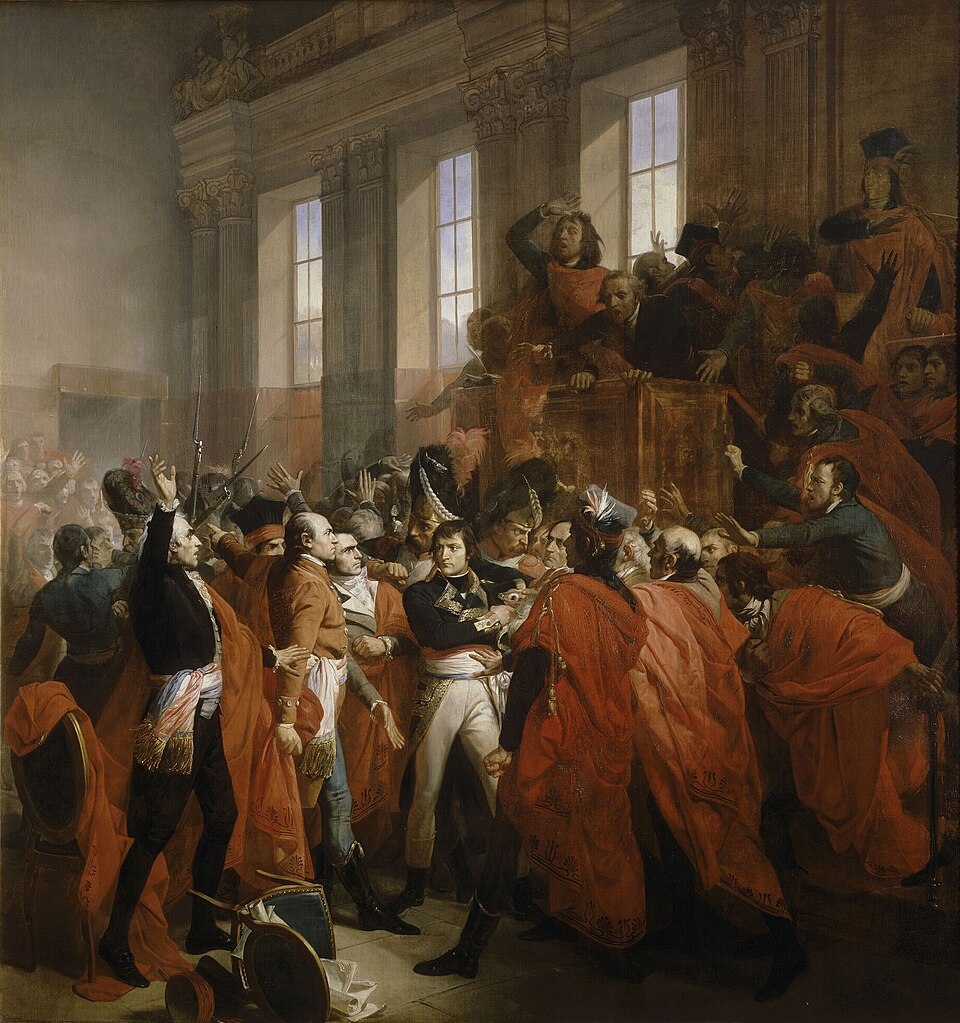
This image shows Napoleon during the coup that ended the Directory in 1799. It illustrates how weak civilian government allowed military power to dominate French politics. Source
Overall judgement: how well was France governed, 1793–99?
· 1793–94: government was effective at war mobilisation, centralisation and crushing opposition, but depended on terror and emergency powers.
· 1794–95: government moved away from Terror but remained unstable, with economic hardship, White Terror and Parisian risings.
· 1795–99: the Directory created a more moderate constitution but failed to solve financial, political and social instability.
· France was governed well in the sense that the republic survived war and internal rebellion.
· France was governed badly in the sense that governments relied on violence, repression, army support and coups, rather than stable consent.
· Best exam judgement: France was governed effectively in crisis management, but poorly in creating stable, legitimate and democratic government.
Checklist: can you do this?
· Explain why France faced instability after Louis XVI’s execution.
· Assess the strengths and weaknesses of the Committee of Public Safety.
· Judge whether the Reign of Terror was necessary, excessive or both.
· Compare the government of 1793–95 with the Directory, 1795–99.
· Make a balanced judgement on whether France was governed “well” using political, financial and military evidence.