

OCR Specification focus:
‘Reactivity trend of Cl₂, Br₂ and I₂ illustrated by displacement reactions with halide ions; colour changes observed in aqueous and organic phases.’
Displacement reactions between halogens and halide ions reveal clear reactivity trends. Observing colour changes in aqueous and organic layers helps establish the order: chlorine, bromine, then iodine.
Displacement Reactions and Reactivity Order
Halogen displacement reactions are central to understanding Group 17 periodic behaviour, allowing comparison of oxidising power and observable reactivity patterns. A halogen will only displace a halide ion if it is a stronger oxidising agent than the halide formed. This principle directly underpins the OCR specification requirement to compare Cl₂, Br₂ and I₂ using colour changes in different phases.
Understanding Halogen Reactivity and Oxidising Power
Halogens act as oxidising agents because they gain electrons to form halide ions. Their relative oxidising ability decreases down the group, meaning chlorine is the strongest oxidising agent, followed by bromine, then iodine. This trend dictates the outcomes of halogen–halide displacement reactions.
Oxidising agent: A species that gains electrons and causes another species to lose electrons.
This decreasing oxidising strength is linked to atomic radius, electron shielding, and attraction between the nucleus and incoming electron. These factors make electron gain progressively harder from Cl₂ to I₂.
General Principle of Displacement Reactions
A displacement reaction occurs when a more reactive halogen oxidises the ions of a less reactive halogen. The general pattern can be summarised as:
Cl₂ can displace Br⁻ and I⁻
Br₂ can displace I⁻ only
I₂ cannot displace Cl⁻ or Br⁻
In each case, the halogen that is reduced forms a distinctive colour, enabling identification of the reaction progress.
Displacement reaction: A reaction in which a more reactive element displaces a less reactive element from a compound.
Between these definition blocks, it is important to emphasise that halide ions themselves are colourless in aqueous solution, making the colours of the displaced halogens crucial for observation.
Observations in Aqueous Solution
OCR emphasises the observation of colour changes in aqueous and organic phases, a key skill in qualitative analysis of halogens. In aqueous solution:
Chlorine (Cl₂(aq)) is pale green
Bromine (Br₂(aq)) is orange
Iodine (I₂(aq)) is brown
When chlorine oxidises bromide ions, bromine is formed, producing a noticeable orange colour. When chlorine oxidises iodide ions, iodine forms, giving a brown colour.
Observations in Organic Solvent (Cyclohexane Layer)
An organic solvent such as cyclohexane is used to enhance the visibility of halogen colours due to their higher solubility in the organic phase:
Cl₂: very pale green
Br₂: orange
I₂: pink–purple
In the organic layer, chlorine appears pale green, bromine orange, and iodine purple, making it much easier to distinguish which halogen is present after a displacement.
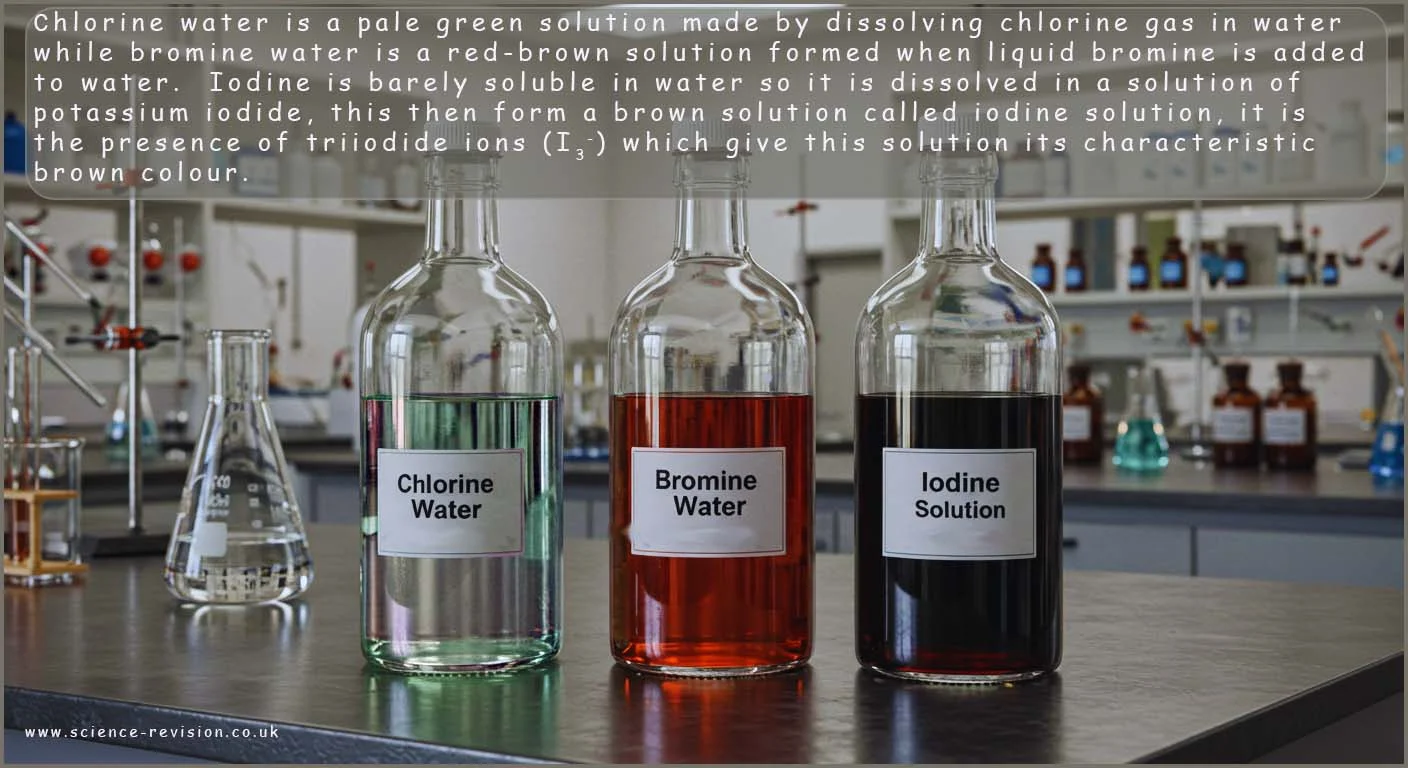
Chlorine, bromine and iodine solutions used for displacement experiments, showing their distinct colours in an organic solvent layer where halogen identity becomes easier to observe. Source
Displacement of Bromide Ions
Chlorine is more reactive than bromine and therefore oxidises Br⁻ ions to Br₂, which imparts an orange colour to the solution.
Chlorine–bromide displacement (ionic) = Cl₂(aq) + 2Br⁻(aq) → 2Cl⁻(aq) + Br₂(aq)
Cl₂ = chlorine molecule
Br⁻ = bromide ion
Cl⁻ = chloride ion
Br₂ = bromine molecule
After the equation, note that in cyclohexane the orange bromine colour becomes more intense, helping distinguish it from chlorine’s paler colour in the aqueous layer.
Displacement of Iodide Ions
Chlorine and bromine both displace iodide ions, forming iodine, which has the most dramatic colour change due to its strong pink–purple colour in organic solvent.
Cl₂ + I⁻ → I₂ gives brown (aqueous) or purple (organic)
Br₂ + I⁻ → I₂ gives the same characteristic iodine colours
Bromine–iodide displacement (ionic) = Br₂(aq) + 2I⁻(aq) → 2Br⁻(aq) + I₂(aq)
Br₂ = bromine molecule
I⁻ = iodide ion
Br⁻ = bromide ion
I₂ = iodine molecule
Iodine’s appearance in the organic layer is a key observational feature used to confirm successful displacement.
Cases Where Displacement Does Not Occur
Reactions fail to occur when the added halogen is less reactive than the halide ion present. This means:
Br₂ does not oxidise Cl⁻
I₂ does not oxidise Cl⁻ or Br⁻
These mixtures remain the colour of the halogen added, with no new colour appearing in either phase.
Reactivity Order from Displacement Evidence
Based on all displacement reactions and observable colour changes, the halogen reactivity order is:
Chlorine (most reactive)
Bromine
Iodine (least reactive)
This ranking directly reflects their oxidising power and aligns with atomic trends across the group.
Summary of Key Observational Patterns
To support OCR-required practical competency, students should recognise:
Colourless halide ion solutions develop distinctive colours when displaced
The organic layer always provides clearer colours
Chlorine produces the most displacement reactions, confirming its high reactivity
Iodine’s strong purple colour allows easy identification of its formation
These observations allow students to deduce halogen reactivity and halide stability based entirely on systematic qualitative data.
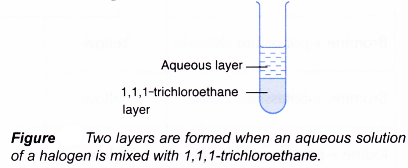
A two-layer test-tube setup showing an aqueous halide solution beneath an organic solvent, where halogen colour in the organic layer reveals the outcome of a displacement reaction. Source
Practice Questions
Chlorine gas is added to an aqueous solution of potassium iodide.
(a) State the colour change you would observe.
(b) Explain why this colour change occurs.
(2 marks)
(a) Colour change
Brown colour appears (aqueous iodine formed) (1 mark)
(b) Explanation
Chlorine is a stronger oxidising agent than iodide ions / chlorine displaces iodide ions forming iodine (1 mark)
A student adds separate solutions of chlorine water, bromine water, and iodine solution to three different halide solutions: sodium chloride, sodium bromide, and sodium iodide.
(a) Predict all the displacement reactions that will occur.
(b) Write the ionic equations for the reactions you have identified.
(c) Using your predictions, deduce the order of oxidising strength of the halogens.
(5 marks)
(a) Displacement reactions identified
Award 1 mark for each correct prediction (max 2 marks):
Chlorine displaces bromide ions to form bromine (1 mark)
Chlorine and bromine both displace iodide ions to form iodine (1 mark)
(If all three correct reactions stated, still maximum of 2 marks)
(b) Ionic equations
Award 1 mark for each correct equation (max 2 marks):
Cl2 + 2Br– → 2Cl– + Br2 (1 mark)
Cl2 + 2I– → 2Cl– + I2 (1 mark)
Br2 + 2I– → 2Br– + I2 (credit if included but do not award more than 2 marks total)
(c) Deduces correct oxidising strength order
Chlorine > bromine > iodine (1 mark)
FAQ
Halogens are far more soluble in non-polar organic solvents than in water. This increased solubility allows halogen molecules to separate from aqueous ions and accumulate in the organic layer, where their natural colours show more strongly.
Additionally, the organic layer prevents dilution by water, so even small amounts of displaced halogen produce a distinct colour that is easier to interpret in qualitative analysis.
Colour misinterpretation is common because aqueous and organic colours can overlap or appear faint.
To reduce errors:
Shake test tubes consistently to ensure thorough mixing.
Compare colours directly against control samples of each halogen.
Observe both aqueous and organic layers, as one may show a clearer contrast depending on the halogen present.
Working near a white background also improves colour discrimination.
The ability to displace a halide depends on relative oxidising power.
Chlorine has the greatest electron-gaining ability among Cl2, Br2 and I2, so it can oxidise both Br– and I–.
Bromine has a weaker oxidising ability, allowing it to oxidise only I–.
Iodine cannot oxidise either Br– or Cl– because it is the weakest oxidising agent of the three.
Several experimental issues can produce weaker colour changes:
Impure or degraded halogen/halide solutions
Using solutions that are too dilute
Insufficient mixing between aqueous and organic layers
Light exposure degrading halogen samples, particularly bromine and iodine
Ensuring fresh solutions and avoiding excessive dilution helps produce reliable observations.
Halide ions (Cl–, Br–, I–) have completely filled outer electron shells, so they do not absorb visible light strongly enough to produce colour. Their electronic transitions occur outside the visible spectrum.
Halogen molecules, however, have partially filled antibonding orbitals and can absorb visible wavelengths, giving rise to pale green, orange, or purple colours depending on the molecule.
