

AP Syllabus focus:
‘As cells grow, surface area-to-volume ratio decreases, limiting resource uptake and waste removal and constraining maximum cell size.’
Cells must exchange nutrients, gases, water, and wastes with their environment. Physical constraints on diffusion and membrane exchange mean that getting bigger is not always better, shaping how cells grow and divide.
Why cell size is limited
Material exchange sets the constraint
A cell’s plasma membrane surface area is the main site for exchange with the environment, while the cytoplasm volume reflects how much metabolically active material needs resources and produces waste. As cells grow, volume increases faster than surface area, so each unit of cytoplasm has less membrane available to support it.
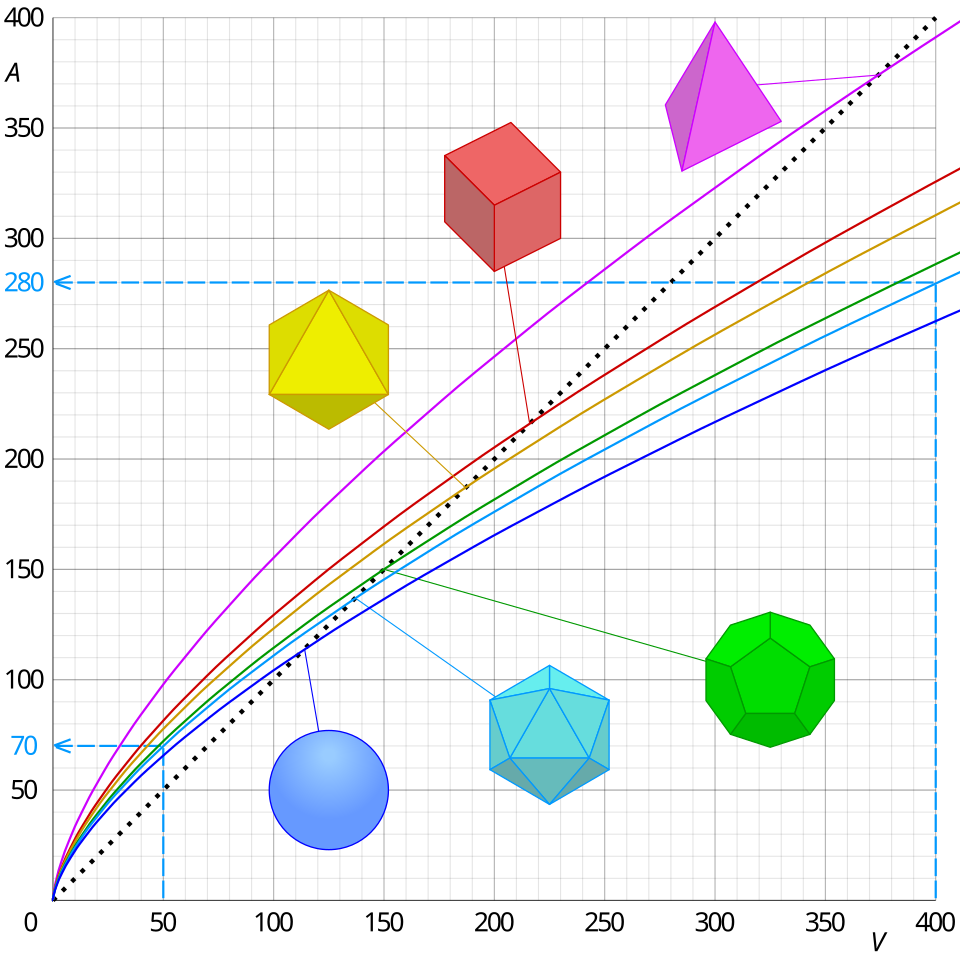
This plot compares how surface area and volume scale for different 3D shapes as size increases, illustrating the square–cube relationship. Because volume rises faster than surface area, the surface area-to-volume ratio necessarily falls as an object (or cell) gets larger. This visual reinforces why membrane exchange capacity becomes limiting during growth. Source
Surface area-to-volume ratio (SA:V)
Surface area-to-volume ratio (SA:V): the amount of cell surface area available per unit of cell volume; it indicates the exchange capacity of a cell relative to its metabolic demand.
SA:V is a core way to express the idea that exchange capacity scales with surface area, while resource demand and waste production scale with volume.
= surface area available for exchange (e.g., )
= cell volume requiring exchange support (e.g., )
A decreasing SA:V with growth directly supports the syllabus statement: resource uptake and waste removal become limiting, placing an upper bound on viable cell size unless other strategies compensate.
How declining SA:V affects exchange
Reduced uptake of essential materials
As SA:V decreases, the rate at which a cell can import substances per unit cytoplasm often falls, because:
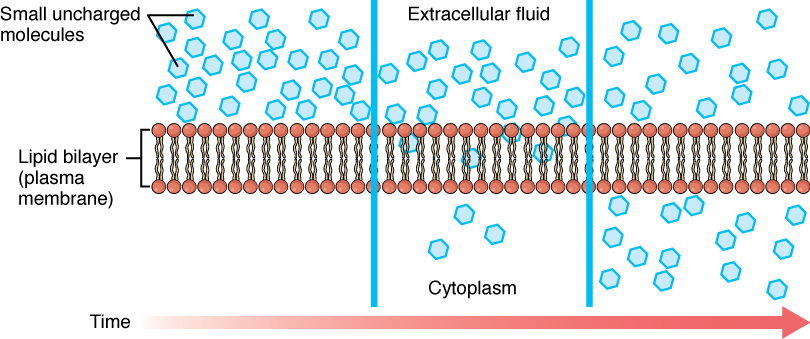
This diagram shows simple diffusion of small, nonpolar molecules across a phospholipid bilayer down their concentration gradient. It connects membrane surface area to the number of molecules that can cross per unit time, which helps explain why reduced SA:V lowers exchange capacity. The labeled gradient emphasizes that diffusion is driven by concentration differences rather than cellular energy input. Source
There is less membrane area to host transport proteins and channels per unit volume.
Diffusion into the cell becomes less effective as internal distances increase.
Key resources affected include:
Oxygen (for aerobic respiration)
Glucose and other nutrients (for ATP production and biosynthesis)
Ions (for maintaining gradients and enzyme function)
Water (for osmotic balance)
Impaired waste removal
Metabolism generates wastes that must be exported to avoid toxicity or disrupted homeostasis. With decreasing SA:V:
Carbon dioxide may accumulate if not exported efficiently.
Nitrogenous and other soluble wastes can build up, affecting pH and enzyme activity.
Heat dissipation (in some contexts) can be less efficient relative to volume, influencing reaction conditions inside cells.
Increasing diffusion distance slows response
Even if membrane transport is sufficient, molecules still must move within the cell. Larger cells tend to have a greater average distance between:
The membrane and deep cytoplasmic regions
Sites of production (e.g., metabolic pathways) and sites of use (e.g., enzymes needing substrates)
Diffusion distance: the typical distance a molecule must travel from where it enters (or is produced) to where it is needed (or removed); greater diffusion distance generally means slower exchange and response.
In larger cells, longer diffusion distances can reduce the speed of:
Delivering substrates to enzymes
Removing byproducts from reaction sites
Achieving rapid changes in internal concentrations after environmental shifts
Why growth changes SA and V differently
Scaling problem in simple shapes
For cells that roughly maintain the same shape as they grow:
Surface area increases approximately with the square of a characteristic length
Volume increases approximately with the cube of that length
This mismatch means that doubling a cell’s linear dimension yields much more cytoplasm to supply than membrane area to support it. The result is a predictable decline in SA:V and, therefore, a predictable decline in exchange efficiency per unit volume.
Biological consequences: why cells divide instead of getting huge
Exchange limits constrain maximum cell size
When exchange becomes rate-limiting, a growing cell may face:
Insufficient ATP production due to limited oxygen/nutrient supply
Reduced biosynthesis because substrates cannot enter fast enough
Accumulation of wastes that inhibit enzymes or damage structures
Slower internal equilibration, impairing regulation and signalling speed
These constraints help explain why many cells remain small and why growth is often coupled to cell division, which restores a higher SA:V and shorter diffusion distances.
Trade-offs and “maximum size”
“Maximum cell size” is not a single universal number; it depends on factors such as:
Metabolic rate (how quickly resources are used and wastes produced)
Membrane transport capacity (number/activity of transport proteins)
Environmental availability of key materials (e.g., oxygen concentration)
The cell’s internal organisation and cytoplasmic crowding, which can hinder movement
However, across contexts, the central syllabus point holds: as a cell grows, lower SA:V increasingly limits uptake and waste removal, constraining how large the cell can become while maintaining homeostasis.
Practice Questions
Explain why a larger cell often has more difficulty obtaining enough nutrients across its membrane than a smaller cell of the same shape. (2 marks)
States that as cell size increases, surface area-to-volume ratio decreases / volume increases faster than surface area. (1)
Links decreased SA:V to reduced exchange capacity per unit cytoplasm (e.g., less membrane area for transport/diffusion relative to demand). (1)
Describe how increasing cell size can limit (i) resource uptake and (ii) waste removal. In your answer, refer to surface area-to-volume ratio and diffusion distance. (5 marks)
Correctly states that SA:V decreases as a cell grows (volume rises faster than surface area). (1)
Explains reduced resource uptake due to less membrane area per unit volume and/or fewer transport sites per unit cytoplasm. (1)
Explains reduced waste removal due to less membrane area per unit volume, leading to potential accumulation of wastes. (1)
Defines or correctly uses diffusion distance as the distance molecules travel within the cell. (1)
Links increased diffusion distance in larger cells to slower movement of substances, reducing the rate at which resources reach internal regions and wastes reach the membrane. (1)
FAQ
Fick’s law predicts diffusion rate increases with surface area and concentration difference, and decreases with diffusion distance.
As cells get larger, surface area per unit volume falls and diffusion distance tends to rise, so diffusion alone becomes less able to meet demand.
Steeper gradients can help temporarily, but they are limited by:
Finite transporter capacity and saturation
Risk of disrupting pH, osmotic balance, or membrane potential
The need for continuous energy input to maintain some gradients
No. Small non-polar molecules diffuse more readily than large or charged solutes.
Large polar molecules and ions depend more on membrane proteins, so reduced membrane area per unit volume can constrain their exchange earlier.
Higher temperature generally increases molecular motion and diffusion rates.
However, temperature also affects enzyme activity and membrane properties, so improved diffusion may not fully offset the geometric disadvantages of low SA:V in large cells.
Cells coordinate growth with checkpoints and signalling that integrate nutrient availability and energy status.
For example, growth-promoting pathways may be downregulated when ATP is low or when building blocks are scarce, delaying further growth or promoting division.

