

AP Syllabus focus:
‘In larger organisms, lower surface area-to-volume ratios affect heat exchange and contribute to differences in metabolic rate per unit body mass.’
Body size strongly influences how organisms exchange heat with their surroundings. Understanding size-dependent heat loss helps explain why small animals typically have faster metabolisms per gram and why larger animals conserve heat more effectively.
Key idea: size changes heat exchange
Heat is exchanged across an organism’s outer surface (skin, body covering), while heat is generated largely by metabolism in the body’s tissues (linked to volume). As linear size increases, surface area increases more slowly than volume, changing the balance between heat loss and heat production.
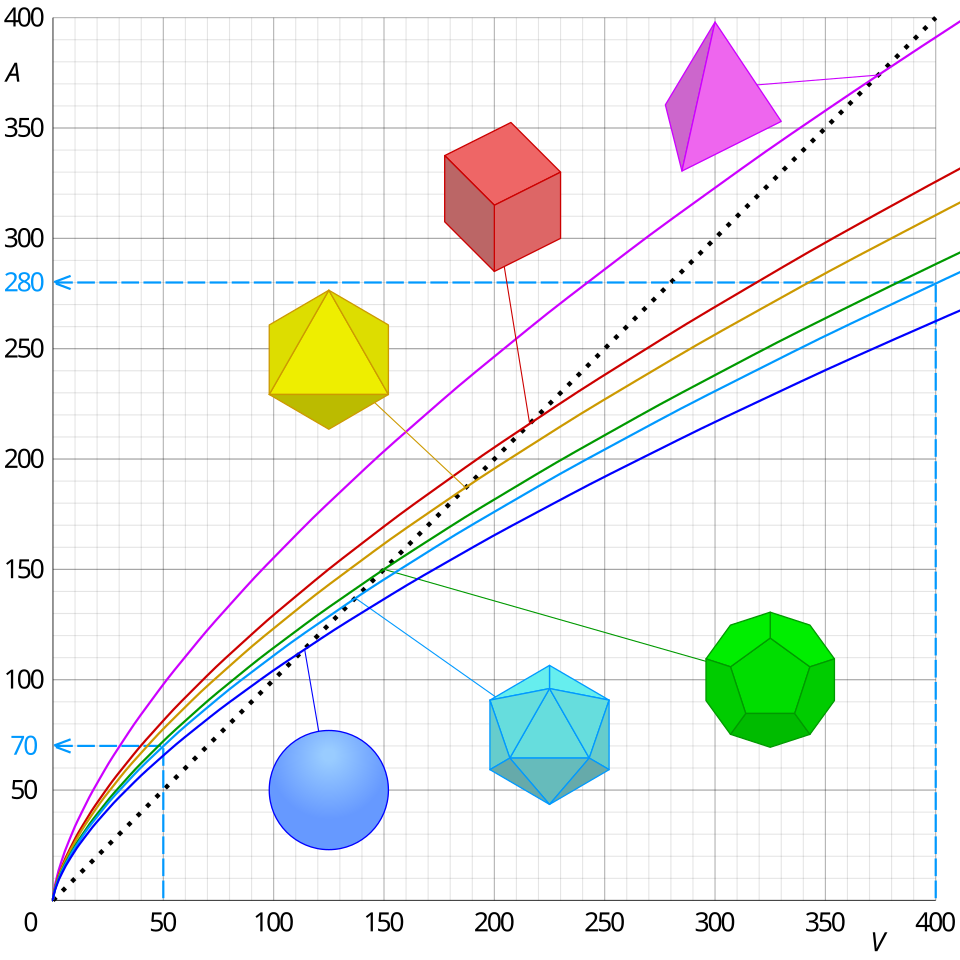
This graph compares how surface area () increases relative to volume () for different 3D shapes, illustrating that larger volumes require disproportionately less surface area. The dashed guide lines highlight the square–cube scaling: if linear size doubles, surface area scales by about while volume scales by about . As size increases, the implied decreases, reducing heat exchange per unit internal tissue. Source
Surface area-to-volume ratio (SA:V): the amount of external surface area available for exchange with the environment per unit volume of tissue producing heat and requiring energy.
A high SA:V favors rapid exchange (including heat loss), while a low SA:V reduces exchange relative to internal volume.
Scaling and why larger organisms lose heat more slowly (per unit mass)
If two organisms have similar shapes and differ mainly in size, geometry predicts how SA and V scale with characteristic length .
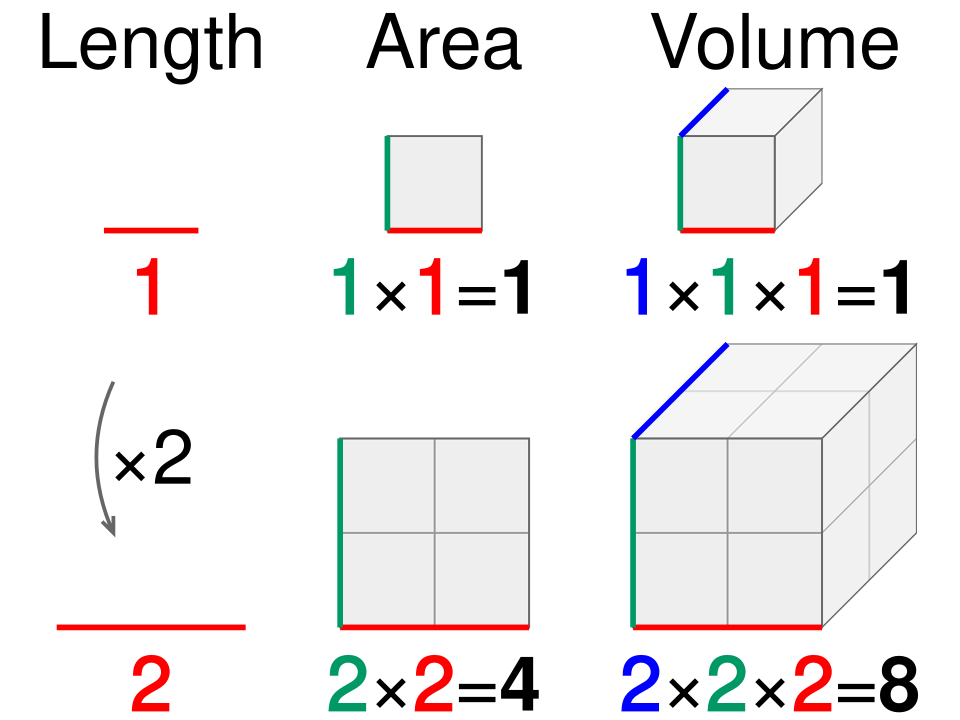
This diagram summarizes how geometric measures scale with characteristic length: length scales as , surface area as , and volume as . The visual makes it clear why volume (and thus heat production capacity) outpaces surface area (heat exchange interface) as organisms get larger. That mismatch is the geometric basis for declining with increasing size. Source
This is why organism size is tightly linked to heat exchange.
= characteristic linear dimension (e.g., body length), in m
= internal volume (roughly proportional to mass), in m
= exchange area per unit volume, in m
Because SA:V decreases as size increases, larger organisms typically:
lose heat more slowly per unit mass (less surface area available for heat loss relative to heat-producing volume)
maintain internal temperatures more easily if they generate metabolic heat
Smaller organisms typically:
lose heat quickly (high SA:V)
must replace lost heat rapidly (if endothermic), often by higher rates of cellular respiration
Heat exchange and metabolic rate per unit body mass
Metabolic rate reflects the rate of energy use, often tied to ATP demand and cellular respiration. The syllabus emphasis is that organism size (via SA:V) helps explain differences in metabolic rate per unit body mass.
Why metabolic rate per gram is higher in small organisms
Small endotherms (heat-producing animals) face rapid heat loss due to high SA:V, so they often require:
increased fuel oxidation to generate heat
faster oxygen delivery and nutrient turnover
greater food intake per gram to match energy demand
This leads to a higher mass-specific metabolic rate (metabolic rate divided by body mass).
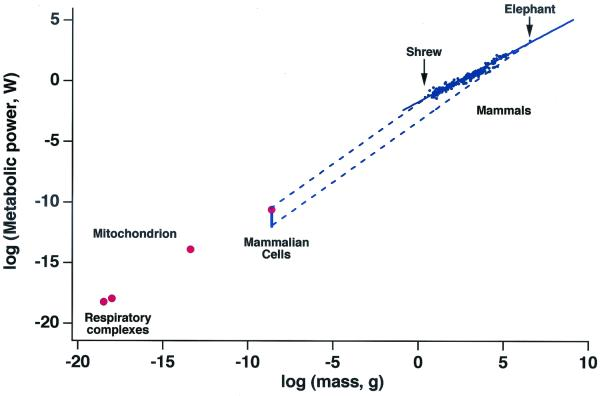
This figure (log–log) shows basal metabolic rate increasing with body mass across mammals and compares the trend to a power-law scaling line. Because the slope is less than 1 on log–log axes, metabolic rate rises more slowly than body mass, implying that metabolic rate per gram decreases as animals get larger. This supports the idea that larger organisms have lower mass-specific metabolic rates even though their total metabolic rate is higher. Source
In contrast, large organisms have lower SA:V, so each gram of tissue loses heat more slowly and needs less energy per unit time to maintain body temperature.
Environmental temperature and size-related trade-offs
Size-dependent heat exchange matters most when the environment differs from an organism’s internal temperature.
In cold environments, small endotherms are challenged by rapid heat loss and may need continuous feeding.
In warm environments, very large organisms can risk overheating because low SA:V can limit heat dissipation; they may rely on behaviors (seeking shade/water) or anatomical features (large ears, increased peripheral blood flow) to increase effective heat loss.
Important AP Biology linkage
The central relationship to remember is:
Lower SA:V in larger organisms reduces heat exchange with the environment, and this contributes to lower metabolic rate per unit body mass compared with smaller organisms.
Practice Questions
Explain why a small mammal typically loses heat to the environment faster than a large mammal of similar shape. (2 marks)
Mentions that smaller organisms have a higher surface area-to-volume ratio (1 mark)
Links higher SA:V to greater heat loss per unit body mass/volume (1 mark)
A mouse and an elephant are both endotherms living in the same cool environment. Explain how differences in body size can lead to differences in (i) heat exchange and (ii) metabolic rate per unit body mass. Include the role of SA:V and the consequences for energy demand. (6 marks)
States that the mouse has a higher SA:V than the elephant (1 mark)
Explains that higher SA:V causes faster heat loss to the environment (1 mark)
States that the elephant has a lower SA:V, reducing heat loss per unit body mass (1 mark)
Links greater heat loss in the mouse to a need for greater heat production (1 mark)
Connects heat production to higher respiration/energy use and thus higher metabolic rate per unit mass in the mouse (1 mark)
States that the elephant therefore has a lower metabolic rate per unit body mass in the same conditions (1 mark)
FAQ
Insulation adds resistance to heat transfer, so heat loss depends on both SA:V and insulation thickness/quality.
Dense fur/feathers trap still air (lowers convection).
Blubber reduces heat conduction, especially in water.
Kleiber’s law is an empirical scaling relationship where whole-organism metabolic rate often scales approximately as $M^{3/4}$ (mass $M$).
This implies mass-specific metabolic rate scales roughly as $M^{-1/4}$, decreasing with size.
Often the pattern is weaker because ectotherms rely more on external heat. Temperature strongly controls enzyme activity and metabolism, so environmental conditions can override SA:V effects.
These structures can increase effective heat loss by increasing exposed surface area and blood flow near the surface, enhancing heat transfer without greatly increasing core volume.
Behaviours can reduce exposed surface area or heat transfer:
huddling reduces total exposed SA per individual
nesting/burrowing decreases convection and radiation
postural changes can minimise exposed surface


