

AP Syllabus focus:
‘Surface area-to-volume ratio determines how efficiently cells exchange materials with their environment.’
Cells must import nutrients and oxygen and export wastes and heat through their boundary. Surface area-to-volume ratio links cell geometry to exchange efficiency and helps explain why cells are generally small.
Core idea: exchange happens at the surface, demand scales with volume
A cell’s plasma membrane is the main interface for exchanging materials with the environment. Exchange capacity depends largely on how much surface area the cell has, while the cell’s resource needs and waste production depend largely on its volume.
Surface area-to-volume ratio (SA:V): The amount of outer surface area available for exchange per unit of internal volume; it indicates how effectively a cell can meet exchange demands.
A high SA:V means plenty of membrane area relative to the amount of cytoplasm that must be supplied and regulated.
Why this matters biologically
Surface area limits rates of:
uptake of water and dissolved solutes
gas exchange (e.g., oxygen and carbon dioxide)
removal of metabolic wastes
transfer of heat with the environment
Volume is associated with:
total number of reactions occurring in cytoplasm
total demand for nutrients and oxygen
total waste and heat produced
The key pattern: as size increases, SA:V decreases
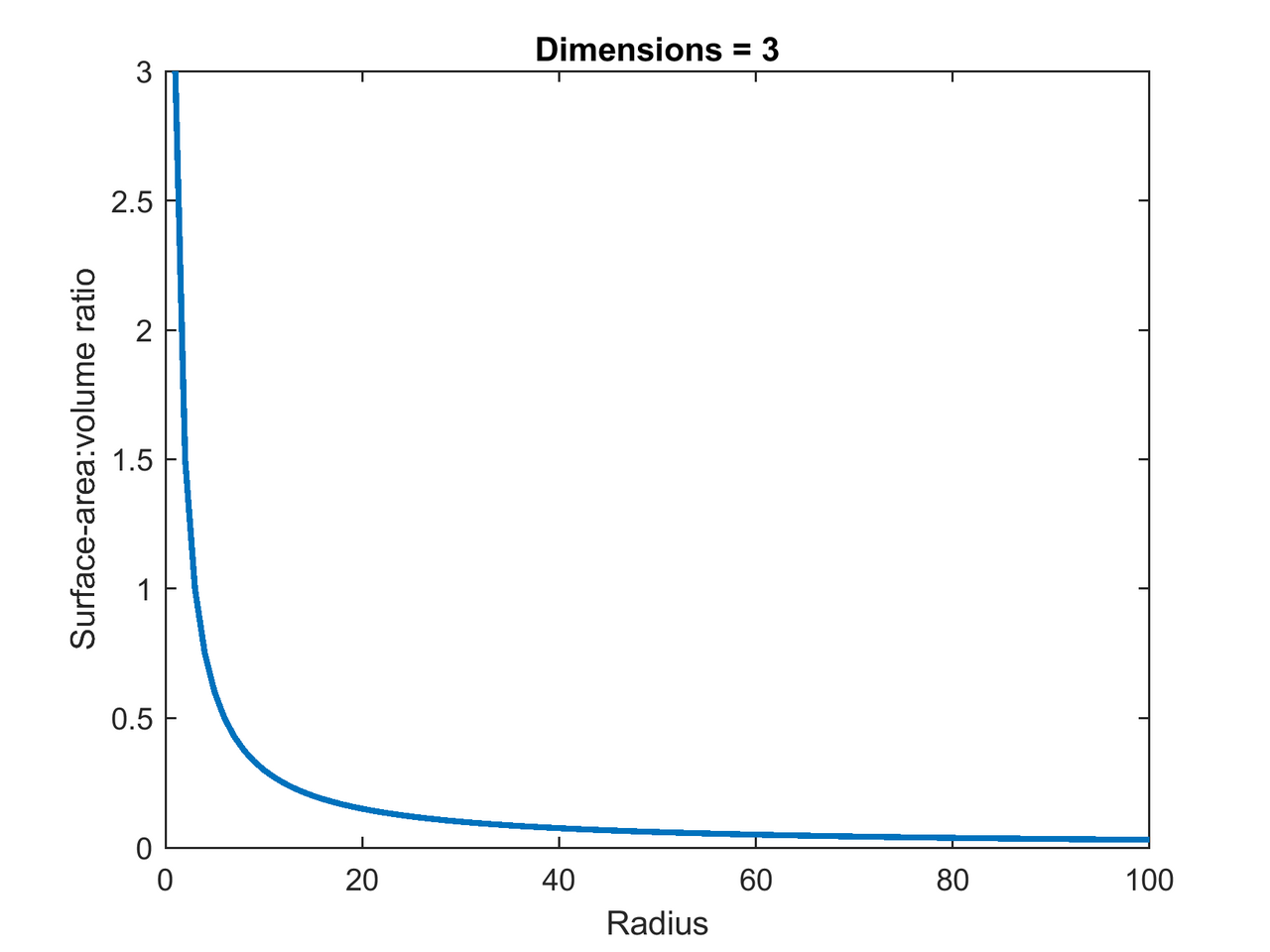
As a cell’s linear dimensions increase (for example, its radius), volume increases faster than surface area. This means large cells have less membrane area available per unit cytoplasm, making exchange relatively less efficient.
This diagram compares two cube-shaped “cells” of different sizes and explicitly labels their surface area, volume, and surface area-to-volume ratio. It visually demonstrates that when linear size increases, volume grows faster than surface area, so decreases. The result is less membrane area available per unit cytoplasm for exchange processes. Source
= total cell surface area available for exchange (e.g., )
= internal cell volume requiring resources and producing wastes (e.g., )
This relationship is a geometry-driven constraint: even without changing membrane composition or transport proteins, a bigger cell tends to have a lower SA:V.
Intuitive comparisons (no calculations required)
Two small cells can have more total surface area than one large cell with the same combined volume.
Thin or flattened shapes tend to have higher SA:V than bulky shapes of similar volume.
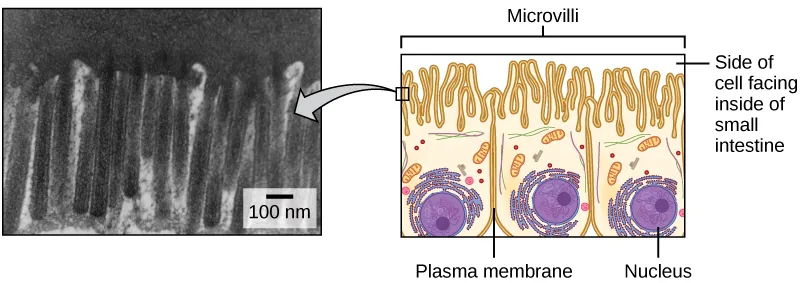
This figure shows intestinal epithelial cells with microvilli (including an electron micrograph and a labeled schematic). Microvilli are membrane projections that increase the membrane surface area without a proportional increase in cell volume, raising effective exchange/absorption capacity. This is a classic “form follows function” example of how cells can increase surface exposure to support high rates of transport. Source
Consequences of SA:V for cell function
Material exchange and internal regulation
When SA:V is high, a cell can more easily maintain stable internal conditions because exchange across the membrane can keep up with cellular activity. When SA:V is low:
nutrient and oxygen delivery to the interior becomes more limiting
wastes can accumulate unless removed efficiently
maintaining appropriate internal concentrations becomes more challenging
Rate limitations and “bottlenecks”
Even if a cell increases the number of membrane transport proteins, the total exchange is still constrained by the membrane’s finite area. SA:V therefore helps explain why many cells divide before becoming too large: division increases total surface area relative to volume, improving exchange potential.
Linking SA:V to what students should look for in diagrams and descriptions
In AP Biology contexts, SA:V is often used to interpret whether a cell’s shape and size support its function. When evaluating a cell:
Identify the exchange surface (typically the plasma membrane).
Consider whether the cell’s shape increases surface exposure relative to internal volume.
Relate high SA:V to efficient exchange, and low SA:V to exchange limitation.
Common misconceptions to avoid
SA:V is not only about diffusion; it describes a broader exchange capacity at the boundary (including transport-mediated movement).
A “bigger” cell does not automatically exchange faster; without sufficient surface area, exchange can become the limiting factor.
SA:V is a ratio: it can improve by increasing surface area, decreasing volume, or both.
Practice Questions
Explain how surface area-to-volume ratio affects how efficiently a cell can exchange materials with its environment. (3 marks)
States that exchange occurs across the cell surface/plasma membrane and depends on surface area (1).
States that metabolic demand/waste production depends on volume (1).
Explains that as cell size increases, SA:V decreases, making exchange less efficient/limiting uptake and removal (1).
A student compares a small spherical cell and a much larger spherical cell. Describe and explain how the difference in surface area-to-volume ratio would affect the cells’ ability to maintain suitable internal conditions. (6 marks)
Recognises both are spherical and that increasing size decreases SA:V (1).
Links higher SA:V (small cell) to more membrane area per unit cytoplasm, enabling faster/adequate exchange (1).
Links lower SA:V (large cell) to relatively reduced exchange capacity per unit cytoplasm (1).
Applies to uptake of resources (e.g., oxygen/nutrients/water/ions) becoming limiting in the larger cell (1).
Applies to removal of wastes (e.g., or other metabolites) being less efficient in the larger cell (1).
Connects these constraints to maintaining homeostasis/internal concentrations being harder in the larger cell (1).
FAQ
They are related but not identical. Mass usually scales with volume (assuming similar density), so SA:V often parallels surface area-to-mass.
In biology questions, use SA:V when the focus is membrane exchange or geometry of cells.
Shapes that are thinner, flatter, or more elongated can increase surface area without a proportional increase in volume.
This raises SA:V and can support faster exchange at the boundary.
For similar shapes, surface area scales with the square of a length ($\propto L^2$), while volume scales with the cube ($\propto L^3$).
So doubling a characteristic length increases volume more strongly than surface area.
Partly. It can increase effective exchange by:
increasing membrane transporter density
maintaining steep concentration gradients
rearranging internal organisation to reduce distances
However, membrane area still imposes an upper limit on total exchange.
SA:V becomes especially important when external supplies are scarce or wastes build up, such as:
low oxygen availability
high metabolic rate conditions
limited fluid movement around cells
These conditions increase reliance on efficient boundary exchange per unit volume.
