

AP Syllabus focus:
‘Complex structures, such as membrane folds, increase surface area to improve exchange of materials without greatly increasing cell volume.’
Cells often need faster exchange of nutrients, gases, and wastes than a smooth surface can provide. Membrane folding is a structural adaptation that boosts transport capacity by enlarging surface area while keeping overall cell size manageable.
Core idea: increasing surface area without increasing volume
Transport across a cell boundary depends strongly on membrane surface area, because diffusion and many transport proteins operate at the membrane. Increasing cell volume without increasing surface area creates a bottleneck: more cytoplasm must be supplied through the same “interface.”
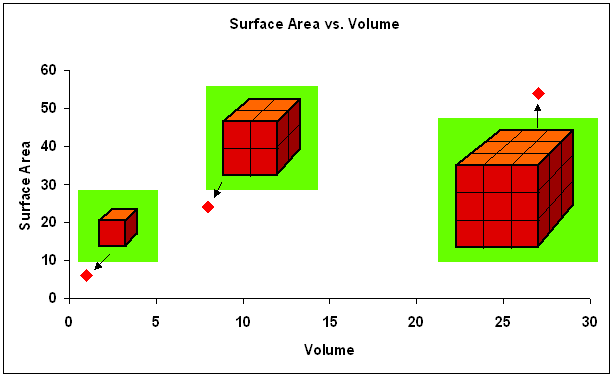
Graph-based visualization showing that as an object (modeled as a cube) increases in size, volume increases faster than surface area, so the surface area-to-volume ratio decreases. This supports why cells benefit from membrane folding: adding membrane area can partially offset the geometric disadvantage of growing larger. Source
Membrane folds solve this by adding extra membrane area packed into a small space, increasing the number of sites where exchange can occur, without a proportional increase in volume.
= Total area available for exchange across a boundary (e.g., )
= Internal space requiring resources and producing wastes (e.g., )
A higher SA:V generally supports more efficient exchange, but real cells also depend on membrane composition and the density of transport proteins embedded in that expanded area.
Types of membrane surface area adaptations
Plasma membrane projections (external folds)
Many cells form outward projections that increase contact with the external environment.
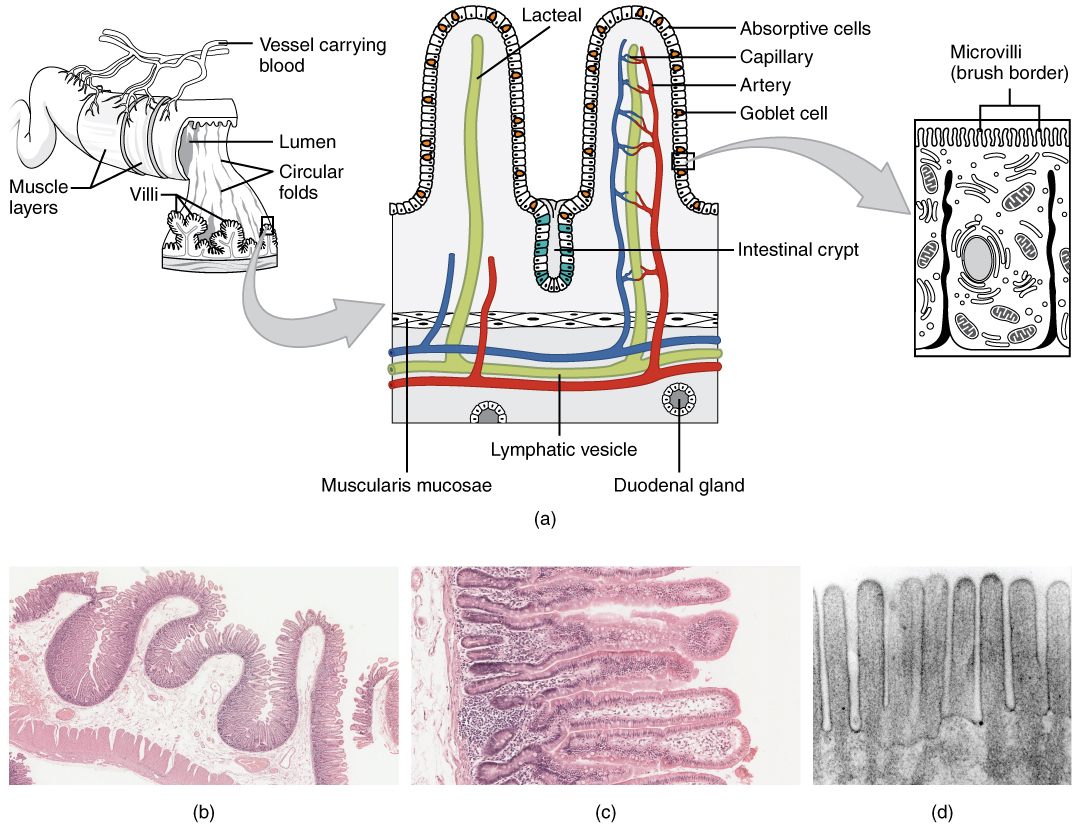
Labeled histology/microscopy figure showing hierarchical surface-area amplification in the small intestine: large circular folds, villi, and (at the cellular scale) microvilli forming the brush border. The labels make it easy to connect structure (folding/projections) to function (increased membrane area for absorption and transporter/enzyme placement). Source
Microvilli: Finger-like extensions of the plasma membrane that greatly increase surface area for absorption or secretion without substantially increasing cell volume.
Microvilli are especially useful where rapid uptake is needed. Because they increase membrane area, they can also increase the total number of channels, carriers, and membrane-bound enzymes available for transport and processing at the cell surface.
Key functional outcomes of projections include:
Increased rate of diffusion for substances that can cross the membrane or move through channels
Increased total capacity for facilitated transport by allowing more transport proteins to be embedded
Increased area for cell surface reactions (for example, enzymes anchored to membranes in some tissues)
Plasma membrane invaginations (internal folds)
Cells can also fold the plasma membrane inward, producing deep invaginations. This increases surface area that faces the extracellular fluid while packing the surface into a compact boundary.
Functional outcomes include:
More membrane area per unit of outer cell boundary, increasing potential transport sites
Shorter effective distances between membrane and internal regions in some cell shapes, improving supply to nearby cytoplasm
Localized regions that can concentrate transport proteins, increasing uptake efficiency in specific membrane domains
Why folds improve exchange (mechanistic view)
Membrane folds support exchange by increasing the number of parallel “entry points” across the membrane.
This can improve:
Nutrient uptake: more total transporter proteins can operate simultaneously
Waste removal: more membrane area for diffusion and transporter-mediated export
Ion balance and signalling inputs: more channels and receptors can be accommodated per cell
However, surface area is only beneficial if the cell can supply the folded regions with sufficient transport machinery and maintain gradients:
A larger membrane area typically requires more transport proteins and cytoskeletal support
Faster exchange can be limited by how quickly substances move within cytosol after entry (intracellular distribution can become limiting)
Trade-offs and constraints of extensive folding
Membrane folding is advantageous, but it is not “free”:
Additional membrane requires more lipids and proteins to build and maintain
Crowding many proteins into folded membranes can create spatial constraints and alter transport dynamics
Folded structures can be delicate; cells often need internal scaffolding to keep folds stable under fluid flow or mechanical stress
Overall, complex membrane structures are a high-impact adaptation that increases surface area to improve exchange of materials without greatly increasing cell volume, helping cells meet metabolic demands while staying small enough for efficient internal organisation.
Practice Questions
State how membrane folds such as microvilli increase exchange in cells. (2 marks)
Increase membrane surface area (1)
Allows increased rate/capacity of absorption/transport due to more sites for diffusion/transport proteins (1)
Explain how two different membrane-folding adaptations can increase transport efficiency without a large increase in cell volume. (5 marks)
Description of an outward projection (e.g., microvilli) increasing surface area (1)
Description of an inward fold/invagination increasing surface area (1)
Link increased surface area to increased diffusion/uptake rate (1)
Link increased surface area to more transport proteins operating in parallel (1)
Clear statement that volume changes little compared with surface area increase, improving SA:V and exchange capacity (1)
FAQ
Often they increase maximum capacity by providing more membrane sites.
Rate may still be limited by gradient size, transporter turnover, or mixing within the cytoplasm.
They are stabilised by internal scaffolding beneath the membrane.
This support helps maintain shape under shear stress and keeps surface area consistently high.
Yes, if folds create poorly mixed “dead zones” where concentration gradients weaken.
Crowding can also hinder transporter movement or accessibility in tightly packed regions.
Researchers approximate fold geometry (length, radius, density) from microscopy images.
They then calculate total added area from the measured dimensions and number of folds.
Cells can target specific transporters to particular membrane regions.
This creates functional “hotspots” where uptake is concentrated in the most exposed or effective folded areas.
