

AP Syllabus focus:
‘The fluid mosaic model describes membranes as phospholipid bilayers with mobile proteins, steroids, glycoproteins, and glycolipids within the flexible structure.’
Biological membranes are dynamic, selectively organised structures.
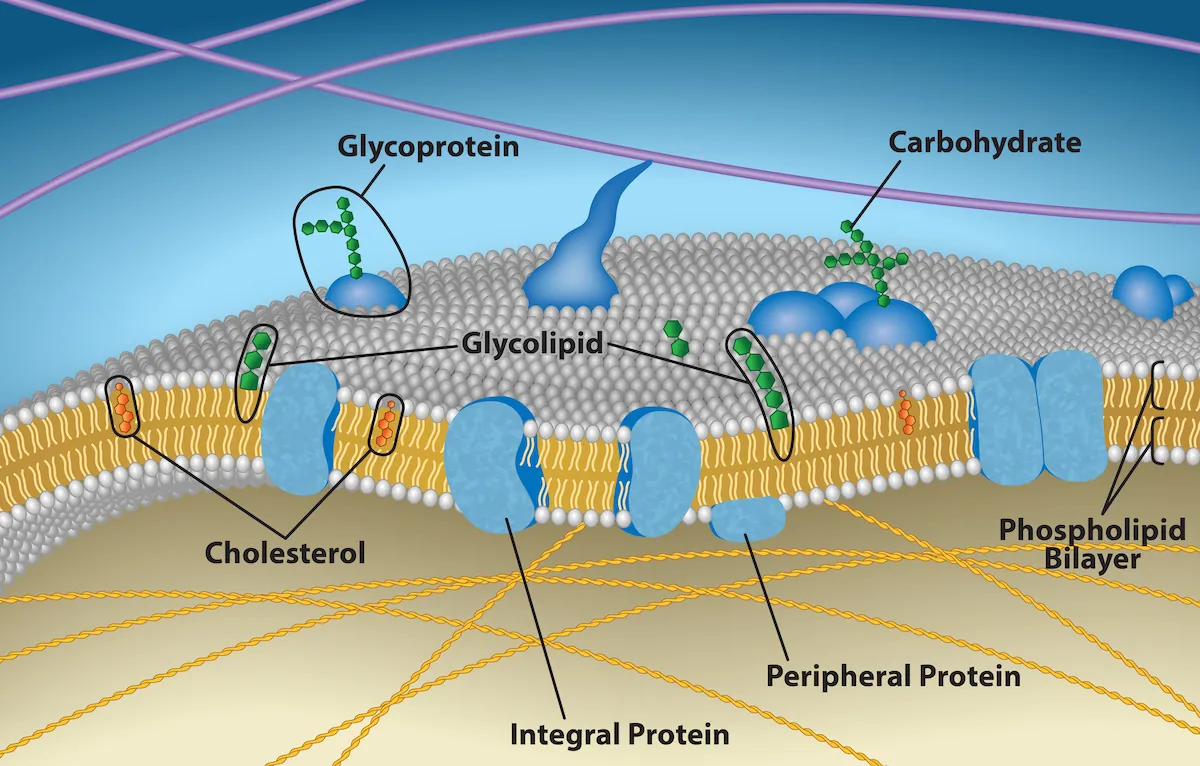
Fluid mosaic model schematic of a plasma membrane showing a phospholipid bilayer with embedded integral proteins, peripheral proteins, cholesterol molecules between fatty-acid tails, and outward-facing carbohydrate chains on glycoproteins and glycolipids. The labeled components visually reinforce that membranes are both structurally organized and laterally dynamic rather than rigid layers. Source
The fluid mosaic model explains how a phospholipid bilayer provides a flexible framework in which diverse molecules move and interact, enabling membrane stability and specialised functions.
The Fluid Mosaic Model: Core Idea
Fluid mosaic model: A model describing membranes as a phospholipid bilayer with embedded and associated components that move laterally, creating a “mosaic” of molecules in a flexible structure.
“Fluid” emphasises movement within the membrane plane; “mosaic” emphasises the varied mix of components rather than a uniform sheet.
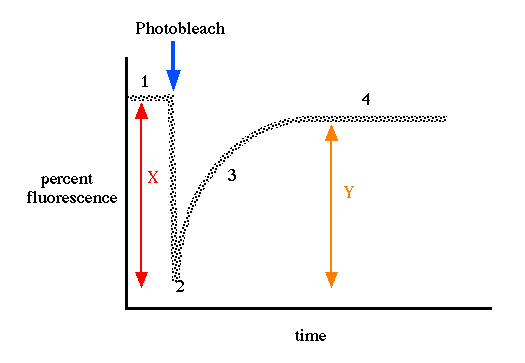
Fluorescence Recovery After Photobleaching (FRAP) sequence illustrating lateral diffusion in membranes: a labeled region is photobleached, then fluorescence returns as unbleached molecules move into the bleached area. The accompanying recovery curve links the extent and rate of fluorescence return to molecular mobility in the membrane plane. Source
Components of the “Mosaic”
Phospholipids (Bilayer Framework)
Phospholipids form the continuous bilayer that underlies membrane structure. Key structural consequences of this arrangement include:
A self-sealing boundary: disruptions can reseal because hydrophobic regions avoid water.
Asymmetry: the two leaflets often differ in lipid composition, supporting specialised surfaces.
Membrane Proteins (Mobile and Functionally Diverse)
Proteins are distributed throughout the bilayer, contributing to the mosaic pattern and many membrane-specific roles. In the fluid mosaic model, proteins are not fixed in place; many can move laterally. Major categories include:
Integral (transmembrane) proteins: embedded within the bilayer, often spanning it.
Peripheral proteins: loosely attached to the membrane surface or to integral proteins.
Protein mobility and placement produce patchy, uneven distributions, supporting localised membrane functions.
Steroids (Cholesterol as a Fluidity Buffer)
In animal membranes, cholesterol is a major steroid component positioned among phospholipid tails. Its presence helps maintain a workable balance between rigidity and fluidity:
At moderate temperatures, cholesterol can reduce excessive fluidity by restricting phospholipid movement.
At lower temperatures, it can prevent tight packing of phospholipids, helping membranes avoid becoming overly rigid.
This buffering supports membrane flexibility across changing conditions.
Carbohydrates (Glycoproteins and Glycolipids)
Carbohydrates are commonly attached to lipids and proteins on the extracellular side, contributing to the membrane’s outer “coat”:
Glycoproteins: proteins with attached carbohydrate chains.
Glycolipids: lipids with attached carbohydrate chains.
These carbohydrate-bearing molecules help create a chemically distinctive cell surface. Importantly, carbohydrate chains are typically oriented outward, reinforcing membrane asymmetry.
What “Fluid” Means in Practice
Lateral Movement and Patchiness
A central claim of the model is that many membrane components can move within the plane of the membrane:
Phospholipids shift and rotate frequently.
Many proteins drift laterally, though movement can be limited by interactions with internal or external structures.
Because different regions can have different compositions (for example, varying protein density), membranes are mosaics with non-uniform distribution.
Factors That Influence Membrane Fluidity
Membrane fluidity is not constant; it depends on composition:
Fatty acid saturation in phospholipids: more unsaturated tails generally increase fluidity by reducing tight packing.
Steroid (cholesterol) content: buffers against extremes of fluidity or rigidity.
Local composition differences: regions enriched in specific lipids/proteins can behave differently from surrounding areas.
These factors help maintain the flexible structure highlighted by the fluid mosaic model while still allowing stable organisation of components.
Practice Questions
State two components of the fluid mosaic model other than phospholipids. (2 marks)
Any two from: proteins, steroids (cholesterol), glycoproteins, glycolipids (1 mark each).
Explain how the fluid mosaic model accounts for membrane flexibility and the varied distribution of molecules within membranes. (5 marks)
Membrane is a phospholipid bilayer providing a flexible framework (1).
Components can move laterally within the membrane plane, giving “fluidity” (1).
Proteins are embedded/associated in different amounts and locations, creating a “mosaic” pattern (1).
Cholesterol (steroids) modulates/ buffers membrane fluidity, helping prevent overly rigid or overly fluid membranes (1).
Glycoproteins/glycolipids contribute to molecular diversity and are typically oriented to the outer surface, supporting asymmetry (1).
FAQ
Classic approaches include cell-fusion experiments and fluorescence-based methods.
In cell fusion, differently labelled membrane proteins mix over time if they are mobile.
In FRAP, a fluorescent region is bleached and recovery indicates lateral diffusion into the area.
Lipid rafts are small, dynamic microdomains enriched in certain lipids and proteins.
They do not contradict the model; they refine it by showing membranes can be laterally heterogeneous while still fluid overall.
Carbohydrate chains are added in ways that preserve orientation during membrane trafficking.
This leads to consistent asymmetry, with glycans facing outward where they can participate in external recognition events.
Spontaneous “flip-flop” of most phospholipids is rare due to energetic barriers.
Cells also use enzymes (e.g., flippases/scramblases) and targeted trafficking to establish and regulate asymmetry.
No. Many animals use cholesterol extensively, while plants use related sterols and many bacteria lack sterols (with some exceptions).
Different steroids can play similar fluidity-modulating roles depending on the organism and membrane composition.
